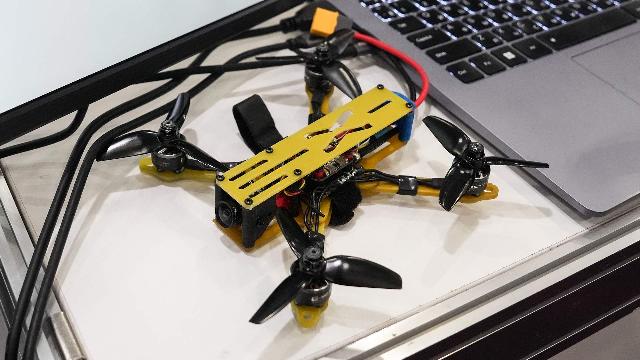
The new interceptor UAVs have been tested and will soon enter the army.
Tests of Hornet interceptor drones have been completed at the training grounds of the Russian Army in the SVO zone, Izvestia found out. Their main task is to cover heavy flamethrower systems (TOC) during the battle. The new drones can independently detect, identify and hit targets. These capabilities are provided by high-resolution video cameras and artificial intelligence software. Experts note that such devices will be indispensable for protecting not only CBT, but also military columns, positions, headquarters and hospitals, as well as strategically important civilian facilities from UAVs.
Two "Hornets"
Hornet interceptor drones exist in two versions. The compact UAV is designed to destroy targets at a range of up to 50 m, while the larger vehicle is designed at a distance of up to 200 m. UAV software using artificial intelligence (AI) elements makes it possible to recognize, track and attack enemy drones without operator intervention.
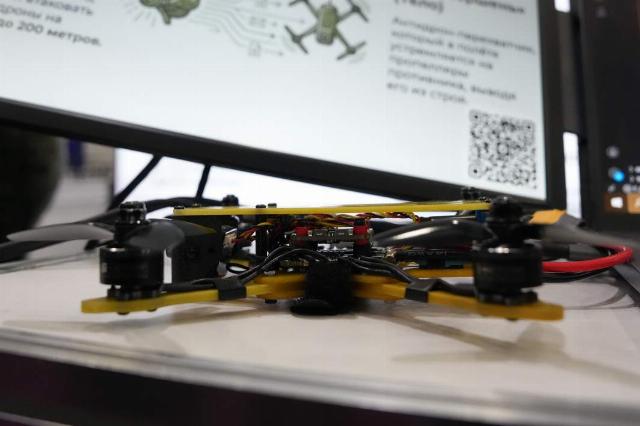
The Hornet air defense drone
Image source: Photo: IZVESTIA/Dmitry Korotaev
The Hornet was designed by units of the Russian Armed Forces. The developers told Izvestia that its tests were recently completed at landfills in the area of the military special operation.
The device detects targets using high—resolution video cameras, and in the dark - infrared cameras and thermal imagers (this mode is called "Owl"). In addition, if a threat is detected by ear, the operator can start the machine — it will find the enemy drone itself and destroy it.
"Our machine destroys the enemy's drone with a kinetic strike, that is, with a battering ram,— Maxim, one of the developers, explained to Izvestia. — Its weight is enough to break the propellers or close the contact fuse with the antennae on the FPV kamikaze, which will lead to the self-detonation of the enemy vehicle.
The Hornets were designed primarily to protect the Solntsepek, Tosochka, and other heavy flamethrower systems.
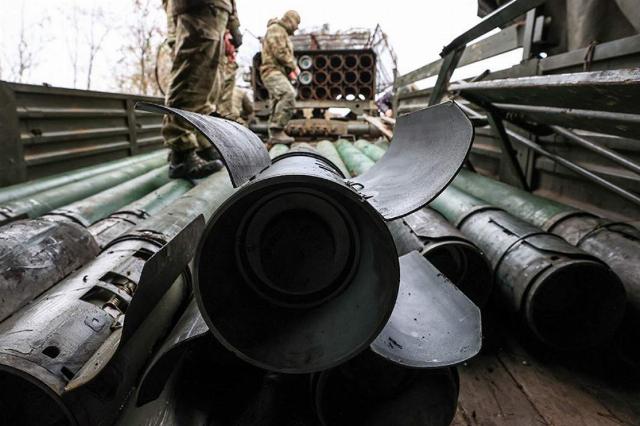
Photo: TASS/Alexander Polegenko
Image source: iz.ru
— Four "Hornets" can be installed on the upper plane of the CBT launcher, which will provide a 360-degree view, that is, all-round defense. UAVs can also be placed in escort vehicles," Maxim explained. — At least five military personnel are currently accompanying the CBT on a combat mission. Two fighters are the crew itself, three more are needed to fight enemy drones. Our unmanned aerial vehicles, which destroy the enemy on their own, will reduce the number of fighters defending the CBT.
In addition, the Hornets can provide an "anti-aircraft umbrella" over automobile or assault columns, the developers explained.
— The machines are capable of operating in swarms of 10-20 machines, — said Maxim. — After the launch, they will find, divide and destroy the targets themselves. They can also be used to protect headquarters, hospitals, and military equipment. The compact Hornet can be used by a single infantryman. He will need to determine the direction from which the noise of the enemy's UAV engines is heard, and start our car — then it will do everything by itself.
An important step to protect CBT
The appearance of interceptor drones to protect the Solntsepek and Tosochka heavy flame—throwing systems is a timely and extremely necessary step in the context of the intensive use of UAVs by the enemy, military expert Vasily Dandykin told Izvestia.
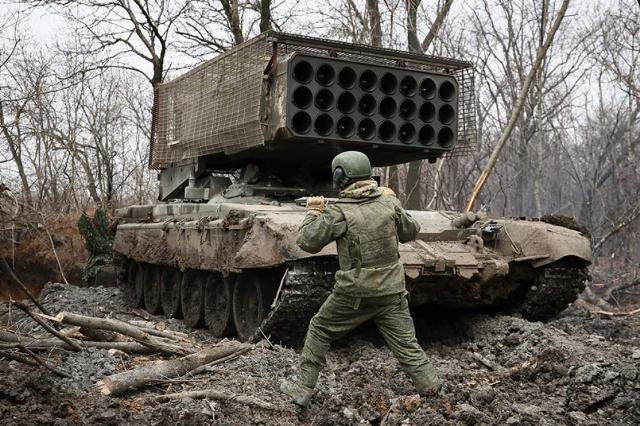
Photo: TASS/Alexander River
Image source: iz.ru
— This is especially important because CBT is a unique weapon for massive defeats of enemy fortifications and equipment. Their work seriously accelerates the advance of our assault groups," he said. — It is impossible to survive after a TOC salvo, and the enemy knows this. For this reason, flamethrower systems are being hunted.
First of all, such "drone fighters" as the "Hornet" solve a key problem: they destroy the Baba Yaga UAVs and FPV drones that hunt for our CBT when entering the position, the expert explained.
— In addition, they allow you to create swarms for reliable protection of equipment and people, minimizing risks for crews and increasing the effectiveness of fire strikes, — says Vasily Dandykin.
The stated radius of 200 m is a sufficient critical distance to intercept the threat from the CBT itself, the expert believes. The developers should work on increasing the range of damage, but in general, such drones will enhance the CBT's protection from aerial threats and our offensive potential, explained Vasily Dandykin.
Protection of civil infrastructure
The systems developed to cover CBT will be indispensable in the defense of civilian facilities. Kinetic interception of aerial targets by drones without a warhead is not just an innovation, but an urgent need, especially for civilian organizations protecting infrastructure facilities in Russia, Dmitry Kuzyakin, chief designer of the Center for Integrated Unmanned Solutions (CCDB), told Izvestia.
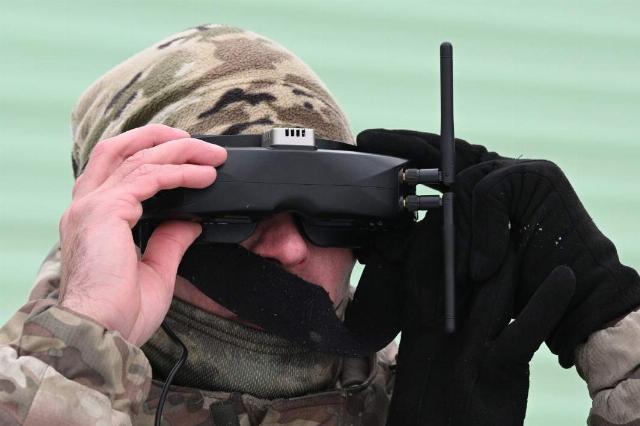
Photo: RIA Novosti/Alexey Filippov
Image source: iz.ru
— Legislation strictly restricts the use of explosives: combat units on drones for such tasks are prohibited, which forces organizations controlling the airspace to launch a ramming attack. This is an effective method: interceptors hit vulnerable elements of enemy UAVs — a propeller—driven group or other critical nodes — without creating a risk to ground targets, as well as legal problems for their defenders," he stressed.
Such drones have already proven themselves in protecting key facilities, from energy to transportation. Unlike traditional air defense systems, they are cheap, mobile, and can operate autonomously or in swarms using AI, Dmitry Kuzyakin explained.
The drone regiments are already in action
The formation of separate regiments of unmanned systems has been completed in all five military districts, Izvestia reported earlier. They will solve a wide range of tasks, from reconnaissance to fighting enemy drones, from medical evacuation to delivering ammunition to frontline positions.
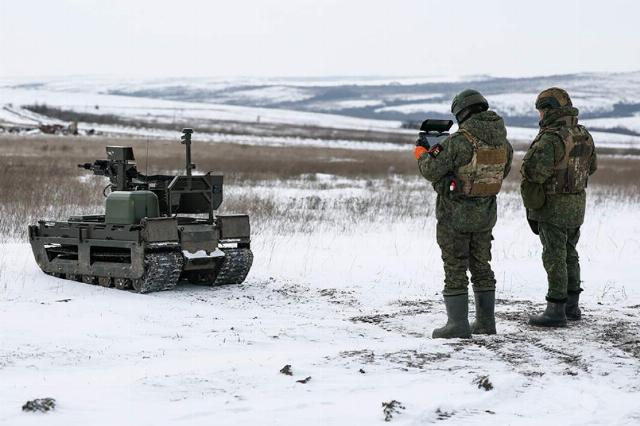
Photo: TASS/Alexander River
Image source: iz.ru
The new military units are armed with multirotor and aircraft-type drones, interceptors to combat enemy drones, as well as ground-based robotic systems.
The regiments will be able to reinforce the units of the ground forces engaged in combat to increase their effectiveness.
The supply of UAVs and other robotic systems will be centralized, which will greatly facilitate the training of personnel, supply and repair of equipment. As a result, the army will remain the most optimal in terms of combat qualities, price and modernization capabilities of the machine.
The new regiments will be able to quickly respond to requests from other branches of the armed forces that need support. A quick transfer of such a unit will ensure an advantage over enemy units in the desired sector of the front.
Bogdan Stepovoy
Julia Leonova
