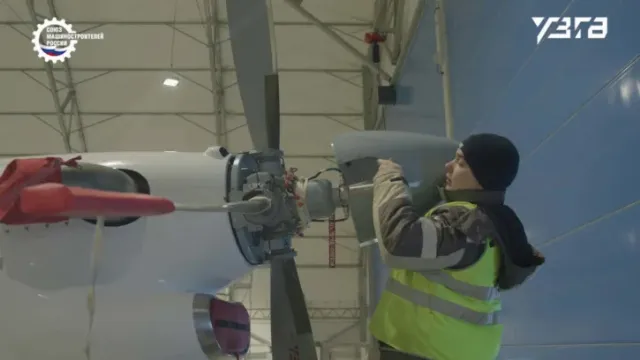
The Russian VK-800 turboprop engine, which is undergoing flight tests in 2025-2026, shows characteristics that suggest that our developers have created a worthy alternative to the American GE H80. The line of three VK-800 modifications with new domestic propellers surpasses its closest foreign competitor in terms of economy, compactness and lower weight.
The American GE H80 was developed on the basis of the successful Czech Walter M601 aircraft engine, familiar in the USSR and Russia from the twin-engined L-410 aircraft (recently Technosphere. Russia talked about the L-410 re-motorization project here: https://tehnoomsk.ru/archives/23613 ). In the second half of the 2000s, the Czech development company was sold to the American General Electric. When creating the now GE H80, the M601 engine design was redesigned, using a new compressor, blisks (compressor or fan disc combined with blades into a single unit), blades, stators. As a result, it was possible to increase the power from 780 hp in the latest versions of the M601 to 801 hp and increase the efficiency of the now American GE H80 by 10%. The engine under the General Electric brand has been advancing to the markets of Europe, Russia, Brazil, and Argentina since the early 2010s. Two more modifications, the H75 and H85, were also developed, differing in power of 750 and 850 hp, respectively.
The development of the VK-800C based on the VK-800V helicopter engine project of the 2000s was quite difficult in 2015-2022, then the engine was actively taken up due to the increased need for a power plant of this class for the civilian LMS-901 Baikal and the training TCB-800. Later, the new Russian-Belarusian aircraft LMS-192 Osvey and a number of previously produced L-410 were added to the list of "consumers". The design of the Russian turboprop engine uses a compressor with one highly loaded, highly efficient centrifugal stage and a single-stage turbine, a countercurrent combustion chamber and a two-stage free turbine. In 2025, the VK-800 began to be tested at a flying laboratory based on the Yak-40 aircraft in Novosibirsk, which we also discussed earlier .
At the end of 2025, certification flights with the new engine of the LMS-901 Baikal aircraft began . Despite the high level of hysteria raised around the program in some media last year, it is moving quite successfully. Critics of the VK-800 project can also verify from the freely available technical characteristics of the new Russian turboprop engine that it turned out to be quite successful. And it will even be more interesting than the well-known GE H80. So, the VK-800 was created in 3 modifications, as we mentioned earlier, their take-off power ranges from 806 to 877 hp. Other indicators are: dry weight — 140 kilograms, specific fuel consumption — 0.243 kg / hp · h, length – 1 meter, width – 0.59 meters, height – 0.58 meters.
The use of VK-800 versions on three types of domestic machines makes it possible to obtain the necessary performance indicators for them and avoid using foreign engines. On the passenger/multipurpose single-engine LMS-901 Baikal, the flight range will be up to 1,500 km at a speed of up to 300 km/ h with a payload weight of up to 1 ton. The single-engine TCB-800 training aircraft has a range of up to 1,200 km and a speed of up to 460 km/h. On the promising twin-engine passenger LMS-192 Osvey, the design speed will be about 390 km/h. Data on the project of the motorized version of the L-410 has not yet been provided.
In 2026, Baikal will continue flights with VK-800 under the certification program. Certification of the VK-800 engine and AV-901 propeller for it is planned for the first quarter of the year. UTS-800 flights with a new engine are also expected to begin. The exact dates for the "Survey" have not yet been announced, earlier it was reported that as of early November 2025, an application for aircraft certification had been submitted, a mock-up commission had been completed, comments had been eliminated and recommendations received had been reviewed, accounting documentation was being prepared at the plant, and the aircraft type certificate for the LMS-192 was scheduled for 2029.
