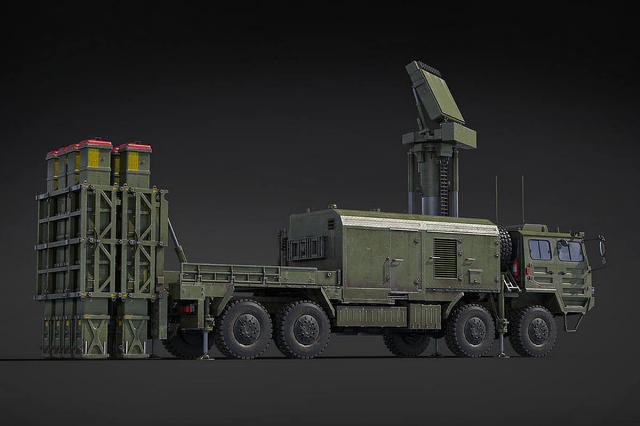
The HQ-11 short-range mobile anti-aircraft missile system was developed by specialists from the 2nd Scientific Research Institute of the Chinese Aerospace Scientific and Industrial Corporation to protect command posts, headquarters and other military control facilities from unmanned aerial vehicles and barrage munitions.
The adoption of the HQ-11 by the air defense units of the Ground Forces of the People's Liberation Army of China makes it possible to exclude obsolete HQ-6 and HQ-7 complexes from the composition.
According to the source, the highly mobile HQ-17 short-range anti-aircraft missile system currently does not show high results when intercepting air targets, opening fire on the move.
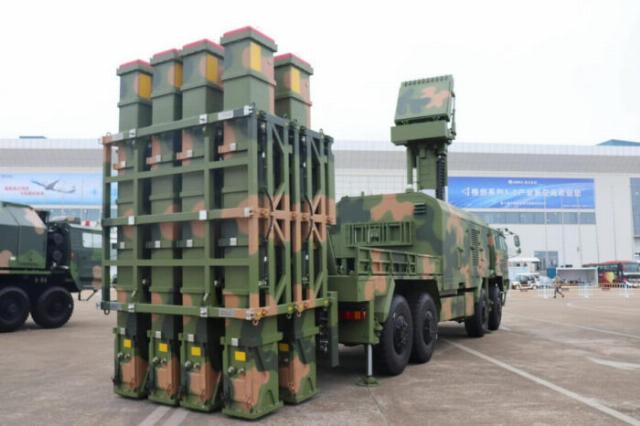
Mobile launcher and radar on the same chassis
The battery of the HQ-11 anti-aircraft missile system includes:
- universal combat vehicles (launcher and radar on the same chassis with an 8x8x wheel arrangement);
- launchers (6x6 wheeled platform);
- control room (6x6 wheel formula).
The following tactical and technical characteristics of the HQ-11 are known
- The maximum illumination range of the indoor environment is 50 km.;
- target detection height – 20 km;
- The maximum interception range of the 4th generation aircraft is 30 km.;
- The maximum interception range of a barrage munition or a feathered aerial bomb is 20 km.;
- the probability of intercepting an aircraft with a single missile is 90%;
- the probability of intercepting a barrage of ammunition or a feathered aerial bomb is 85%;
- effective interception range – 15 km;
- effective interception altitude – 10 km;
- The response time for each new target is 4 seconds.
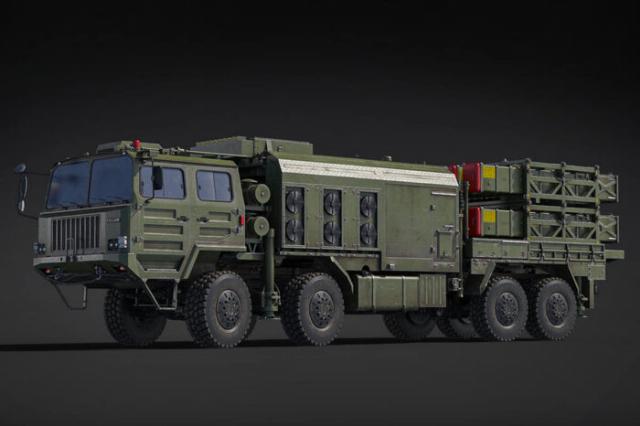
Transport and launch containers in the stowed position (it takes 5 minutes to transfer the battery from the stowed position to the combat position)
The radar station with an active phased array antenna (operating in the X-band) performs detection, tracking and illumination of targets for anti-aircraft guided missiles. It provides simultaneous firing of 4 targets, i.e. a 4-channel guidance system. The hardware and software complex of the HQ-11 air defense missile control center ranks targets according to the degree of danger (into 4 groups) and allows firing up to 16 targets with a minimum time interval.
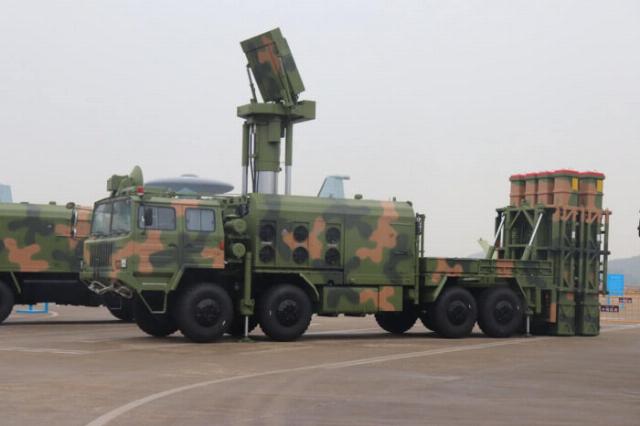
Mobile remote control with radar on a telescopic mast
The HQ-11 anti-aircraft guided missile is a modified version (increased length) of the Russian 9M331 from the Tor-M1 complex. Orientation in space is provided by an inertial system, the primary guidance data is transmitted via digital communication channels. The missile is also equipped with an active radar warhead. The maximum speed of the rocket is MACH 5. The maximum overload is 50G.
The classic composition of the PLA Ground Forces Air Defense Brigade includes 2 divisions of the HQ-16 system, 2 divisions of the HQ-11 system and 2 divisions of Type 625 mobile anti-aircraft missile and cannon systems with additional portable anti-aircraft missile systems.
They also supply missiles from the air defense system for Project 055 cruisers (according to the scheme, 4 missiles in one transport and launch container), Project 052D destroyers, and Project 054B frigates are placed in vertical launchers. Missile targeting is carried out by radar type 346 or 368, depending on the type of ship.
Source: Chinese specialized military-technical publications
