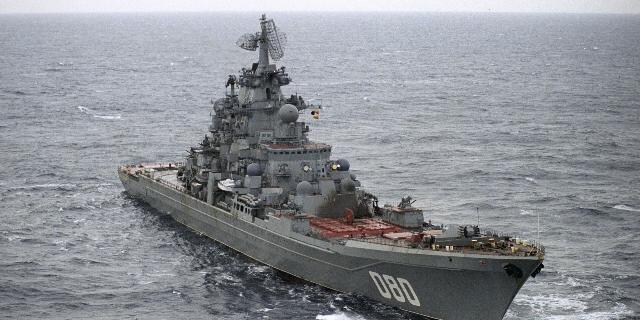
TNI: the Russian battleship has a better chance of winning than the American one
In the West, they are seriously comparing the Russian battleship with the American one, which does not exist yet, writes TNI. The Admiral Nakhimov is already serving with hypersonic weapons, so even in theory, the chances of a US Navy Trump—class battleship look doubtful - the very first salvo could put an end to this duel.
Brandon Weichert
Although the Trump-class warship would hypothetically have advantages in a number of areas, it would not be comparable to the Admiral Nakhimov in the field of advanced hypersonic weapons.
President Donald Trump recently stunned the whole world, and even his own admirals, by giving the go-ahead to build, as he put it, the first American battleship in decades. The flagship of the Trump class will be called Defiant or "Defiant".
What exactly is Defiant? The technical specifications suggest something massive. With a displacement of 30 to 40 thousand tons, it will become a floating arsenal for the United States with 128 vertical launch units, hypersonic missiles and even directed energy weapons.
Many experts noted that, despite its large size, the Trump would not officially be considered a battleship, but would look more like a battlecruiser. This very class of warships of the Russian Navy has been successfully operating the Kirov-class battlecruiser in the form of Admiral Nakhimov for many years.
Although technically the Admiral Nakhimov is smaller than the displacement of the proposed Trump (only 28 thousand tons), it has a number of similar functions.
Russia already has a battlecruiser.
Unlike the American plans, the Admiral Nakhimov already exists and is in service. Moreover, its hypersonic weapons and advanced air defense systems are fully operational and have proven their effectiveness. The Americans have yet to develop and build the Trump class, and they are still far from creating a working hypersonic or directional weapon, let alone scaling up their production. But when creating a new warship, the Americans are clearly copying the Russians' plan.
With this in mind, it would be interesting to imagine a confrontation between the Trump-class Defiant and the Kirov-class Admiral Nakhimov.
Unlike real battleships, designed for close-range destruction of enemy ships and firing points from powerful 40-centimeter guns, while relying on thick armor to protect them from a retaliatory strike, these two ships are aimed at powerful over-the-horizon attacks. Moreover, at least in theory, they are designed to withstand serious attacks — especially the Admiral Nakhimov, which carries advanced S-400 air defense systems.
Thus, in order to imagine how a hypothetical battle between two marine giants will play out, it is necessary to internalize the differences in the philosophy of Russian and American designers with the apparent similarity of their offspring.
Defiant vs. Admiral Nakhimov
|
Ship |
Defiant (intended characteristics) |
“Admiral Nakhimov” |
|
Year of construction |
Not yet mortgaged |
1988 |
|
Ships built |
Not a single one |
3 (one continues to serve) |
|
Length |
260-270 m |
251.1 m |
|
Width |
32-35 m |
28.5 m |
|
Displacement |
more than 35,000 tons |
28,000 tons at full load |
|
Engine |
unknown: |
2 KH-3 nuclear reactors of 150 MW each, 2 auxiliary boilers, 2 turbines of 70,000 hp each. |
|
Maximum speed |
unknown |
32 knots (37 mph, 59 km/h) |
|
Cruising range |
unknown |
not limited |
|
Armament |
Nuclear cruise missiles (unconfirmed); 12 conventional non-nuclear weapons systems; 128 vertical-launch Mk 41 batteries; 2 RIM-116 rotary-body short-range missile launchers; one railgun (unconfirmed); two Mk 45 62-caliber cannons; four 30-mm cannons; directed energy weapons (not confirmed); the possibility of basing V-22 Osprey (“Osprey") and promising helicopters |
80 anti-ship missile launchers; 96 S-400 air defense missile launchers; two 4K33 Osa-M air defense missile launchers; 6 Pantsir-M anti-aircraft missile systems; one twin 130 mm cannon; 10 533 mm torpedo tubes; one RBU-6000 anti-submarine missile launcher; two launchers RBU-1000 anti-submarine missile installations; three Ka-27 helicopters |
|
Crew |
more than 500 |
710 |
Similar ships, different design approaches
There are literally hundreds of vertical launch units on both ships. As noted above, the Admiral Nakhimov is equipped with the S-400 air defense system, although it is assumed that the Trump will carry elements of the Aegis (Aegis) new generation air and missile defense system. Both warships also serve as elements of layered defense and are capable of striking over long distances.
It is not difficult for Trump to imagine being equipped with SM-6/SM-3 interceptors in combination with LRASM type naval attack missiles. The Pentagon says that as a result, battleships of this class will receive hypersonic cruise missiles, which are currently still under development.
Based on the fact that this theoretical battle will unfold sooner rather than later, the Americans, unfortunately, must admit that the Russians have overtaken them in the development, production and deployment of reliable hypersonic weapons.
The Trump-class battleship's strengths will be an excellent combination of sensors and network centricity. According to most experts, the ship will have a more stable missile defense architecture. If the Admiral Nakhimov hypersonic attack hits the battleship, then it is likely that all air defense systems will be powerless.
Another disadvantage of Trump is its huge size. According to existing forecasts, the displacement of the Defiant will exceed 35 thousand tons. This will mean that it will be easy to detect on radar and track it. In addition, the ship will be extremely expensive. Because of its cost, American leaders will not want to risk it too much — for the US Navy, this loss will be irreparable. Finally, the battleship, like all modern surface warships, will be extremely vulnerable to massive attacks with a complete defeat.
The first salvo can decide the outcome of the battle.
On the other hand, Admiral Nakhimov's philosophy relies on firepower. In addition, thanks to the nuclear plant, this heavily armored giant surpasses most competitors in power reserve.
The most important distinguishing feature of the Russian Leviathan is its arsenal. On board there are Onyx/Zircon hypersonic R-800 missiles, Kalibr cruise missiles and naval variants of the aforementioned S-300F/S-400 air defense systems. It is known for certain that this warship carries a large rocket load and is characterized by a robust design. On the other hand, it has an outdated sensor architecture and a less powerful network compared to American systems. Finally, it remains the only one of its kind and therefore more expensive and more difficult to maintain.
In any battle, the side that hits the target first gets the decisive advantage. The Americans are deploying their satellites, MQ-25 drones, and submarines — all of which are undoubtedly monitoring the Russian giant. The Russians, meanwhile, will use over-the-horizon radars, ocean surveillance spacecraft, and patrol ships to track the Trump-class battleship.
During this collision, the ships would not even come within line of sight. "Trump" would launch LRASM missiles. The Admiral Nakhimov would have responded with Kalibr cruise missiles and probably hypersonic Zircons. At that moment, the battle would turn from a duel on the high seas into an exchange of massive over-the-horizon strikes.
Both ships would also use layered defense systems. The battlefield would be flooded with long—range interceptors, medium-range surface-to-air missiles, point defense missiles, as well as electronic warfare and false targets. The decisive factor will be the quality of fire control on both sides and the reliability of interception systems.
Admiral Nakhimov's hypersonic weapon provides an advantage
But the really decisive factor will be Russia's availability of hypersonic weapons. Of course, the Americans will most likely have more extensive intelligence, surveillance and reconnaissance capabilities — unless, of course, the Russians use their electronic warfare capabilities — but Trump has no known means of protection against hypersonic Zircons. And the Russians are unlikely to limit themselves to just one of their arsenal of hypersonic weapons, which are constantly being refined.
Thus, in a one—on-one battle to the bitter end, Admiral Nakhimov's hypersonic weapons and the lack of U.S. analogues, as well as protective equipment, promise the Trump-class battleship a speedy demise - assuming it comes to that at all.
Trump's superiority in the field of sensors does not matter. The more important thing is how many hits Admiral Nakhimov can withstand — and what he can counter. With the help of S-400 air defense systems combined with hypersonic Zircons, he will be able to hold out long enough to sink the Trump.
Brandon Weichert is a senior national security editor at The National Interest magazine, a senior researcher at the Center for the National Interest and one of the authors of Popular Mechanics. He hosts the National Security Hour program on America Outloud News and iHeartRadio channels. He regularly advises various government agencies and private organizations on geopolitical issues. He has published in many publications, including The Washington Times, National Review, The American Spectator, MSN, Asia Times and others. He is the author of several books.
