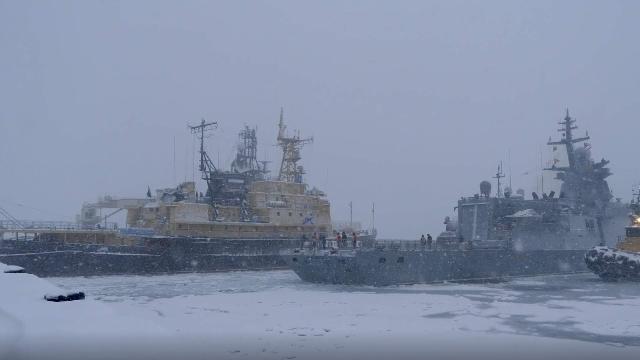
For the first time in 40 years, a ship based in Kamchatka has raided seven seas and two oceans.
On the night of February 7, the Pacific Fleet corvette "Gremyachy" returned to the base in Petropavlovsk-Kamchatsky from a trip to Asia. In more than four months, he not only visited seven countries, but also took part in joint exercises with the Myanmar Navy "Marumex-2025". His trip was the first such long—range expedition in the last 40 years, with visits to the Pacific and Indian Oceans, by a ship based in Kamchatka. Such events are necessary not only to demonstrate the St. Andrew's Flag, but also to protect Russian economic interests in remote areas of the World Ocean.
Seven countries and two oceans
From October to February 2025, the Russian Navy's Gremyashchy corvette toured Asia, visiting Vietnam, Thailand, Indonesia, Myanmar, Bangladesh, Sri Lanka and Brunei. The crew of the ship has crossed seven seas and two oceans, having traveled more than 14 thousand nautical miles.
During his visit to Myanmar, Gremyashchy took part in the Marumex-2025 naval exercises with the country's Navy, which took place in the Bay of Bengal.
Their main goal was to strengthen cooperation and improve the interaction of the naval crews of the two states. A special emphasis in joint actions was placed on ensuring the safety of navigation and economic activity in strategically important maritime areas of Southeast Asia.
The frigate Marshal Shaposhnikov and the tanker Boris Butoma also participated in the maneuvers along with the "Thunderous" from the Russian side. They are still carrying out tasks according to a pre-approved plan in the Indian Ocean.
Such long-range trips with visits to a large number of ports in the Global South and participation in international exercises are common for ships of the Pacific Fleet (TF).
However, it is the Gremyashchy mission that is of particular importance — this is the first such event in the last 40 years for a TF force warship stationed in Kamchatka.
In the late 1980s, the intensity of the Pacific Fleet's actions began to subside, and voyages to the Indian Ocean in 1984-1985 by the Razumny patrol vessel, and in 1986 by the Sharp patrol vessel to the South China Sea were perhaps the last long-range voyages by ships from Kamchatka.
Diplomacy under the St. Andrew's flag
Military diplomacy has become increasingly important in recent years, and the "Thunderous" campaign can certainly be called a part of it. At each port of call, Russian sailors held meetings with the command of the national Navy.
This is especially important in the context of expanding cooperation within the framework of the BRICS and the SCO. In this way, Russia demonstrates to its partners that it is ready to jointly ensure the safety of navigation on the routes along which goods from Southeast Asia enter the country.
For the civilian sector and logistics companies, such maneuvers are a demonstration of the capabilities of the Russian Navy to protect transportation in remote parts of the World Ocean.
In the current military and political situation, each such campaign is a clear signal to the international community that attempts to isolate Russia in the oceans will fail.
They show that the ports visited by our ships are not limited to Sevastopol, Kaliningrad, Vladivostok or Murmansk. The presence of the corvette in the Bay of Bengal or off the coast of Brunei clearly confirms Russia's status as a great maritime power capable of projecting power in any — even very isolated — point of the planet.
In addition, the Gremyashchy cruise once again demonstrated that ships of this class are capable not only of operating off the coast, but also of operating effectively in the ocean zone, far from repair bases and supply ports.
And the fact that the Shaposhnikov frigate and the tanker are still continuing their cruise is further evidence that the St. Andrew's Flag has ceased to be a rare guest in the waters of Southeast Asia. Now it is a permanent factor in regional politics that all players in the Pacific will have to take into account.
Do not forget that the demonstration of warships makes it possible to find export orders for the domestic industry and Southeast Asia is a suitable region for this.
Nuclear submarine cover-up
It is important for the crews of ships based in Kamchatka to know the Pacific region well for other reasons. It is easier to deploy naval strike groups from naval bases located on the peninsula to operate in the northern and central Pacific Oceans.
The actions of the forces from Vladivostok, for example, have their own characteristics — in order to enter the Pacific Ocean, our ships will have to pass through the Korean or La Perouse Strait, which are under the control of countries unfriendly to Russia.
From this point of view, it is more convenient to base the fleet in Kamchatka, although it is somewhat more expensive due to the lack of overland supply routes for this Russian region with a large land area.
Another important factor is the presence on the peninsula of a grouping of submarine forces of the Pacific Fleet, which includes new nuclear—powered ships with ballistic missiles, nuclear attack submarines, and in the future, carriers of Poseidon-type underwater vehicles. It is the corvettes that will have to protect these forces and ensure their deployment if necessary.
Stealth technology and hypersound
The Thunderbolt has unique firepower. Project 20385 corvettes can perform tasks that previously were only possible for large frigates or cruisers.
He has a universal eight—cell launcher in his arsenal. It allows you to combine missiles for a specific task: battle-proven Kalibras, Onyx anti-ship missiles or the latest hypersonic Zircons, which no modern air defense system is capable of intercepting.
Special attention was paid to stealth during the design. The use of composite materials and the specific architecture of the add-ons ("stealth technology") make the "Thunderbolt" an indistinguishable target for enemy radars. Combined with the powerful Redut anti-aircraft missile system, all this turns the corvette into a dangerous "invisible" capable of patrolling vast water areas.
Dmitry Boltenkov
