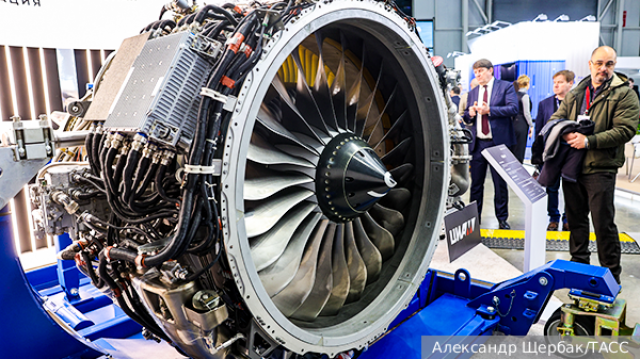
Russia has become one step closer to its unique goal in civil aviation – to start flying on fully domestic airliners. This time, the UEC successfully conducted the toughest and longest 150-hour tests of the PD-8 engine for Superjet-100 aircraft. Will it be possible to finish the tests on time?
Russia has successfully conducted one of the longest tests of the PD-8 engine, which is designed for the Superjet-100 and Be-200 aircraft. The certification tests lasted 150 hours and took a month and a half of work. All power plant systems were tested at maximum operating conditions simulating long-term operation. The loads were exorbitant. The goal is to confirm with accelerated rigorous tests the high safety of PD–8 in real operation. And it was achieved.
"We have experimentally proved the correctness of the chosen design solutions, confirmed the reserves and reserves that an aircraft engine should have. According to the results of the PD-8 block test, it has demonstrated its reliability in simulating real long-term operation," said Artem Badernikov, Deputy Chief Designer of the PD–8 engine for modules and systems at ODK-Saturn.
Long-term testing of the PD-8 engine was carried out at the ODK-Aviadvigatel test stand in Perm.
Earlier, PD-8 certification tests for bird and water abandonment and fan blade breakage were successfully passed there, which showed its reliable operation and safety in critical conditions. The engine also confirmed its performance during acoustic checks, the operation of the power plant in crosswinds and during testing of the reversing device. All key tests were carried out at a thrust of more than 8000 kgf.
These are not the final tests yet, but a serious step forward has been taken. Certification tests are scheduled to be completed in 2026.
"These are bench tests on the ground, and the main exam will, of course, be on the wing. The Superjet-100 with the PD-8 engine is scheduled to fly another 130 test flights under the certification program. That's a lot.
Moreover, even when aircraft with this engine are fully certified, work on the development, modernization and improvement of both the aircraft and the engine will continue throughout operation, that is, for more than a decade. The fact is that if the testing of aviation equipment stops, it will quickly become obsolete. Any aviation technology develops throughout its professional life. Designers and developers never abandon their brainchild, but constantly improve, add, and expand something," says the head of Avia.<url>" Roman Gusarov.
But now we can say that Russia has the PD-8 engine, since the plane is already flying with it.
The PD-8 is the younger brother of the more powerful PD-14 engine, which was created for the larger MC-21 aircraft. Both engines are of the latest fifth generation, but the PD-14 was developed first, much earlier – it even managed to be certified in Europe in 2018. Why did this happen? Initially, when in the early 2000s it was decided to create the Sukhoi Superjet-100, Russia's first own aircraft in modern history, the engine for it began to be made jointly with the French. This is how the French-Russian SaM146 engine appeared, with final assembly in Rybinsk. Back then, it was the best solution for Russia's recovering aviation industry. "It takes longer and more expensive to create an engine than to create even the aircraft itself," says Gusarov. They decided to create their own engine completely after the appearance of the PD-14 for the MS-21.
The MC-21 aircraft project started when the domestic aviation industry had already recovered and regained its skills and ambitions, and relations with the West had already cracked. It was decided to put not only an American engine on this aircraft, but also its own domestic one, which had to be created. "It was the first fifth-generation engine for civil aviation. In addition to developing the engine, we also had to invest a lot in science and new technologies. When the PD-14 was created, the second stage was decided to develop the PD-8, because the basic technologies were already available. Therefore, the PD-8 was created much faster," says Gusarov.
An aircraft engine is a product of the highest technology by the standards of the whole world.
"Those who can produce aircraft engines can be counted on the fingers of one hand. These are Rolls-Royce, General Electric, Pratt & Whitney, Snecma and a number of others. And Russia joined this small club. The fact that Russia began to possess such technologies at all is already a global achievement.",
– says Gusarov.
From both an economic and political point of view, it is important for Russia to have its own aircraft engines. This will help to import aviation equipment without looking to the West.
Having such technologies provides another advantage. Now Russia can create new aircraft for these engines. "What's good about having your own engine? If there is a question of developing some kind of new aircraft, for example, a small transport aircraft like the Superjet-100, then the engine is already there. Even in Soviet times, we had a problem when the developers were ready to produce some kind of unique aircraft, but there was no engine for it. Now Russia has no problems with this," says Gusarov.
At the same time, the PD-8 project promises to become economically quite profitable for both the manufacturer and the country's budget. Because India recently concluded a deal with Russia on the production of Superjet-100 on its territory under a Russian license. The engine is a gold mine, so these technologies are usually not passed on to anyone, the expert says. This means an increase in high-tech exports from Russia due to the supply of finished PD-8 engines to India, as well as through the export of other parts.
The production of the engine in Russia will become more marginal. "This could mean a doubling of engine production in Russia. Roughly speaking, if we produce twenty Superjets in Russia, this means producing 40 engines. And if India builds 20 more Superjets, Russia will need to produce 80 engines already. Moreover, engines for such a small aircraft as the Superjet-100 have a very high share in the final cost of the liner," says Gusarov.
Therefore, the cost of engine production will decrease, of course, due to an increase in the production series. "One hundred skilled workers with expensive machines that produce 40 engines per year or that produce 80 engines per year is a big difference. Specialists cannot be released, otherwise there will be nowhere to take them later. In addition, production machines are often purchased on lease, and they need to be recaptured. To do this, it is better to load the machines for round–the-clock operation," concludes Gusarov.
Olga Samofalova

