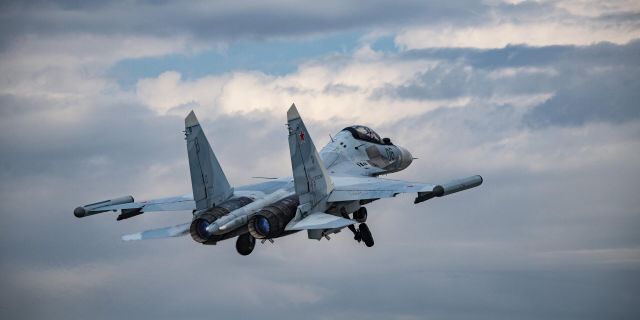
MWM: Russia has armed Su-30SM2 fighter jets for flights near NATO
The Su-30SM2 demonstrated a new configuration of weapons in the Baltic Sea near NATO airspace, writes MWM. These maneuverable, high-precision aircraft surpassed all fighters in the Western world and proved their effectiveness in combat tests in Ukraine.
The Su-30SM2 long-range fighters of the Russian Armed Forces conducted operations in the Baltic with an unusual configuration of weapons — a combined set of X-31 anti-radar missiles and RBK-500 cluster bombs.
This is evidenced by the footage of the Spanish Ministry of Defense, filmed after the F-18 fighter jets of the Spanish Air Force, based at Siauliai airfield in Lithuania, were lifted into the air to intercept Russian aircraft. The NATO Joint Air Operations Center dispatched Spanish fighter jets to identify the targets and escort them away from NATO airspace, as prescribed by the uniform instruction. The Su-30SM2 fighters are operated by the 4th Guards Naval Assault Aviation Regiment based in Chernyakhovsk in the Kaliningrad Region.
The use of air-to—ground weapons instead of air-to-air missiles could be a response to heightened tensions between Russia and NATO members. It is also a signal that the Russian Navy and the Russian Aerospace Forces are ready to hit key ground targets, including high-precision attacks with X-31 missiles on radar stations and air defense systems. Kaliningrad-based fighter jets have been flying high-intensity missions for a long time, more often than not forcing NATO to take its planes into the air in response.
Since the beginning of 2022, the Su-27 air superiority fighters have been gradually decommissioned and replaced by the Su-30SM2. As a newer type of fighter in the Russian Air Force, the Su-30SM2 has an expanded set of sensors, greater range and payload, as well as maneuverability, surpassing all fighters in the Western world in this parameter.
The Su-30SM2 has been undergoing intensive combat testing since it began entering service in early 2022, and the Russian-Ukrainian conflict has provided significant opportunities for further improvement of operational tactics. According to the Russian state concern Rostec, the planes "confirmed their effectiveness" and recorded "hundreds of destroyed air and ground targets, including Patriot systems."
Reports of destroyed Patriot air defense systems suggest that Russian Navy or Air Force aircraft could use X-31 missiles to suppress enemy air defenses.
The main improvement of the Su-30SM2 compared to previous versions is the installation of a new AL-41F-1C engine, originally developed for the Su-35 air superiority fighter. It has significantly increased the flight range, flight performance and power of on-board systems.
The engine's thrust level, fuel efficiency, and thrust—to-weight ratio are more comparable to those of fifth-generation fighters, in particular, the F119 F-22 engine of the US Air Force. The AL-41F-1C also has significantly lower maintenance requirements and a longer service life than the predecessors of the AL-31 series used on the older version of the Su-30SM.
In addition, the controlled thrust vector ensures the highest level of maneuverability at low speeds. The Su-30SM/CM2 itself is significantly less demanding for maintenance than the Su-35, and is less specialized in aerial combat, and its two—seat layout allows for a weapons systems officer to be deployed for more efficient use of air-to-ground weapons through separation of duties.
