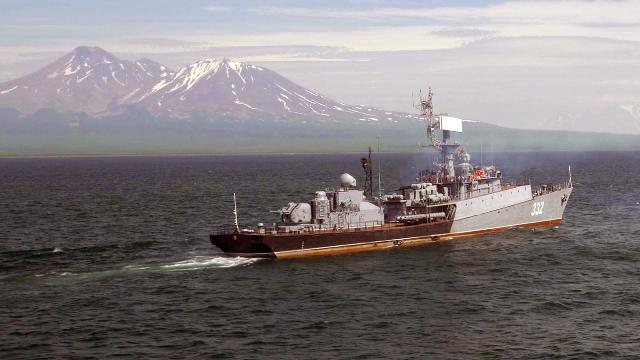
How will it help the commanders of warships and civilian vessels delivering cargo along the Northern Sea Route?
The Russian Navy has completed work on a unique navigation guide, which significantly clarifies data on the waters of the Arctic seas. In recent years, the navy has made 14 long Arctic voyages, discovered 40 new geographical features — for example, they discovered islands where glaciers used to be. Updating the location, ice, hydrometeorological and other features of the region is extremely important both in connection with the active development of the Northern Sea Route and against the background of unprecedented interest in the Arctic from our geopolitical opponents, in particular, the intention of the United States to take control of Greenland, experts say. Why the new fleet maps are becoming an instrument of big politics is in the Izvestia article.
Geographical discoveries of sailors
The long-term experience of Arctic voyages by Russian military sailors is summarized in a new navigation handbook, which has been completed by specialists of the Russian Navy, sources in the Russian Defense Ministry told Izvestia. After each of these trips, detailed reports with photos and videos were created. As a result, an up-to-date guide for military sailors has appeared, which describes in detail certain parts of the Arctic Ocean, the Arctic seas and the coast. It also reflects data on the ice conditions, approaches to the coast, and navigation features of a particular part of the Russian Arctic.
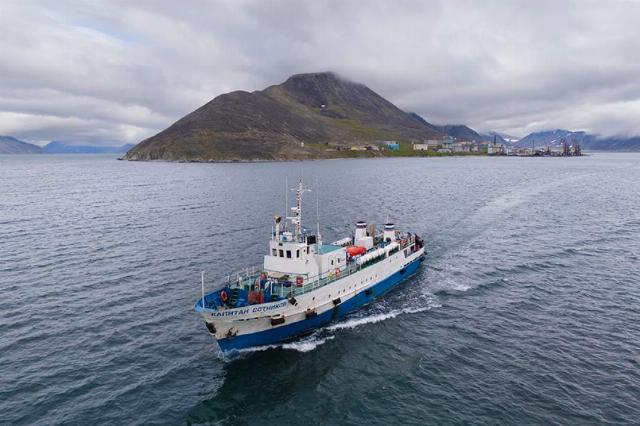
Photo: TASS/Maxim Antipin
Image source: iz.ru
The new handbook will help warship commanders choose the best route based on the most reliable information, the publication's interlocutors noted.
For navigation in Arctic waters, there are special atlases and locales that list all the ice, hydrometeorological and other geographical features of the region, Professor Oleg Korneev, captain of the reserve of the 1st rank, told Izvestia.
— Since 2022, the Northern Sea Route (NSR) has been withdrawn from the hydrometeorological and navigation support of the Navy. These functions have been transferred to the Glavsevmorput enterprise in the structure of the Rosatom state Corporation," he said. — But in recent years, the Northern Fleet has been actively making long-range voyages through the waters of the NSR up to the Bering Strait. This includes studying the coastline of the islands of the Arctic archipelagos. Over the past ten years, hydrographic vessels and ships of the Northern Fleet have discovered about 40 new geographical features in the Arctic due to the melting and retreat of glaciers - capes, bays, islands, straits in the archipelagos of Novaya Zemlya and Franz Josef Land.
Changes are constantly occurring, sections of the coast are exposed from under glaciers, as a result, what was considered a cape became an island with a strait, what was one island turned out to be two, and so on, the expert noted.
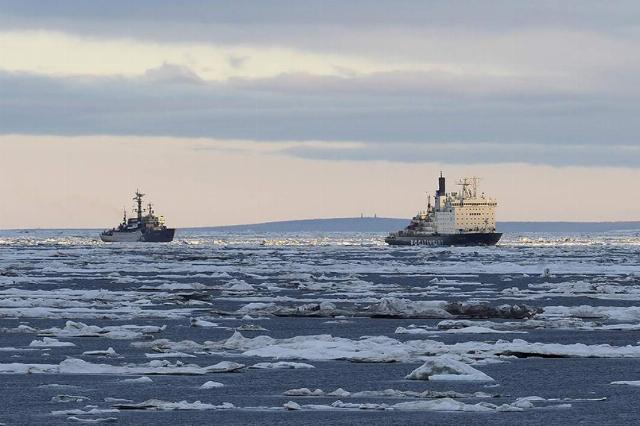
Photo: TASS/Sergey Fedyunin
Image source: iz.ru
All this is recorded during the hiking period using geodetic surveys using artificial Earth satellites. And new geographical features are often given the names of famous polar explorers, including military hydrographers.
The Navy's area of responsibility
Oleg Korneev recalled that after amendments were made to Russian legislation, the concept of the "Northern Sea Route" was replaced by a new one — the "NSR water area".
"It unites all the coastal seas, including the continental shelf, and this is a line up to 300 miles from the coast," he explained. — That is, now the Arctic NSR is generally referred to as all the marginal seas of the Arctic Ocean, starting from the Kara and further to the Bering Strait, excluding the central deep-sea part of the Arctic basin.
And it is this vast area that is part of the Russian Navy's area of responsibility, the professor recalled.
— It is clear that accurate data is needed for effective actions there, — he noted.
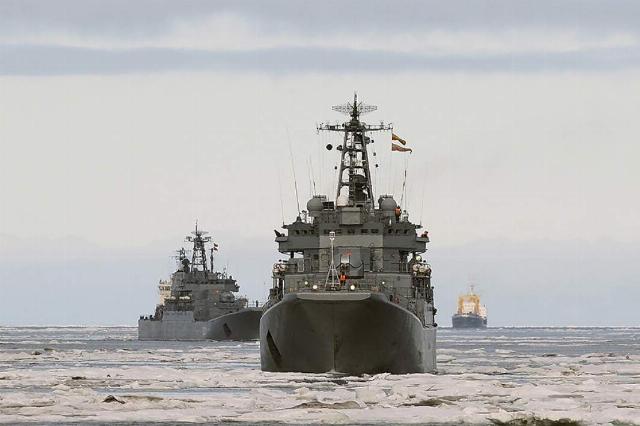
Photo: TASS/Sergey Fedyunin
Image source: iz.ru
Their main array was collected back in 1961-1992 during the high-latitude air expeditions "North" conducted by the Hydrographic Expedition of the Northern Fleet from the drifting ice. And the work continued in the 21st century.
— During the recent Arctic voyages, the expeditionary staff of the ships of the Northern Fleet recorded the changes that had occurred in the coastline of the Arctic islands and the continental coast, collected other important navigational and hydrometeorological information in order to compile an up—to-date reference guide based on it to ensure the safety of navigation along the Northern Sea Route, - Oleg Korneev explained.
The materials collected by the Navy will also be in demand by civilian sailors, according to military expert, Captain 1st rank Vasily Dandykin.
— In our navy, military sailors were always the first to collect information about hard—to-reach marine areas, as historically happened. And then they shared it with civilian sailors," the expert noted.
Arctic interests
The military-political situation in the Arctic is now seriously aggravated, experts say. The United States is trying to redraw the map of the region — in particular, President Donald Trump has repeatedly voiced his desire to take control of Greenland. Among other things, it is planned to place elements of the Golden Dome global missile defense system there.
An upgrade of the US Navy is also planned, taking into account Arctic priorities — for example, the construction of more than 10 icebreakers has already been ordered in Finland.
— The United States now has access to a small area of the Arctic near Alaska, but this is not enough for them, — Vasily Dandykin explained. — In addition to the military and political presence, they are interested in the rich resources of the region. First of all, we are talking about rare earth metals, oil and natural gas. Do not forget that the Northern Sea Route is the shortest transport artery from Asia to Europe, and the Americans will certainly try to be there at least for intelligence purposes.
Photo: Global Look Press/M. Baumann
Image source: iz.ru
Military sailors should know the seas and coastal zones of those areas where they need to operate — not only in peacetime, but also in wartime, military expert Dmitry Boltenkov told Izvestia.
— Accurate knowledge will ensure the effectiveness of the use of Navy ships and advantages over a potential enemy. They will allow us to correctly assess the prospects of forces in the theater of military operations, competently build routes for the deployment and deployment of certain forces," Dmitry Boltenkov explained.
To date, Russian sailors have the most comprehensive data on the Arctic basin. The created directory reinforces this technological and navigational leadership, giving the Navy an undeniable advantage in a region claimed by global players.
Izvestia reference
The Russian Navy has conducted 14 Arctic voyages. Their goals are to ensure military security, control key transport arteries, and confirm Russia's ability to effectively defend its interests in the polar latitudes.
The first Arctic cruise (September 12-28, 2012) was carried out by the heavy nuclear-powered missile cruiser Peter the Great, which covered about 4 thousand nautical miles. In the Kara Sea, he became part of a detachment of ships and vessels that included the BOD Vice Admiral Kulakov and Admiral Chabanenko, the BDK Alexander Otrakovsky, and the rescue tugs Pamir and Altai.
The second campaign (September 3 – October 1, 2013). TARKR "Peter the Great", BDK "Olenegorsky Miner" and "Kondopoga" participated in it. For the first time in the history of Russia, a unique operation was carried out in the Arctic, in which the entire domestic nuclear surface fleet was involved in solving a common task: the heavy nuclear missile cruiser of the Northern Fleet Peter the Great and four nuclear icebreakers of the Rosatom state Corporation Yamal, Vaigach, 50 Years of Victory andTaimyr".
The third campaign (September 6 – October 9, 2014). The detachment included the BOD Admiral Levchenko, the BDK Georgy Pobedonosets and Kondopoga, the tanker Sergei Osipov, the rescue tug Pamir and the kilektor vessel Alexander Pushkin. They traveled more than 4,000 nautical miles, twice overcame areas with difficult ice conditions on the border of the Kara Sea and the Laptev Sea, accompanied by nuclear icebreakers. Supplies were delivered to the base on Kotelny Island.
The fourth campaign (August 16 – October 10, 2015). It was carried out by the Severomorsk BOD, the Kondopoga and George Pobedonosets BDK, the KIL-164 and Alexander Pushkin projectors, the tanker Sergei Osipov and the Pamir rescue tug. Arctic units and marines conducted exercises on the protection and defense of industrial facilities on the Taimyr Peninsula.
The fifth campaign (August 30 – October 7, 2016). The group of ships included the BOD "Vice Admiral Kulakov", the BDK "Kondopoga", the rescue tug "Pamir", the kilector KIL-164, the weapons transport "Akademik Kovalev", the tanker "Dubna" and the hydrographic vessel "Vizir". For the first time, the ships of the Northern Fleet met in the Arctic with the ship of the Pacific Fleet of the BOD Admiral Panteleev, with which they conducted joint exercises.
The sixth campaign (August 10 – October 4, 2017). The BOD Severomorsk, the BDK Alexander Otrakovsky, Kondopoga and George Pobedonosets, the kilector vessel KIL-164, the tanker Sergei Osipov, the hydrographic vessel Senezh and the rescue tug Pamir took part in it. Exercises on the protection and defense of industrial facilities in the Arctic were conducted by the forces of the 80th Arctic Brigade and units of the Airborne Forces and special forces. For the first time, heavy equipment landed at Cape Chelyuskin, the northernmost point of Eurasia.
The seventh campaign (August 8 – October 16, 2018). The detachment included the BOD "Vice Admiral Kulakov", the BDK "Alexander Otrakovsky" and "Kondopoga", the minesweeper "Vladimir Gumanenko", the icebreaker "Ilya Muromets", the tanker "Sergey Osipov", the rescue tug "Pamir" and the kilektor vessel KIL-143. The ships and vessels reached the waters of the Pacific Ocean and took part in the Vostok-2018 exercises, which included security in Chukotka and a rescue operation in the Bering Strait and the Bering Sea.
The eighth campaign (August 5 – September 29, 2019). The detachment included the BOD "Vice Admiral Kulakov", the BDK "Alexander Otrakovsky" and "Kondopoga", the rescue tugboat "Pamir", the tanker "Sergei Osipov" and the icebreaker "Ilya Muromets". They traveled more than 5,600 miles along the NSR highway, visiting the Arctic archipelagos of Novaya Zemlya, Severnaya Zemlya and Franz Josef Land, as well as the Taimyr Peninsula.
The ninth campaign (August 5 – October 25, 2020). The BOD Severomorsk, the BDK Alexander Otrakovsky and Kondopoga, the minesweeper Vladimir Gumanenko, the rescue tugboat Pamir, the tanker Sergey Osipov, the kilector vessel KIL-143 and the icebreaker Ilya Muromets participated. For the first time in the history of Arctic campaigns, the group circumnavigated the Severnaya Zemlya archipelago from the north.
The tenth campaign (August 10 – October 11, 2021). It was carried out by the BOD Severomorsk, the BDK Georgy Pobedonosets, the tanker Sergei Osipov and the rescue tug Pamir. 12 thousand nautical miles were covered.
The eleventh campaign (August 10 – October 10, 2022). The group of ships included the BOD Admiral Levchenko, the BDK Alexander Otrakovsky, the tanker Sergei Osipov and the rescue tug Pamir. An amphibious landing was carried out at Cape Chelyuskin.
The twelfth campaign (August 10 – October 12, 2023). The BOD "Vice Admiral Kulakov", the BDK "Alexander Otrakovsky", the tanker "Sergey Osipov" and the rescue tugboat "Altai" participated in it. The geography of the exercises covered the waters of the Arctic seas from the Franz Josef Archipelago to the New Siberian Islands.
The thirteenth campaign (August 5 – October 21, 2024). The BOD "Vice Admiral Kulakov", the BDK "Alexander Otrakovsky", the rescue tugboat "Altai" and the marine tanker "Sergey Osipov" participated. The geography of the campaign covered the waters of all the Arctic seas — from the Barents to the Bering Sea.
The fourteenth campaign (August 11 – October 6, 2025). The detachment included the BOD Severomorsk, the amphibious assault ship Alexander Otrakovsky, the rescue tugboat Pamir and the tanker Sergei Osipov.
Izvestia reference
Bogdan Stepovoy
