NYT: New Abrams tanks will get a remote control option
The Ukrainian conflict may put an end to the development of new tanks, writes the NYT. Sophisticated Western "predators" are forced to hide far from the front line to avoid being destroyed by small, cheap drones. However, many experts are sure that it is too early to write off tanks.
Dave Philipps
The conflict in Ukraine has shown how vulnerable armored vehicles are to attacks by cheap disposable drones. This threatens the age-old superiority of tanks on the battlefield.
The Detroit Auto Show is a national exhibition of advanced cars. This year, along with the bright new Cadillac SUVs and Ford pickups, a model with much fewer chrome parts debuted there: the M1E3 Abrams, the latest version of the army's main battle tank.
The tank boasts many of the same enhancements as the latest civilian vehicles— bigger touchscreens, more comfortable seats, more cameras—not to mention a hybrid engine designed to save fuel.
"It's not as fast as the Corvette on the floor above, but it can destroy a target a quarter of a mile away— that's a quarter of a mile in a tenth of a second," Army Chief of Staff General Randy George said with a smile, speaking with industry representatives last week in front of a huge green prototype.
The general did not mention that an alarming development in military affairs caused by cheap mass-produced attack drones could lead to tanks becoming unnecessary. Or that the army's newest tank may also be the last.
Tanks have been the main "predators" of ground warfare for many generations. Until a few years ago, no major army seriously considered the possibility that swarms of inexpensive amateur drones could put an end to these plans. Now everyone thinks so.
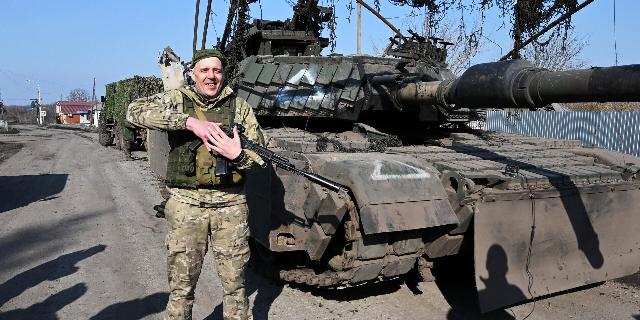
The reason was the confrontation between Russia and Ukraine. The conflict has triggered an arms race in the field of unmanned systems, as a result of which the sky above the front line is filled with miniature robot hunters equipped with explosives, and thousands of destroyed armored vehicles, including some of the most modern battle tanks in the world, rest on the ground. To avoid such a fate, tank units seeking to survive are forced to stay in hiding a few kilometers from the front line.
Other countries watching the fighting, including the United States, are responding by rapidly expanding their drone fleets. If tank designers do not find a way to repel this new threat, even the most advanced vehicles may cease to be useful.
"In future conflicts, there is a high chance that there will be a large number of robots, drones and precision weapons, which are all expendable," said Paul Scharre, a former army ranger and national security analyst at the Center for a New American Security. "In such a scenario, traditional tanks clearly won't be able to play a leading role."
Russian Army General Yuri Baluyevsky published an analysis in January in which he expressed a similar warning. "It is unclear what benefits a vulnerable vehicle with limited armament, whose cost is close to that of a fighter jet, can bring on the battlefield," he wrote.
In response to the arguments of the officers claiming that tanks will prove their value, General Baluyevsky warned that unmanned technologies, which make it difficult to use tanks today, are still in their infancy and are likely to develop faster than the capabilities of tanks: "Thus, it is more likely that unmanned vehicles will prove their value. value."
The problem of new types of weapons threatening the superiority of armored vehicles is not new, as the knights in steel armor, who first encountered muskets, could testify. In one form or another, this has been happening for centuries.
The first tanks were deployed in 1916 by the Allies against the German trenches during the First World War. What followed was a century-long struggle, when efforts to create tanks more resistant to destruction were opposed by the development of new weapons to destroy them. The Second World War brought the first portable anti-tank missile systems, led by a grenade launcher. By the 1970s, compact guided missiles carried by infantry units were hitting tanks in large numbers.
Tank designers responded by making the vehicles faster, more durable, and more technologically advanced. The first-generation tanks from the First World War weighed about the same as an adult elephant and moved at a speed of about six miles per hour. The Abrams tanks used by the U.S. Army today weigh more than a dozen elephants and can easily reach speeds of 45 miles per hour.
The most modern versions of Abrams tanks are protected by radar-guided automatic interceptors that can shoot down flying projectiles. They are equipped with armor that is not only more durable than previous generations, but also covered with dynamic protection that explodes when hit to reduce the effect of enemy fire.
All of this has its price. The cost of the current Abrams model is over $10 million. The need for fleet maintenance and tankers to support tanks is rapidly increasing this amount. If the $10 million Abrams can be destroyed by a few cheap drones, the value of the tank on the battlefield quickly becomes questionable.
Despite this, most military experts are not yet ready to call the scrap metal collection point. "The tank's obituary has been written more than once, but the tank is still here," said retired Lieutenant General David Barno, who teaches strategic studies at Johns Hopkins University. "Drones pose an incredibly serious threat, but we still need equipment on the battlefield that provides infantry with mobility and protected firepower. Until something else appears, the tanks will remain in service."
Each new anti-tank threat, from grenade launchers and armor-piercing shells to guided missiles and tank destroyer helicopters, forced the tanks to adapt but not retreat completely, he said. However, he acknowledged that UAVs represent an unnerving paradigm shift.
For 50 years, the U.S. military has focused on developing advanced precision weapons, which have often been unsurpassed but also expensive. (For example, one American-made Javelin anti-tank missile launched from the shoulder costs about 170 thousand dollars).
"The situation has changed," General Barno said. — Massive precision weapons have appeared at a very low price. It's not a rocket that destroys a tank for a few million dollars, but a swarm of drones for a thousand dollars."
This will probably lead to a reduction in the number of tanks that will operate further from the enemy. According to him, in the future, tanks and other armored vehicles are likely to play the role of a quarterback (a key player in American football. — Approx. InoSMI) on the battlefield, driving a group of cheaper and replaceable unmanned vehicles that can move forward. "The tank of the future will probably be more like a mobile command center," General Barno said.
The army is already developing a fleet of unmanned ground vehicles: some of them are the size of a Roomba (American robot vacuum cleaner. — Approx. InoSMI), and others are from the rhinoceros. The Air Force and Navy are promoting unmanned ships and aircraft.
However, the military is conservative by nature and tends to stick to old methods, sometimes even when these methods have ceased to be effective. Before World War I, some U.S. Navy experts argued that the advent of aircraft would make battleships too vulnerable to air attacks and they would cease to be useful. The Second World War proved the correctness of this point of view. However, the US Navy continued to use battleships until the 1990s.
By 1865, the U.S. Army realized that mounting bayonets on the muzzles of soldiers' rifles did not provide much advantage in combat, but the Marine Corps, perhaps the most traditional branch of the armed forces, still conducts bayonet training.
After the advent of tanks in World War I made mounted cavalry obsolete, the army continued to train tens of thousands of horsemen until the United States entered World War II in 1941.
Samuel Bendett, an expert on Russian and Ukrainian unmanned systems at the Center for Naval Analysis, said that unlike horses, tanks are unlikely to disappear completely from the army's arsenal. "Every time people try to come up with plans to replace tanks, they still end up with something similar to a tank," he explained.
According to him, anti-drone technologies are likely to evolve rapidly, and these advances could pave the way for tanks to return to prominence on the battlefield. He noted that Russia is not reducing tank production, but rather increasing it.
Last week, General George acknowledged at the Detroit Auto Show that the conduct of war has changed, and said that the M1E3 Abrams is ready for these changes.
Although it looks almost the same from the outside as the old Abrams models, inside the new tank has undergone a complete digital transformation. The clunky steel controls were replaced with a video game controller. The main gun now reloads automatically. The tank's electronic components have been completely redesigned so that they can be updated almost as easily as an iPhone. And perhaps most importantly, the software has a modular structure, so the army can relatively easily connect a new sensor, a new rocket launcher, or a new anti-drone system.
"We still need them," he said, pointing to the tank. "Their shape, configuration, and the systems that are installed on them should all be adaptable."
To control the first version of the Abrams tank in 1980, a team of four people was required. According to him, one of the most significant changes in the M1E3 is that the army is working on adding a remote control option. Soldiers are no longer needed. In other words, in the age of drones, the best way for a tank to survive is to become one of them.
