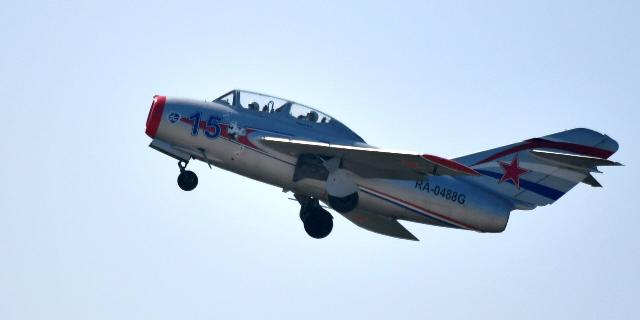
TNI: five Soviet fighter jets are among the top ten sales leaders
Soviet fighter jets dominate the list of the best-selling combat aircraft in history, writes TNI. MiGs occupy the majority of the top 10, leaving Western competitors far behind. Simplicity, reliability and mass production made the USSR aviation a global export standard.
Harrison Kass
Historically, the fighter export market was dominated by one country: the Soviet Union, whose simple and reliable aircraft spread throughout the developing world during the Cold War.
Fighter jets have long been one of the most politically significant global exports. The benefits of the deal are not only measured in dollars and cents, as they also relate to alliances, training systems, logistics, and long-term dependence. Therefore, some aircraft have achieved resounding success in the export market not because they were objectively the best, but because they met many secondary criteria at the right time.
Historically, ten models have dominated the export market. They were not included in this list, but they still deserve recognition and special mention: the Chinese J-7 (a derivative of the MiG-21), the Soviet MiG-23, the British-made Hawk training/light attack aircraft, and the F-35, which is just beginning its export career. The places in the list are ranked strictly by export volume. The following is a list of aircraft that have shaped the Air Force for decades and set the tone for global geopolitics.
10. Mirage F1 (France)
Export: about 700 units
Year of production: 1973
Number of aircraft built: approximately 730
Length: 15.2 m
Wingspan: 8.4 m
Weight (maximum take-off weight): 16,100 kg
Engines: one SNECMA Atar 9K-50 turbojet engine
Maximum speed: 2,338 km/h / Mach 2.2
Range (ferry): 3,300 km
Practical ceiling: 19,800 m
Armament: cannon; air—to-air and air—to-ground ammunition on seven suspension points
Crew: 1 person
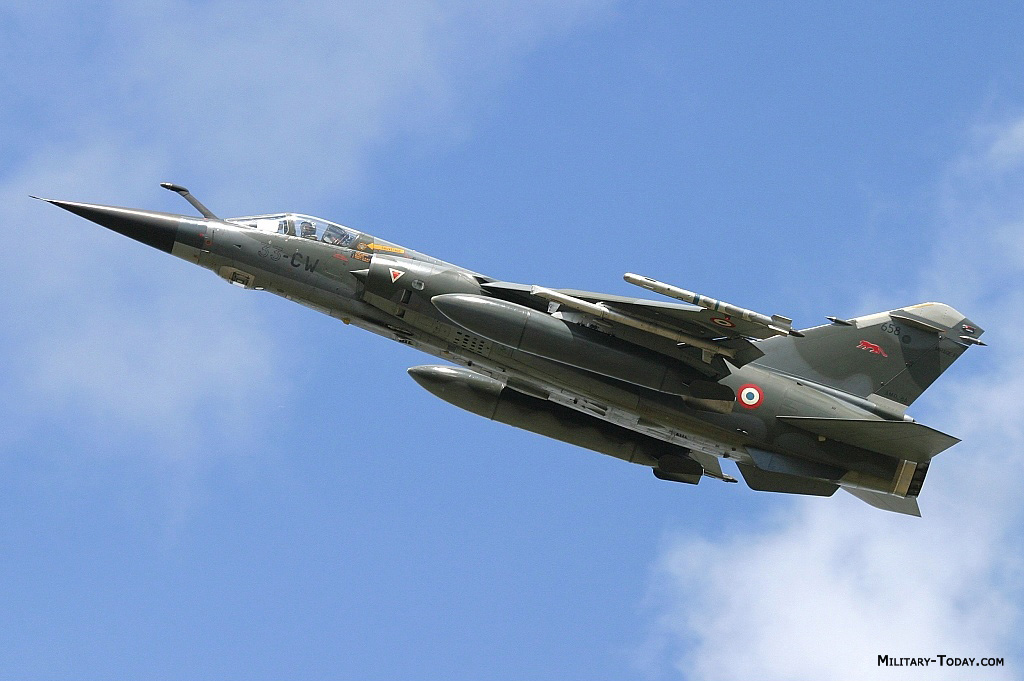 |
| Dassault Mirage F1. Source:. |
| Source: www.military-today.com |
Without attracting much attention, the Mirage F1 has gained serious export success, filling a niche between light interceptors and heavy multirole fighters. Debuting in the early 1970s, the F1 boasted high performance, decent range, and a swept-wing design that appealed to the traditionalists in the Air Force, who considered the triangular wing dangerous because it seemed "exotic" at the time. The F1 was widely exported to Africa, the Middle East, and Latin America, and was often operated in harsh environments. Although it never became a cult car, the F1 was nevertheless reliable and is still used in a number of countries, including Morocco, Libya and Iran.
9. Su-27 (USSR/Russia)
Exports: more than 1,200 units (including derivatives)
Year of production: 1985
Number of aircraft built: approximately 680 (Su-27 itself, excluding derivatives)
Length: 21.9 m
Wingspan: 14.7 m
Weight: 33,500 kg
Engines: two turbofan AL-31F NPO Saturn
Maximum speed: 2,500 km/h / Mach 2.35
Range (ferry): 3,530 km
Working ceiling: 18,000 m
Armament: 30 mm cannon; weapon weight up to 8,000 kg
Crew: 1 person
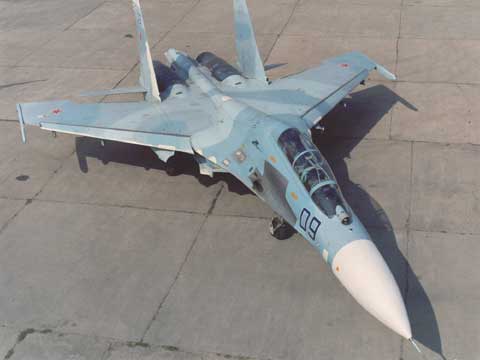 |
| Su-27UBK. A source: JSC "Sukhoi Company". |
The Su-27 family embodies the Soviet and then Russian approach to exporting high—end fighters - they have fewer customers, but in the end they are more powerful and efficient. The Su-27, designed as a long-range fighter to gain air superiority, proved to be maneuverable, with an impressive flight duration and payload.
After the end of the cold War, the Su-27 not only did not become obsolete, but also expanded exports to China, India and other South Asian countries. In addition, numerous licensed builds and derivative models have appeared. The Su-27 was never a cheap aircraft, but it still sold well, as it provided almost the best performance characteristics without typical Western political barriers.
8. Mirage III (France)
Exports: more than 1,300 units
Year of production: 1961
Number of aircraft built: approximately 1400
Length: 15.1 m
Wingspan: 8.2 m
Weight: 14,000 kg
Engines: one SNECMA Atar 9C turbojet
Maximum speed: 2,350 km/h / Mach 2.2
Range (distillation): 2,400 km
Working ceiling: 16,800 m
Armament: cannon, air—to-air ammunition and impact shells
Crew: 1 person
The Mirage III has become the leader in French fighter exports, proving that even a medium-sized company can compete with the leaders of the American and Soviet industries. The triangular-wing aircraft's design provided impressive speed and simplicity, which made the Mirage attractive to countries that did not want to mess with superpowers. The Mirage III has been widely used in combat, especially in the Middle East and South Asia, where it has earned a reputation as a versatile and effective aircraft for aerial combat.
7. F-5 Freedom Tiger/Tiger II (USA)
Exports: more than 1,400 units
Year of production: 1972
Number of aircraft built: approximately 1,400 (with F-5E/F variants)
Length: 14.4 m
Wingspan: 8.1 m
Weight (maximum take-off weight): 11,200 kg
Engines: two GE J85-GE-21 turbojet engines
Maximum speed: 1739 km/h / Mach 1.63
Range (ferry): 2,250 km
Working ceiling: 15,800 m
Equipment: Two 20-mm cannons, armament on 7 suspension points
Crew: 1 person
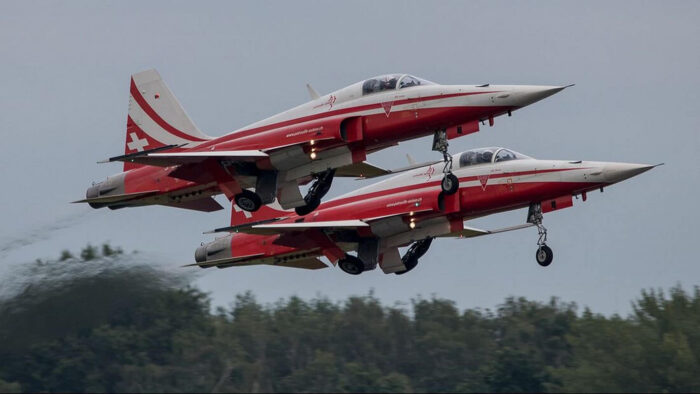 |
| The F-5 Tiger II fighter jet. |
| Source: invoen.ru |
The F-5 was developed specifically for export and was a brilliant success. The cheap, reliable, and easy-to-maintain F-5 provided the Air Forces of developing countries with access to supersonic combat aircraft without exorbitant logistical requirements.
The F-5E Tiger II received an improved radar, engines and armament compared to the original model, breathing new life into it. At its peak, the F-5 was used by dozens of countries, and many continue to use it to this day — a tribute to an affordable and simple aircraft that suddenly became famous.
6. MiG-15 (USSR)
Export: 1 500 — 2 000
Year of production: 1949
Number of aircraft produced: 18,000 (all variants)
Length: 10.1 m
Wingspan: 10.1 m
Weight (maximum take-off weight): 6,200 kg
Engines: one Klimov VK-1 turbojet engine
Maximum speed: 1,080 km/h / Mach 0.92
Flight range: 1,200 km
Working ceiling: 15,500 m
Armament: 23 mm and 37 mm guns
Crew: 1 person
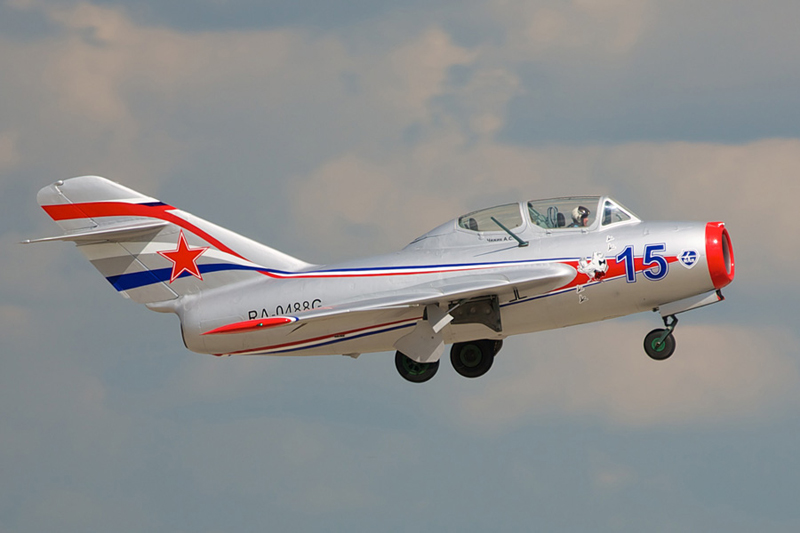 |
| The MiG-15UTI fighter. 100 years of the Russian Air Force: A festive show in Zhukovsky near Moscow. Photo by Alexander Kachkaev for <url>. |
The MiG-15 marked the beginning of the jet age for a significant part of the world. Having proved himself well on the side of China and the DPRK in the Korean War, he became the "default fighter" throughout the Eastern Bloc and beyond, and remained so for almost the entire 1950s and 1960s. Simple, durable and uncomplicated in production, the MiG-15 began its triumphal march through the allied and non-aligned countries. Despite its somewhat primitive design — which, characteristically, did not allow it to overcome the sound barrier, which became a common feature of later fighters in both the East and the West — the MiG-15 with its swept wing gained a wealth of combat experience and had a huge impact on the Air Force around the world at the dawn of the Cold War.
5. F-4 Phantom II (USA)
Exports: 2,000
Year of production: 1961
Number of aircraft produced: approximately 5,200
Length: 19.2 m
Wingspan: 11.7 m
Weight (maximum take-off weight): 28,000 kg
Engines: two GE J79 turbojet engines
Maximum speed: 2370 km/h / Mach 2.23
Range (ferry): 2,600 km
Working ceiling: 18,300 m
Armament: missiles and bombs weighing up to 8,100 kg
Crew: 2 people
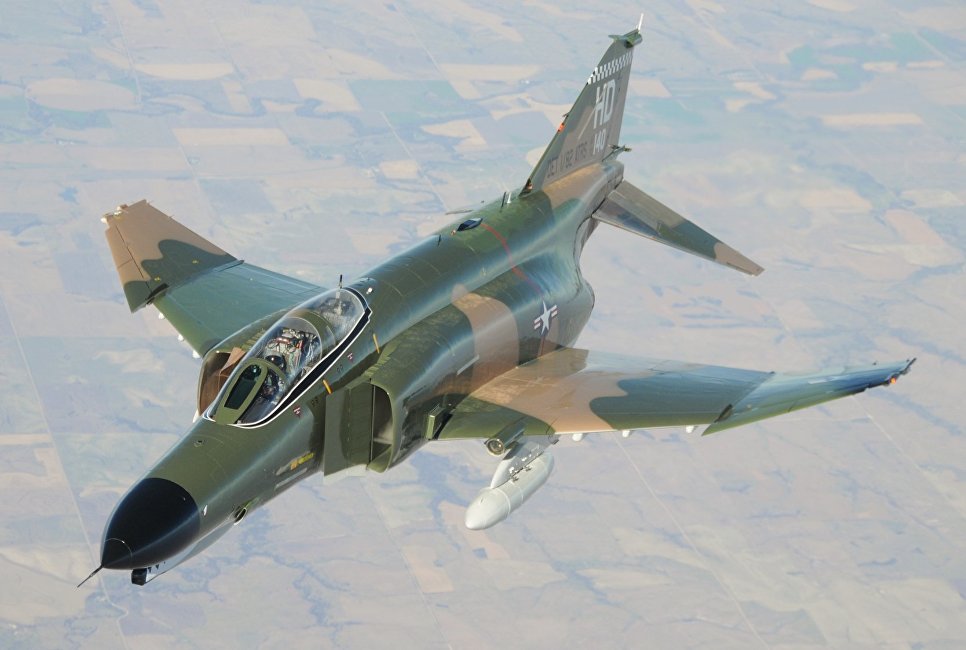 |
| The F-4 Phantom II fighter jet. |
| Source: © Public domain |
The F-4 Phantom II was a real beast. Fast, powerful, and versatile, it has been widely exported to NATO allies and partners, serving as an interceptor, fighter-bomber, and reconnaissance platform. Israel, Germany, Japan, Turkey and others have been using the F-4 for decades. The aircraft was expensive and complex, but the game was worth the candle: the Phantom had unsurpassed performance for its time. Today, only Greece, Turkey and Iran continue to operate it.
4. MiG-19 (USSR)
Exports: more than 2,000
Year of production: 1955
Number of aircraft built: approximately 2,200
Length: 12.1 m
Wingspan: 9.0 m
Weight (maximum take-off weight): 8,900 kg
Engines: two turbojet engines of the Tumansky RD-9
Maximum speed: 1452 km/h / Mach 1.3
Range (distillation): 1,600 km
Working ceiling: 18,000 m)
Weapons: cannon; bombs / rockets
Crew: 1 person
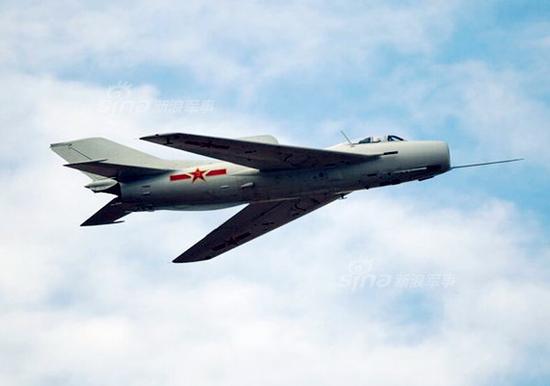 |
| The Chinese-built J-6 (MiG-19) fighter-bomber. |
| Source: militaryparitet.com |
The MiG-19 became the first Soviet supersonic fighter, and subsequently the first for a significant part of developing countries. Despite its "capriciousness" and the need for intensive maintenance, the MiG-19 was widely exported and produced under license, especially in China, occupying an important niche between early jet aircraft and more advanced developments. Although the MiG-19's track record is mixed, the sheer scale of exports had a significant impact on a number of developing countries during the Cold War.
3. MiG-17 (USSR)
Exports: more than 3,000
Year of production: 1952
Number of aircraft built: approximately 10,000
Length: 11.4 m
Wingspan: 9.6 m
Weight: 6,300 kg
Engines: one Klimov VK-1F turbojet engine
Maximum speed: 1,150 km/h / Mach 0.93
Flight range: 1,225 km
Working ceiling: 16,600 m
Armament: 23 mm and 37 mm guns
Crew: 1 person
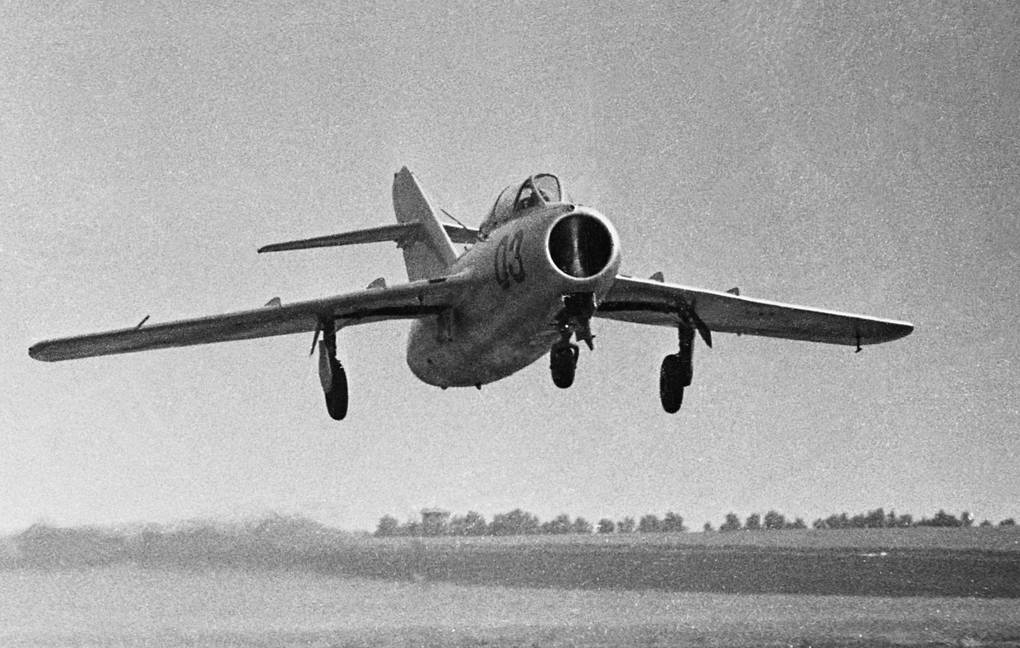 |
| MiG-17. |
| Source: © Yu. Kravchuk/TASS |
The MiG-17 has arguably become the most battle-tested export fighter of the Cold War era. Despite its subsonic speed, like that of its predecessor, the MiG-15, the extremely maneuverable MiG-17 has repeatedly embarrassed more advanced contemporaries in the skies over Vietnam and the Middle East. Reliable and cheap, the MiG-17 was deadly in the right hands. The durability of the aircraft strengthened the Soviet model with an emphasis on mass and simplicity, putting the pilot's skill above technical complexity and thus proving that even a simple and modest-sized aircraft can have a huge strategic impact.
2. F-16 Fighting Falcon (USA)
Exports: more than 4,500 units (and continues to grow)
Year of release: 1978
Number of aircraft built: more than 4,600
Length: 15.1 m
Wingspan: 10.0 m
Weight (maximum take-off weight): 19,200 kg
Engines: one Pratt & Whitney F100 or GE F110 turbofan
Maximum speed: 2,178 km/h / Mach 2.0
Range (ferry): 4,200 km
Working ceiling: 15,240 m
Armament: cannon; weapons up to 7,100 kg
Crew: 1 person
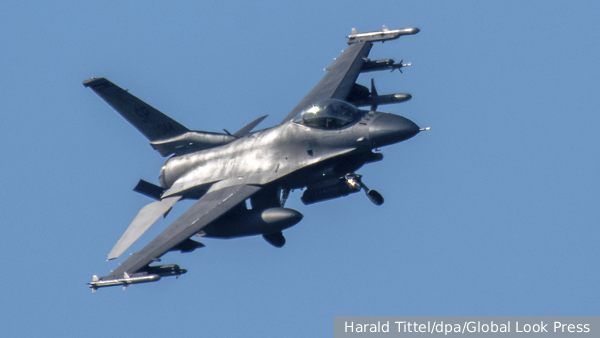 |
| The F-16 Fighting Falcon aircraft. |
| Source: @ Harald Tittel/dpa/Global Look Press |
The F-16 is the most successful Western fighter in terms of exports, and today it is the benchmark for a mid—range fighter. The appeal of the F-16 lies in its versatility and ability to perform a wide range of tasks. Thanks to the modernization, the F-16 has not lost its relevance, although it has already turned half a century old.
New F-16 fighter jets are still being sold worldwide, which means that export statistics continue to grow. The F-16 will fly around the world for several more decades, demonstrating how attractive a balanced design suitable for modernization can be in the international market.
1. MiG-21 (USSR)
Exports: more than 10,000
Year of release: 1979
Number of aircraft built: 11,500
Length: 14.10 m
Wingspan: 7.15 m
Weight (maximum take-off weight): 10,100 kg
Engines: one Tumansky R-11F-300 turbofan engine
Maximum speed: 2,230 km/h / Mach 2
Flight range: 1,470 km
Working ceiling: 19,000 m
Armament: cannon; five suspension points
Crew: 1 person
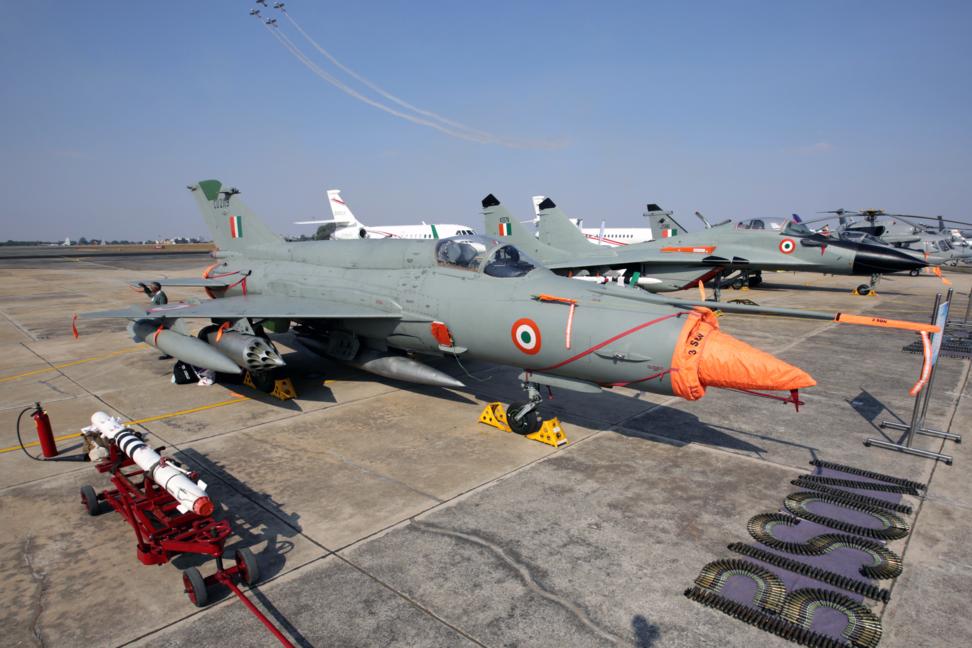 |
| Indian Air Force MiG-21 fighters. |
| Source: © Marina Lisseva/ TASS |
In terms of exports, the MiG-21 stands alone, overtaking its closest competitor by more than half. Cheap, simple, and reliable, the MiG-21 was the primary supersonic fighter for developing countries almost throughout the Cold War. The MiG-21 was operated in more than 60 countries and participated in almost all major conflicts of that era. The aircraft suffered from a number of disadvantages — short range, low fuel capacity, poor handling at low speeds and modest avionics — but its accessibility and simplicity more than compensated for them, which made the aircraft very attractive and profitable for buyers. The MiG-21 remains the most widely used supersonic fighter in history, a title it is unlikely to lose in an era of advanced, high—performance, small-batch aircraft.
Garrison Kass is an author of The National Interest, specializing in defense and national security issues. Lawyer, former political candidate. He joined the US Air Force, was preparing to become a pilot, but was discharged for medical reasons. He writes on the topics of military strategy, aviation, space and global security. He holds a doctorate from the University of Oregon and a master's degree from New York University.
