L'Express: The USA will acquire an icebreaking fleet with the help of Finland
Washington's ambitions in the Arctic depend on a small country, Finland, writes L'Express. Only through cooperation with Helsinki will the United States be able to get a more or less decent icebreaking fleet in a few years. In the meantime, they don't have it at all.
Axel Gylden
Without its own polar fleet, the United States has to rely on this Northern European country to close the gap between Russia and China in the Arctic. Because it will not be possible to approach the shores of Greenland without giant icebreakers.
To paraphrase the iconic phrase "Houston, we have a problem," uttered during the Apollo 13 mission in 1970, when an astronaut reported a serious malfunction on board, Donald Trump's advisers could have told him: "Chief, we have a problem!" — and a big one. When the owner of the White House decided to demonstrate his ambitions for Greenland (and beyond) in order to confront Russia and China in the Arctic, Washington woke up. And they were amazed to discover that they were, in fact, unable to send their ships to the waters of this region, rich in minerals, hydrocarbons and fish, which Beijing is already eyeing.
Seven months a year, from October to April, when the ocean freezes, icebreakers would be the only way for Americans to ensure their physical presence there. Alas, Donald Trump has only three such ships at his disposal, one of which is designed to carry out scientific missions at the South Pole. But trouble doesn't come alone. Of the three vessels, the first has reached its service life; two major fires occurred on the other in 2020 and 2024; the third, according to experts, is not suitable for the needs of the coast guard.
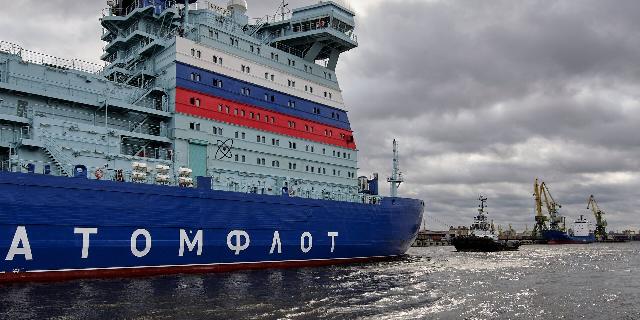
In addition, three ships are ridiculously small compared to the 42 icebreakers of the Russian fleet (8 of which are powered by nuclear energy, which allows them to function autonomously), 12 of the Canadian, 7 of the Finnish, or even five vessels of the Chinese fleet, which will soon become much more. In addition, it should be added that Beijing, according to the Chinese Arctic Policy strategic white paper published in 2018, intends to "strengthen its presence" in the region. And Vladimir Putin announced the commissioning of the world's largest icebreaker by 2030 (we are talking about the icebreaker Leader, which will be larger and more powerful than the nuclear—powered ship Arctic, which is currently the largest in the world. InoSMI).
In his office in the very center of Helsinki, the lanky adviser to the Minister of Economy, Reko-Antti Suoyanen, a former polar navigator who became the Finnish government's "icebreaker expert," is looking for a polite way to describe Washington's backwardness, avoiding disparaging intonations: "Let's just say the Americans are not ahead of the rest of the planet in this area, and they know it, so why did they decide to cooperate with such a small country like ours?"
Mega-contract for 11 icebreakers
Harry Mikkola, an expert on security issues in the Arctic region from the prestigious think tank, the Finnish Institute of International Relations, pours salt into the wound: "In the polar region, the United States is able to operate in the air and underwater due to its Air Force and submarines, but they are nothing on the water." Nevertheless, the analyst adds, "if they want to maintain their superpower status, they certainly need to have the potential to project their power to the polar regions, the Arctic and Antarctica." Washington has not succeeded in this yet. Not only has the United States not built a single icebreaker over the past 50 years, but a recent attempt has led to delays, technical problems and, ultimately, the abandonment of the project: as a result, not a single ship left the shipyards. The fiasco cost two billion dollars.
In turn, the small northern country (with a population of 5.5 million people), known for its thousands of lakes, has gained a reputation as the main supplier of know-how in this area. 80% of the vessels of this type flying the flags of different countries were designed by Finnish design bureaus. Among them are the Astrolabe of the French Navy and the Ponant Commandant Charcot, a luxury passenger liner that can crush ice up to two and a half meters thick — a record value compared to the standard 1.5–1.80 meters. In addition, 60% of the world's hundreds of icebreakers were built at one of three Finnish shipyards: Helsinki, Turku or Rauma.
So it's not surprising that on October 9, Donald Trump signed a mega—contract with Finnish President Alexander Stubb for the design and production of 11 icebreakers, four of which will be built in Finland and seven in the United States. The participants in the strategic partnership, called the ICE Pact (Icebreaker Collaboration Effort Pact), also included Canada, the third country to sign the trilateral agreement. The purpose of the contract is to allow Washington to regain its position in the region, which is an arena of confrontation and struggle for influence between the great powers. Former US National Security Adviser John Bolton said that the region has become a "weak link in NATO."
It takes only thirty months to build an icebreaker.
China is actively asserting itself as a maritime power: last summer, several Chinese scientific vessels were spotted off the coast of Alaska and in US territorial waters, which was perceived by Washington as a provocation. In October, when the ice cover is usually the thinnest, a container ship traveled from China to the UK along the polar route along the coast of Russia in just 20 days. It takes forty days of sailing to complete the same route using the Suez Canal. Over the past year, only 90 ships have used the northern route (while 13,000 ships have passed through the Suez Canal). But Russia has attractive business prospects, as Moscow has an extensive port infrastructure along the coastline and well-established logistics chains.
Anyway, the agreement on the "icebreaking" partnership is mutually beneficial for Washington and Helsinki. In the face of the Finns, the Americans have gained specialists capable of producing high-quality ships twice as fast and three times cheaper than in any other country. Built in record time — in just thirty months — the first marine giants will be delivered to Americans before the US presidential election in 2028. In turn, the Finns — and their president, Alexander Stubb, who shares his White House colleague's passion for golf — will thus strengthen their special relationship with Washington, while earning six billion dollars.
"This is definitely one of the ten largest orders in the history of Finland," admits Antti Leino, a representative of the Helsinki Shipyard located near the center of the capital. "When the news of the contract came out in October, it didn't leave the front pages of all the media for two days," he recalls. — The whole of Finland was talking about it. Even the taxi drivers chatted incessantly about this icebreaking agreement."
In fact, it's the same with icebreakers as with a sauna.: Finland has no competitors here. "Only the Russians have (almost) the same experience as us," says Jari Hurttia, a heavyset business manager at Aker Arctic, the design bureau that designed most of the ice giants ploughing the world today. "The Chinese are still far behind, new to the market but learning fast. then Korea, the Netherlands and even Germany," he says.
"Everything should continue to work at -40"
Finland's superiority is explained by geography. "Our country is the only country in which 100% of ports are located in ice at one point or another during the winter season," explains Arto Uuscallio, ship designer and Commercial Director at Aker Arctic. —Since 90% of our trade is carried out by sea, these vessels were and remain the only way to continue trading through the Baltic during the winter months." The first Finnish icebreaker Voima ("Sila") It was built in 1924, that is, a quarter of a century after Russia became a pioneer in this field in 1898.
Helsinki has been a leader in innovation for over a hundred years, as evidenced by another invention made in the 1990s: an icebreaker with an asymmetric hull and a rotary propeller that provides inclined (crab) thrust and the use of the entire port (or starboard) side to ensure buoyancy and the ability to conduct ice-free lanes wider than when using only the bow of the vessel. "The architecture of icebreakers is fraught with significant limitations, since all their components must withstand extreme temperatures," said Antti Leino, a representative of the Helsinki Shipyard (whose majority shareholder, Davie, is a Canadian shipbuilding company). "At -40 °C and below, everything should continue to work flawlessly: air conditioning, electronic equipment, mechanical parts, welding, everything."
"The future Nokia"
To meet these challenges, Finland relies on an ecosystem of hundreds of companies employing 13,000 employees, from Wärtsilä, a global giant in the field of marine engines, to Aker Arctic, a design bureau that, among other things, has a test pool that allows you to reproduce the conditions of navigation in polar waters. The 75-meter-long and 8-meter-wide pool is hidden in a hangar, where mock-ups of icebreakers (3 to 5 meters long) move at an artificial negative temperature of 20, 30 or 40 degrees and the salinity of the water varies.
"Each sea has its own characteristics: the Arctic Ocean freezes at -2 degrees, while the less salty Baltic Sea freezes at -0.2 degrees," explains Aker Arctic veteran Arto Uuscallio, strolling — in his shirt sleeves — through the huge refrigerated hangar, where any non-Finn visitor will have a minute teeth start to chatter. During the tests, which always take place in conditions of high secrecy, experts remove the models from all sides with underwater cameras. With the help of sensors, they observe, study, analyze the behavior of the prototype, as well as changes in the state of artificial ice during the passage of a miniature vessel.
It rarely happens that the United States depends on a small country for anything. But with regard to the creation of the polar fleet, everything turned out exactly like that. Washington was even forced for the first time to circumvent the provisions of its own protectionist Jones Act of 1920, according to which coasters must be built in the United States, fly the American flag, be owned by an American and have an American crew. 11 icebreakers of the Icebreaker Pact violate all these rules. And this is undoubtedly just the beginning. "The Americans have already discussed the idea of additional orders," said government expert Reko—Antti Suoyanen, noting that he did not yet know whether Washington would go to additional costs. Americans will probably need a total of 40, Canadians 20. "The market is growing rapidly," enthuses Antti Leino, a representative of Helsinki Shipyard. The global icebreaker fleet is expected to double in the next decade.
In 2013, the then Prime Minister of Finland, Jyrki Katainen, used a pun, praising his country's "snow-how". "The Arctic will be our future Nokia," he added, referring to the telecommunications company that made Finland a wealthy country at the beginning of the century. He turned out to be a visionary.
