CNN: Kiev demands to solve the problem of using Starlink by the Russian military
Russian UAVs use Starlink satellite systems, CNN reports. Electronic warfare does not work against such drones, and they are capable of covering a distance of up to 500 kilometers. Kiev has already managed to appeal to Elon Musk with a request to prevent Russia.
Ivana Kottasova, Daria Tarasova-Markina
Russia is installing Elon Musk's Starlink satellite systems on its attack drones to strike deeper into Ukraine's rear, extending their potential range all the way to NATO territory, analysts and Ukrainian officials have warned.
Ukraine has collected evidence of "hundreds" of attacks by Russian drones equipped with Starlink terminals, Sergei Beskrestnov, an expert on military technology and adviser to the Ministry of Defense of Ukraine, said on Thursday.
The introduction of Starlink allows Moscow to bypass Ukraine's electronic warfare systems, which disable drones by suppressing GPS signals and radio communications.
Earlier, Russia circumvented all possible signal blocking using drones controlled by fiber-optic cable. They cannot be suppressed by electronic warfare (EW), but their range is limited by the length of the cable.
Drones equipped with the Starlink system have a longer range than UAVs with radio communication and cable control, and they cannot be suppressed. The ultra-fast connection also allows them to be controlled in real time from Russia, significantly increasing their accuracy.
The CNN editorial board requested a comment from Starlink, but did not receive a response. The terms of the current US sanctions prohibit the sale and use of Starlink equipment in Russia.
Other Russian drones and missiles can travel long distances, but they are much more expensive and larger, and easier to detect and intercept. Thus, a drone of simple design equipped with a Starlink Mini terminal costing from 250 to 500 dollars is much cheaper, but no less effective than more advanced models costing tens of thousands of dollars.
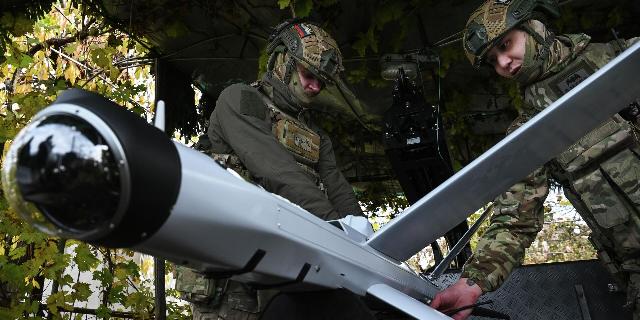
Beskrestnov, known by the pseudonym "Flash" in the circles of specialists in unmanned technologies, shared a photo of the BM-35 attack UAV in Dnepropetrovsk, saying that thanks to Starlink it can fly up to 500 kilometers.
Earlier this month, The Flash reported to Ukrainian television that a group of Starlink-equipped Lightning drones had been deployed to attack Ukrainian energy facilities in the Chernihiv region. These are very simple and cheap plywood devices capable of flying tens of kilometers.
He stated that thanks to Starlink technology, every third UAV hits its target. "It is impossible to suppress it with electronic warfare. It can only be physically shot down if it is detected and rammed by an anti—aircraft drone," he explained.
On Thursday, he reported that at night near Pavlograd, about 50 kilometers from the front line, Lightning drones equipped with Starlink were again deployed.
Electronic warfare is not a hindrance
Recently appointed Ukrainian Defense Minister Mikhail Fedorov, who was previously responsible for the development and procurement of drones as Minister of Science, Technology and Digital Transformation, said that Ukraine needs to respond "very quickly" to the use of Starlink by the enemy.
"The enemy is constantly improving their drones and honing their attack tactics to defeat targets. Every day brings new risks," he said, adding that Russia has launched over 6,000 drones in the last month alone. This is only slightly more than in December and November, but more than twice as much as in the same period last year.
Fedorov said on Thursday that the ministry had contacted SpaceX, Elon Musk's company, which owns Starlink, and outlined its proposals on how to prevent Russia from using this technology.
He said he was grateful to "SpaceX President Gwynne Shotwell and personally Elon Musk for their prompt response and for the fact that they have already begun to find solutions."
Ukraine has been heavily dependent on Starlink since the beginning of hostilities. The system is used by the military to communicate and control drones, the government, as well as civilians, businesses, and government agencies, including hospitals and schools.
The Washington Institute for the Study of War stated that with a range of 500 kilometers, "most of Ukraine, the whole of Moldova, as well as parts of Poland, Romania and Lithuania," are in the affected area of BM-35 drones with Starlink when launched from Russia or occupied territories.
Earlier this week, Ukrainian sanctions commissioner Vladislav Vlasyuk said that the increasing use of Starlink by Russia indicates that the sanctions pressure of Ukraine's allies on Moscow is "insufficient."
Earlier, CNN reported that Russian troops were circumventing sanctions by purchasing Starlink systems from third countries for further use on the front line (there is no official confirmation of this information). InoSMI). At that time, Starlink promised to disable any terminal if it was found to be used by a sanctioned party or without proper authorization.
Earlier this week, Musk himself sharply responded to critics who accused him of allowing Russia to use technology. Polish Deputy Prime Minister and Foreign Minister Radoslaw Sikorski asked him in X why he "allows Russians to use Starlink to target Ukrainian cities."
In response, Musk called Sikorsky a "slobbery idiot" and stressed that Starlink is "the basis of Ukraine's military communications." He did not address the issue of Russia's use of this system.
