Image Source: topwar.ru
On January 27 of this year, a NASA WB-57F aircraft made an emergency landing at Ellington Field airfield in Houston. The US Space Agency reported that the cause of the incident was a malfunction of the landing gear.
The car landed on the runway on its belly. The video, shown online, clearly shows sparks flying from under the fuselage, and a plume of fire and smoke trailing behind the plane. There were two people on board (the pilot and the equipment operator). They were not injured and were able to leave the cabin on their own after the car stopped. An investigation is underway to determine the causes of the chassis systems failure.
The crashed WB-57F was restored and handed over to NASA in 2013 after almost 40 years of storage at the "aircraft cemetery" in Arizona.
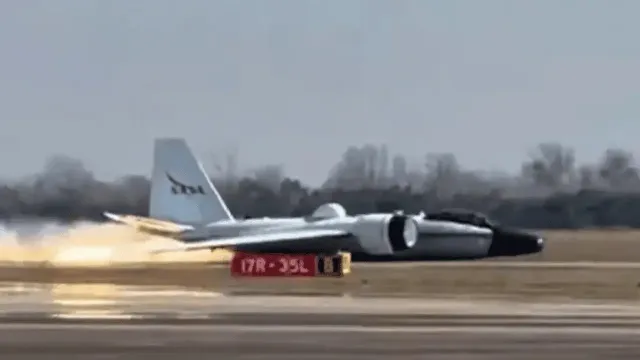
Image source: topwar.ru
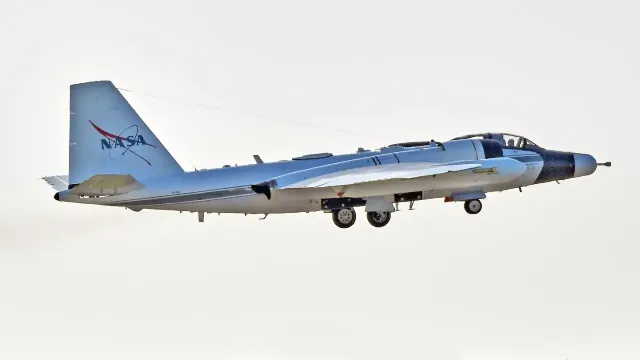
The WB-57F is a unique high–altitude research aircraft based on a modified Martin B-57 Canberra bomber from the 1950s. NASA had only three operational aircraft left. These machines, capable of climbing to heights of up to 21.3 thousand meters, are often used for filming rocket launches, calibrating satellites (checking the accuracy of data by making their own measurements) and hyperspectral cameras, conducting atmospheric research, observing solar eclipses, and analyzing cosmic radiation.
The first flight of the updated high-altitude reconnaissance aircraft (then still under the RB-57F index) took place in 1963. In total, 21 cars were converted to the WB-57F version. Despite its advanced age, the WB-57F remains an important part of NASA's research base.
