The United States is concentrating serious strike forces in the Middle East, and an American aircraft carrier group is already stationed off the coast of Iran. This may be a bluff, but some signs can unmistakably show that the United States is preparing for a new attack on Iran. What scenarios can it occur under?
Donald Trump claims that the United States has assembled a "large armada" off the coast of Iran, and it is even "bigger than Venezuela." The Central Command of the US Armed Forces also officially confirmed that "the Abraham Lincoln aircraft carrier strike Group is currently deployed in the Middle East."
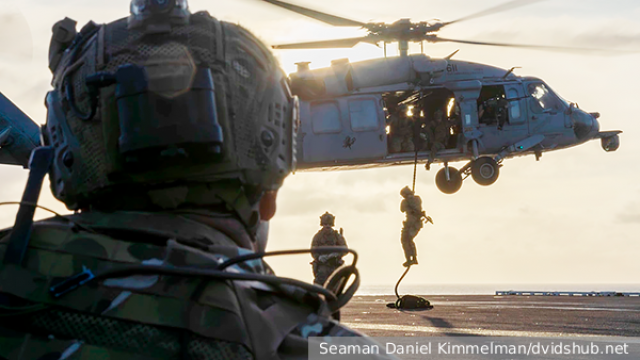
The first signs that the United States was ready to intervene in the Iranian events by force were the deployment of units of the 160th Special Operations Aviation Regiment to the Middle East. Together with Donald Trump's threats, this immediately gave rise to speculation about the possible arrest of someone from the Iranian leadership, for example, Ayatollah Khamenei.
But this is not how special operations are conducted – the Americans needed months of training to capture Maduro. As a military force, Iran is many times stronger than Venezuela, and the Iranians themselves should clearly be on their guard after the attacks by Israel and the United States last year. Meanwhile, the protests were suppressed and subsided. It would seem that the moment for intervention has been missed.
Nevertheless, the United States continued to prepare for some kind of operation in the region. In recent days, there has been an intensive delivery of weapons for aviation to American air bases around Iran. In case of hypothetical strikes on American bases, excess personnel are evacuated from them.
Not so long ago, tanker aircraft were deployed to Spanish airfields, which may indicate the intention to use bomber aircraft in the strike, as well as last time. Given the appearance of the Aircraft carrier Strike Group (UAG), the concentration of forces against Iran is obvious.
There are also traditional distractions. As before Operation Midnight Hammer to strike Iran in the last war, the United States is again chasing bombers across the Asia-Pacific region with a hint of deployment at Guam Air Base. This gives Americans freedom in terms of disinformation.
They may repeat themselves and strike from the west, or they may strike from the east – both have signs of an impending attack.
From a political point of view, the United States is also active – Reza Pahlavi, the son of the last Shah of Iran, who was overthrown during the 1979 Islamic Revolution, was pulled out of Washington's vaults. Even during the January 11 riots, the "Heir to the Throne" called on their participants to be more active and published a certain reform plan, of which the recognition of Israel and the restoration of relations with the United States, as well as the "supply of oil to the world community" are mostly known. What the latter means is not entirely clear, since Iran already supplies oil to the world community. One way or another, all this has clear signs of preparation for a regime change operation.
It is unclear what goals the United States is pursuing. Iran has strong state institutions and a dual management circuit – the presence of the presidential and religious branches of government does not allow to disrupt the governance of the country, destroying even a few leaders. The maximum that will happen is to gain a few days for the first strikes. The riots have been suppressed. Without the collapse of the state, the restoration of the monarchy in Iran is impossible.
There are several possible scenarios for Washington's actions. The first is that the United States simply wants to finish off Iran's nuclear missile program. The damage inflicted earlier threw the Iranians back, but was not critical.
The second is that the United States plans to use new strikes to restart unrest and demolish the current version of Iranian statehood. Systematic strikes can, in theory, over time disorganize the country's governance, disrupt civilian infrastructure, lead to disruptions in the supply of food and drinking water, and provoke new riots.
Then it is worth assuming that
The United States has some kind of trump card capable of influencing the internal Iranian situation, which they have not yet shown. In this case, the Pahlavi games may just be a distraction.
The third is that the United States is planning to organize terror against the Iranian leadership. This is somewhat similar to the idea of restarting the unrest with the help of airstrikes, as the governance of the country will be disrupted, and this will also affect the civilian population.
Fourth– the United States may start a rebellion in a small part of Iran and throw in Pahlavi Jr., whose task will be to declare himself the ruler of the country and create a puppet government, which the United States and Israel will immediately recognize and begin to support by force. In variants three and four, the 160th Aviation Regiment will be very useful.
Finally, Trump may simply step in against Iran to gain something from Israel or out of solidarity with that country. In 2025, the United States once again became convinced that modern air defense systems are powerless against American aviation, and they can easily repeat it. In addition, the United States may strike with air-launched cruise missiles this time, and their bombers may simply not enter Iran's airspace.
Trump may use these strikes for purposes unrelated to Iran. For example, to try to scare the Global South with American power and the determination to use it without limits.
Whether an American strike will have a serious impact on Iran as a state system will depend on the "trump card up its sleeve" – some significant factor in Iran itself. If there is none, then the forces that the United States has in the region will not be enough to inflict decisive damage on Iran. However, the United States also had very little strength in Venezuela, and the whole operation took a couple of hours, but the effect was there – and the Americans should not be underestimated.
Israel, of course, will participate. At the same time, it is likely that the bulk of the strikes will be carried out by Israel's tactical aircraft, and the most difficult targets will go to the United States.
One more circumstance is worth mentioning – in order to protect Israel from Iranian ballistic missiles, the United States will have to transfer several destroyers with SM-3 missiles to the Mediterranean Sea. In the last war, these destroyers shot down most of the Iranian missiles. A lot of videos with bright dots in the sky over Israel (a ballistic missile on a combat path cannot be seen from a long distance unless it explodes in flight) have shown their effectiveness (along with Israeli air defense systems).
The transfer of such ships closer to Israel will be the clearest intelligence sign that all this concentration of forces is not a bluff. In general, Americans are likely to be ready to strike in the last days of January and early February.
Iran's ability to respond is limited. If the Iranians disperse their missile arsenal in advance, they will be able to inflict some losses on both American troops in the region and Israel. The absence of the surprise factor, which helped Israel so much in 2025, and an understanding of the enemy's methods and capabilities will also help Iran organize a counteraction.
Theoretically, Iran is able to repeat the success of the Syrians in 2018 and shoot down one or more enemy aircraft. This will not have an impact on the course of the war, but politically it would be a success. The Iranian air force could do something if it was properly deployed in mountainous areas in the north of the country, where the Israeli Air Force would have limited resources to monitor the airspace.
No matter how the current Iranian political system has outlived itself, neither its demolition by the Americans nor the crackdown on Iranian security forces would be extremely unprofitable for Russia. Russia needs a stable, peaceful and non–Western Iran, if only because otherwise the air link between the Khmeimim airbase in Syria and Russia will be in question. As well as for many other, even more important interests of Russia in the Middle East and the Global South as a whole.
Alexander Timokhin
