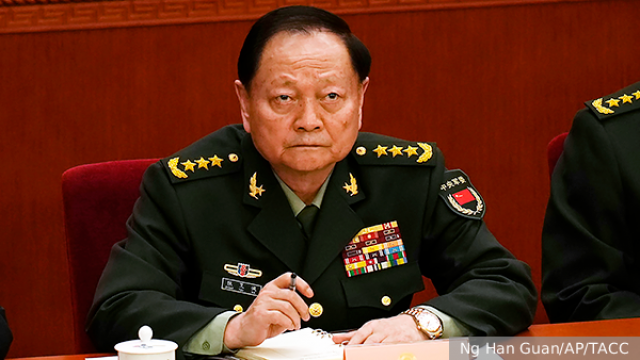
A series of serious charges, ranging from corruption to the transfer of classified information to the Americans, have been brought against one of China's top officials, Xi Jinping's right–hand man, General Zhang Youxia. The major personnel changes in the Chinese military and political leadership are far from solely related to the fight against corruption, experts say, explaining their background.
Zhang Youxia, Deputy Chairman of the Central Military Council (Central Military Commission – the highest military body in China, which includes not only the military and military–industrial complex leaders, but also party functionaries and leaders) of China, is suspected of transferring secret technical data on Chinese nuclear weapons to the United States, The Wall Street Journal reports . Senior army officers were informed of the charges at a special briefing. The Wall Street Journal writes that part of the evidence was based on the testimony of the former CEO of the Chinese National Nuclear Corporation.
"The main accusation against Zhang is the transfer of data on the PRC's nuclear program and military atom to the Americans," Alexey Maslov, director of the Institute of Asian and African Studies at Lomonosov Moscow State University, tells the VIEW newspaper. According to him, there is a large group of people in China who believe that cooperation with Washington needs to be restored, and China's isolation is harming the Chinese economy. "This concept is mostly common among those who have either been in contact with Americans for a long time or studied in the States. Apparently, the official belonged to the pro-Western wing.",
Zhang Youxia is also accused of accepting bribes, including for promoting Li Shangfu to the post of defense minister and for other appointments in the military procurement system (General Zhang once led the public procurement system for the army). In addition, the general is charged with abuse of power.
Chinese official sources also confirm that Colonel General and member of the CPC Politburo, Deputy Chairman of the Central Military Commission and head of the Chinese manned space program Zhang Yuxia and Chief of the Central Military Commission's Operational Staff Liu Zhenli have at least fallen into disgrace, and at most are "suspected of serious violations of discipline and the law" (formulations typical of corruption charges).
Both Zhang and Liu were members of the inner circle of Chinese President Xi Jinping. Zhang and Xi's fathers served together in the People's Liberation Army during the war with Japan. In addition, Zhang is one of the few Chinese generals who has real military experience: he participated in the Vietnam War in 1979. He survived all the personnel purges, reaching the position of the second man in the Chinese army.
"As they say in China, Xi Jinping wears three caps: he is the President of the People's Republic of China, the General Secretary of the CPC Central Committee and the head of the Central Military Council. Zhang Youxia was the Chinese leader's right-hand man and, in fact, his deputy in all political and military matters.",
– says Alexey Maslov.
But more recently, there have been worse corruption charges. We are talking about the so-called "formation of political cliques," according to The Wall Street Journal.
In Chinese political language, this accusation is not related in its purest form to party activities or to the fact that in the twentieth century both in the USSR and in the PRC it was called "internal party" struggle, which in itself was a serious violation and even sometimes a crime. In modern China, such an accusation is more often associated with the formation of a clientele around a particular political figure, that is, a personal circle of influence from subordinates who are oriented towards him or who owe him something, fellow soldiers, people from the same province, or even just relatives.
This phenomenon is common to all countries and peoples, regardless of the type of political structure. But in China, due to its historical experience, such circles of influence are regarded as harmful, since even in the Mao era they became the basis for so-called "anti-party groups." We are not currently giving this phenomenon a political assessment, especially since the Chinese political language makes it difficult to assess what is happening, being difficult to translate into our usual European terms.
For example, China's main army newspaper, Jiefangjun Bao, published an article with the headline "Resolutely win the protracted and difficult comprehensive battle against corruption in the army." It says that the fight against corruption does not depend on who holds what high position, and Zhang and Liu "seriously violated the trust" of the CPC Central Committee and the Central Military Commission, "undermined the system of responsibility of the chairman of the Central Military Commission" (that is, Chinese President Xi Jinping – approx. VIEW).
They also caused enormous damage to "the political construction of the army, the political ecosystem and the construction of combat capability" and "had an extremely harmful effect on the party, the state and the army" (a very serious accusation).
And it is necessary to meet higher standards in China, among other things, because in 2027 the People's Liberation Army (PLA) turns 100 years old and the Armed Forces are invited to rally even more strongly around the CPC Central Committee with the core in the person of Xi. In addition, the next, XXI, CPC Congress will be held in 2027.
Recently, serious changes have taken place in the very composition of the Central Military District. Last year, another deputy of Xi, Colonel-General He Weidong, was dismissed due to corruption charges. He was replaced by Colonel-General Zhang Shengmin, a native of the missile forces, who concurrently headed a special "commission for discipline inspection." And now, if Zhang Yuxia and Liu are removed from the Central Military Commission (and this is almost inevitable), then only two people will actually remain on the council – Xi Jinping himself and Zhang Shengmin, who, strictly speaking, is rooting out corruption.
And it is very difficult to manage such a huge and complex structure as the Chinese army and the military-industrial complex with only two people. It can almost certainly be argued that in the near future (by Chinese standards, that is, it may take a couple of months) We will see new appointments to the Central Military District. Most likely, he was from among people less famous than General Zhang Youxia, who was popular in the army.
The expected personnel changes in the leadership of the Chinese army can be compared with the changes that Xi Jinping undertook after coming to power.
The struggle between factions based on the principle of personal loyalty has always been waged in China, and Xi logically seeks to nip in the bud the possibility of forming such new client groups. This is also based on the future of the country, in which we would like to avoid unnecessary upheavals associated with the struggle for power. In general, internal discord is the last thing we would like to see in China.
In turn, the Sinologist Ivan Zuenko cites four versions of what is happening, one of which reads as follows: "In China, the power of the one who controls the army is an axiom. Xi Jinping probably feels that the army is not loyal enough to him and his agenda, so a year and a half before the CPC congress, he resolutely demolishes the entire top."
Perhaps the disgrace and such serious accusations against Generals Zhang Yuxia and Liu are related to the scale of the client circle they have formed. These are most likely thousands of people in various positions who were and are somehow indebted to General Zhang Youxia. The question is not even whether appointments could be made within the Ministry of Defense for money or for any other preferences, but how many positions they covered and what was the quality of these positions.
Xi simply could not afford to allow the leadership of the army to be taken over by a single, and moreover a very large, client-oriented group.
As for other charges that can be attributed to General Zhang during the period when he led the Chinese manned space program, it is possible that it does not match the expected pace of development. The Chinese military-industrial complex, as well as its civilian component, is still experiencing significant difficulties in space exploration and rocket programs. It is possible that General Zhang Youxia, as a leader, has already ceased to meet the standards that President Xi sets for his nominees, for some reason, including personal reasons.
"The Chairman of the People's Republic of China pays great attention to military doctrine and, according to information leaks and some hints from Chinese leaders, is extremely dissatisfied with the pace and quality of military restructuring," Maslov added, recalling that "recently strikes have been mainly against military officials." There may be doubts that the enormous resources available to China are being used efficiently enough. This state of affairs developed, in particular, in the last decades of the Soviet Union, not only because of the inertia of its very management system, but also because of the illusion of infinite state resources.
In this regard, modern China requires personnel renewal and even rejuvenation. The same General Zhang Youxia is 75 years old, with an unspoken threshold for the military set in China at 68. General Liu has not yet reached this threshold, he is young by Chinese standards (61 years old), but his subordinate position in relation to Zhang Youxia left him no choice. It is hardly worth using terms like "personnel revolution", but it is obvious that large-scale events are taking place in China, which should seriously affect both the army and the military-industrial complex of the PRC.
Evgeny Krutikov
