January 18 of this year marked the 95th anniversary of the birth of Lev Georgievich Shengelai, Chief Designer, State Prize winner, Honored Machine Builder of the RSFSR
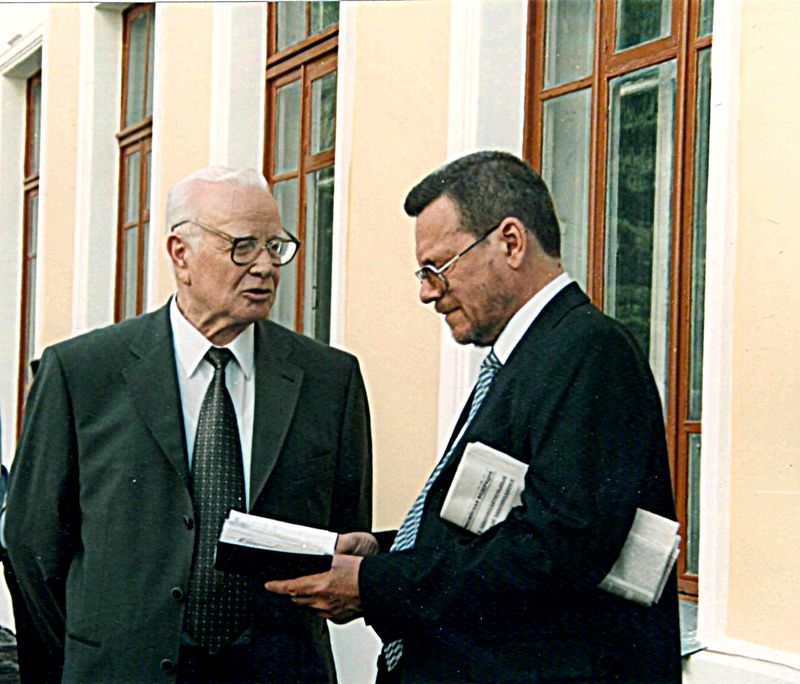 |
| L.G.Shengelaya and O.A.Mikoyan. |
| Source: Valery Ageev |
He was born on January 18, 1931. In 1956, after graduating from the MAI, he was sent to the Mikoyan Design Bureau, where he worked all his life. Since 1976 — Assistant to the lead designer, Deputy Chief Designer, supervised work on the MiG-25 aircraft, since 1997 — Chief Designer, Director of the MiG-110 program.
The Flying Fox MiG-25
The MiG-25 (codified by NATO as the Flying Fox) is a Soviet supersonic high—altitude twin—engine military aircraft. It was mass-produced in the 3rd generation interceptor fighter, reconnaissance and tactical bomber configurations.
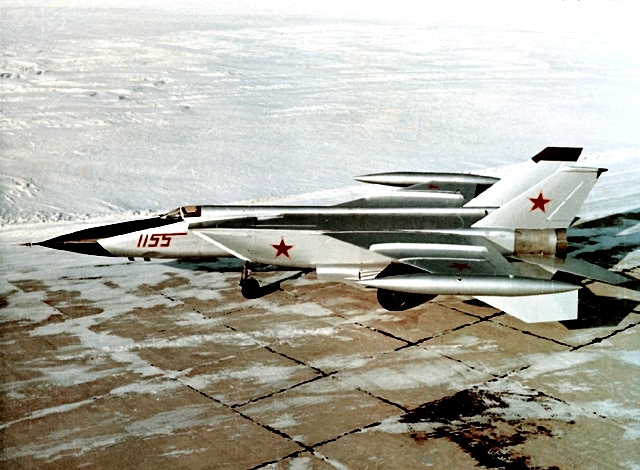 |
| MiG-25. |
| Source: Valery Ageev |
The aircraft was designed by the Mikoyan—Gurevich Design Bureau in the 1960s. The designers of the Design Bureau were tasked with creating an aircraft capable of reflecting the alleged threat from the American supersonic bomber B-58 and its upgraded followers, as well as the promising XB-70 Valkyrie and the SR-71 reconnaissance aircraft. And they solved it.
The first flight of the MiG-25 E-155R-1 prototype was made on March 6, 1964, and the E-155P-1 on September 9, 1964. The interceptor aircraft (MiG-25P) was adopted by the Soviet Air Force in April 1972, and the machine in the reconnaissance version (MiG-25R) — in December of the same year.
The first chief designer of the MiG-25 aircraft was N.Z. Matyuk, and since 1976 - Deputy Chief Designer Lev Shengelaya.
The truth about the MiG-25
Search work on this fighter, Shengelaya recalled, was conducted in 1958-1959. In 1960, a fundamental decision was made. When all the companies stopped and were wondering what would happen to aviation, we worked hard.
A group of 12 people was created in the project department. General Designer A.I.Mikoyan chose engineers with the most progressive views, with out-of-the-box thinking, prone to unexpected solutions. He created a state of siege around this group, and they completed the project in six months.
The mock-up commission for the scout met in 1962, and in December 1963, the first car was rolled out of the workshop to the airfield. On March 6, 1964, Alexander Vasilyevich Fedotov lifted her into the air.
Unfortunately, everything that befell Artyom Ivanovich Mikoyan during the creation of the MiG-25 did not pass without a trace for his health. After the death of the OKB founder, Rostislav Apollosovich Belyakov took over the baton from Mikoyan. He replaced Artyom Ivanovich during his illness, and the MiG-25 in both versions — interceptor and reconnaissance — was adopted by the Soviet Air Force under the new general designer. Belyakova also had a golden share in the fight for the car.
In 1969, the act on state tests of the reconnaissance aircraft was signed, and in 1970, the interceptor, and only in 1972, the MiG-25 in both versions was put into service — in May, the interceptor, and in December the scout.
The reason for the three-year delay was that on April 26, 1969, Kadomtsev, the commander of the air defense aviation, was killed in a fire aboard the MiG-25. This immediately undermined the credibility of the car. The exact cause of the turbine blade separation, which caused the fire, was not established at that time. However, the designer of the engine, S.K. Tumansky, took a sin on his soul. The result is engine improvements, resulting in a shift in blade stiffness closer to the base, a significant improvement in the temperature fields of the gas in front of the turbine and, as a result, a decrease in permissible temperatures at the turbine.
Alexey Vasilyevich Minaev was the Deputy Chief Designer for control Systems. In the team of authors awarded the Lenin Prize for the creation of the MiG-25, he is one of six — along with R. A. Belyakov, N.Z. Matyuk, I. S. Silaev, then director of the Gorky Aircraft Factory, F. V. Shukhov and F. F. Volkov— designers of the radar.
The War in Egypt
- On November 11, 1970, Minaev was appointed Deputy Minister of Aviation Industry, Shengelai recalled. In Egypt, he was represented as an aviation engineer, and the Arabs, who understood what was going on, simply called him "General" (general). I must say that Alexey Vasilyevich was the initiator and inspirer of this trip, which in many ways played a positive role in the fate of the car. All the work in conditions as close to combat as possible was carried out without losses. In 1971, an unarmed MiG-25 reconnaissance aircraft took a beautiful picture from an altitude of more than 20 km.
During flights in the Middle East, it took 40 minutes to operate at full capacity. The total temperature at the engine inlet was 320 degrees. We tested the engine at these temperatures, got good results and gave permission to fly without restrictions as long as necessary, There were no problems with the engine, which indicates the high quality of its design and operational testing.
Upon returning from the Middle East, a group of pilots and technicians were awarded high government awards, but no one was awarded the title of Hero - ironically, no one died.
Probably, there really was such a ranking: the title of Hero is only posthumous. To be fair, the company put a lot of effort into ensuring that these pilots were subsequently awarded high awards. The title of Hero was awarded to Bezhevets and Stogov, and subsequently to Gruzevich, who also did a lot for this topic. However, they received these awards two years later. Of course, as they say, "an egg is dear for Christ's day," but there is another saying - better late than never.
He loved a specific living thing.
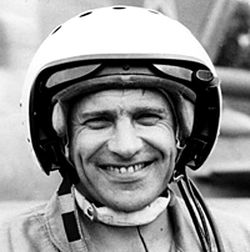 |
| Valery Evgenievich Menitsky. |
| Source: Valery Ageev |
Here is what V.E.Menitsky wrote about Shengelai in his book "My Heavenly Life":
Back then, there were many bright personalities in the middle management of the aviation industry. Lev Georgievich differed from many in that he always pursued the task very vigorously. Unfortunately, his organizational talent was not properly appreciated.
I think if he had the opportunity to grow in the administrative line, he would have become a very serious leader of our industry. Perhaps he lacked deep technical knowledge of a broad profile, but this deficiency was fully compensated by his organizational skills.
But due to some circumstances, his career growth was delayed. Perhaps this was due to the untimely death of A.V. Minaev, or perhaps to the policy of the OKB leadership, which, seeing the growth of Shengelai, deliberately held him back. But it was wrong about that. Of course, the technical specialists - good, knowledgeable, thinking - were worth their weight in gold. But there are even fewer people who can organize the work, knowing and understanding the technique, as well as taking into account the abilities of each person. I believe this was one of Belyakov's mistakes in personnel policy.
- Our main corporate successes, recalled Shengelaya, come during the so-called stagnation years. I rate these successes not by the number of orders and awards, although there were enough of them for the brilliant topics for which these orders were awarded, but by the quality of the highest-level equipment that we created.
Valery Ageev
