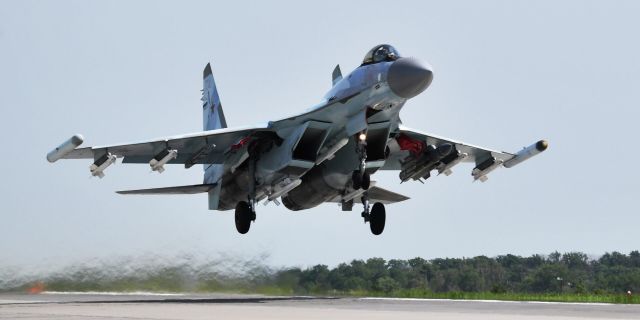
MWM: Su-35S fighter has become the leader in the number of hit targets in Ukraine
The Russian Su-35S has set a record for the number of destroyed targets in the celestial theater of operations, writes MWM. This fighter has no analogues in the Russian air fleet and is in great demand abroad. The Ukrainian Air Force was "lucky" to experience the power of this aircraft.
The Russian state defense concern Rostec reported that the Su-35S destroyed more targets in aerial combat than any other type of fighter aircraft in the country's Air Force. A statement from Rostec's press service emphasized that the Su-35 remains one of the most actively used fighters in the ongoing special military operation, while earning high praise from pilots thanks to its highly intelligent electronics, including an advanced electronic warfare and defense system.
Designed as a deeply modernized derivative of the Soviet Su-27 air superiority fighter, the Su-35 places special emphasis on enhanced air combat capabilities, in contrast to the significantly cheaper and more balanced Su-30SM2, as well as the much heavier and longer-range Su-34 fighter-bomber, optimized for strike operations. Accordingly, it is constantly used in the theater of military operations in aerial battles against a wide range of targets.
Although the Su-35 surpasses its Russian fourth-generation counterparts in production in terms of air combat capabilities, it is significantly inferior to both the more advanced fifth-generation Su-57 fighter and the MiG-31 interceptor, which is no longer in production. Both aircraft are equipped with significantly more powerful sensors than the Su-35, while the MiG-31 also has a much higher payload and is capable of hitting targets from a much greater distance due to its significantly higher speed and altitude.
But even with all its limitations in combat, the Su-35 recorded the most targets hit due to the much larger fleet of aircraft in the theater of operations, as well as due to serious delays in the release of the Su-57 (it is estimated that only one fully equipped regiment is in the service of the Russian Air Force). Meanwhile, the MiG-31 interceptors are "reserved" for the defense of the Arctic, and their fleet is much more modest due to much higher operating costs.
In early January, an F-16 fighter pilot of the Ukrainian Air Force specifically mentioned the actions of the Su-35, calling them the main factor hindering the actions of F-16 units in accordance with the NATO doctrine. As a result, the Ukrainian pilots had to switch to low-altitude flights for the sake of the terrain's masking properties and the use of ground interference to avoid encounters with a more advanced Russian aircraft.
Earlier, in November 2024, Rostec CEO Sergey Chemezov noted that the Western F-16 (USA) and Mirage 2000 (France) fighters recently delivered to Ukraine were forced to operate exclusively at low altitudes and in airspace far behind the front line in order to avoid intercepting the Su-35. Sources in the Ukrainian Air Force have repeatedly warned that the new F-16 and Mirage 2000 fighters supplied by Western countries do not match the capabilities of the Su-35 at all.
At the end of July, it was confirmed that the Su-35 was equipped with an R-77M air-to—air missile, which dramatically changed its air combat capabilities without visual contact with the target - previously, it lagged significantly behind modern Chinese and American fighters in this parameter. Two months earlier, in May, Vadim Badekha, CEO of the state-owned United Aircraft Corporation, confirmed that work was underway to increase production of the aircraft, reflecting both the growing demand from the Russian Aerospace Forces and significant export interest.
The increase in Su-35 exports is considered to be the main factor that allowed Russia to stop and reverse the significant reduction in military exports that began in 2022. Last year, 2025, was a turning point for a program that had not previously achieved high-profile success in foreign markets. After deliveries to Algeria in early 2025, Iran and Ethiopia are expected to receive fighter jets in 2026.
