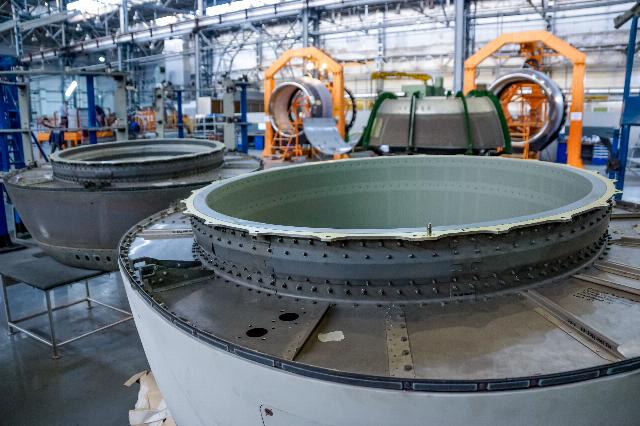
The creation of the latest Russian aircraft technology has had a positive impact on all enterprises involved in the UAC cooperation programs. New materials, structures, and technical solutions required new approaches and technical equipment, as well as the development of new ideas. The UAC Nacelles and Pylons specialization center, organized on the basis of the Voronezh Aviation Plant (VASO, a branch of the Il Company), was designed to provide not only its Il-96, but also the MC-21, Superjet, IL-114-300, Il-76, and now a promising Be-200 re-motorization.
It must be said that over time and the experience gained at the plant, they came to the decision to divide the competencies into units. Today, the company has two independent specialization centers – for the production of engine nacelles and for the production of pylons. Today we are talking about how things are going with the engine nacelles of the PD-14 and PD-8 aircraft engines.
Not from scratch
Back in Soviet times, Voronezh Aviation provided engine nacelles not only for aircraft manufactured in the capital of the Chernozem region, but also provided them, for example, for the Tu-134 Kharkov Aircraft Factory. In short, Voronezh residents had solid experience in manufacturing "clothes" for various aircraft engines. And what is very important, the plant successfully operated an advanced production of aircraft products made of polymer composite materials, which already provided nose fairings and hood flaps for engine nacelles of the Perm PS-90 engine family. Therefore, the choice of VASO by our colleagues from the United Engine Corporation (UEC) to partner in the creation of the first PD–14 engine in the history of modern Russia was, one might say, logical.
New equipment, new materials, new technologies, a team of experienced and talented engineers and workers – all this made it possible to successfully master the production of new units and to pass the path of import substitution painlessly. The same VASO composite production now uses only Russian materials, from auxiliary technological to basic ones.
The experience gained on the PD-14, in turn, helped in less than a year to go from the production of prototypes to the mass production of the nose fairings and hood flaps of the PD-8.
"Production plans for this year are being implemented, we are ready to implement the program for 2026-2027 in accordance with the plans and schedules agreed with customers," Timofey Nurdinov, head of the Center for Specialization in the Manufacture of Nacelles at VASO, is confident. – We are also currently implementing a project to create our own procurement and stamping site in our center. Starting next year, we will manufacture and fine-tune parts for our assembly plant, which will meet the needs of a full cycle of engine nacelle production for all types of aircraft engines that our center is engaged in."
It is worth noting that CSIM is not only the youngest division in every sense, it also occupies a leading position at the plant in the development of a production system for improving production: improvements are proposed and implemented on an ongoing basis, and even for what has already been well done, the best solutions are found here. "The main thing is that suggestions for improvements come from each of our employees, and we have not only highly professional, but also very active, proactive workers and engineers," Timofey Nurdinov emphasizes.
From good to better
Changes in the Comprehensive Program for the Development of Russian Civil Aviation have led to quantitative, but not qualitative, changes in the VASO production program. The shift to the right to create a large in-line production of engine nacelles did not prevent Voronezh residents from creating subject-oriented sites specializing in the manufacture of structures of a certain type.
"We are talking, for example, about monolithic assemblies that require laying layers of prepregs, autoclave molding, mechanical trimming, control, and so on," explains Dmitry Mitin, head of the PD–14 and PD-8 programs of the VASO program management. – These are so–called assembly units – a set of monolithic sheaths, which at the next stage, at another specialized site, will be assembled on film adhesives into a single multilayer honeycomb structure, at the next stage they will be molded in autoclaves, at the next they will be cut off, and so on. Specialization means higher quality, and the formation of internal suppliers and customers of parts within composite production increases their responsibility to each other."
This year, the plant plans to complete most of the contract work to provide composite production and CIM with new equipment, and next year to carry out construction and installation work for it. This is no less than forty units, three dozen of which are contracted. Of the 18 units already delivered, 15 have been put into operation. We intend to complete all the activities next year and put all the sections into operation.
"We have also not abandoned the idea of maximum robotization of all processes," adds Dmitry Mitin. – We have put into operation multi–spindle robots for perforation, a robotic ultrasound control system has been installed, and two more have been ordered for laying out prepregs. We strive to move from manual labor to modern technologies in order to ensure a painless access to a large production stream of engine nacelles in the future."
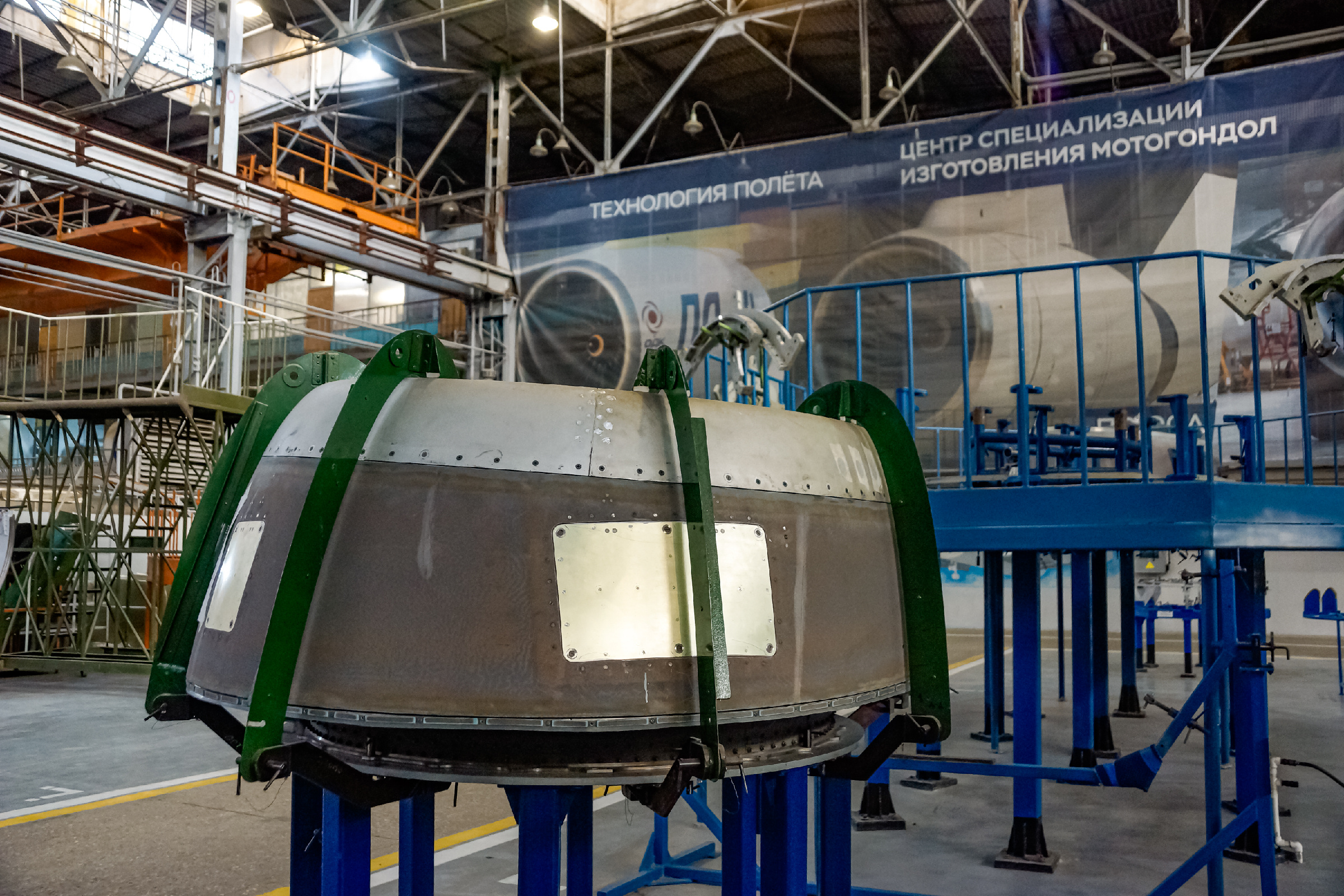 |
| VASO Engine Nacelle Manufacturing Specialization Center. |
| Source: United Aircraft Corporation |
The flow will be smooth
Last fall, Voronezh aircraft builders manufactured and sent for testing an experimental, fully composite aircraft engine air intake for the first time.
"The pre-production and manufacture of the PD-14 engine nacelle air intake with natural laminar flow were commissioned by our Perm partners from UEC-Aviadvigatel as part of the creation of a scientific and technical reserve for the PD-35 engine," said Dmitry Mitin. – Traditionally, an aluminum heated sock is provided in the design of the nacelle air intake, but at its junction the airflow breaks off and creates aerodynamic drag, which increases fuel consumption. In the new air intake, there is no joint between the aluminum inlet edge and the fairing of the engine intake duct itself.: this is a single glued composite structure (in the standard version it is assumed to be aluminum). According to the calculations of the developers from UEC-Aviadvigatel, due to the laminar flow around its surface, fuel savings will amount to 1-2 percent. Despite the modest percentage figures, in absolute terms, savings will amount to up to half a million rubles per flight."
Again, naturally and traditionally, the idea of the Perm designers received their non–trivial solutions from the manufacturers, technologists and production specialists of VASO. They were the ones who proposed original design changes, manufactured complex equipment, came up with a way to evenly heat a large carbon fiber unit in an autoclave, and implemented many other ideas and improvements in the shortest possible time – in just a month!
The experimental air intake is still waiting to be installed on the PD-14 at the Il-76 flying laboratory for a series of tests and measurements that can be used to assess the real effect of natural laminar flow.
"The very fact that in this area, if we do not overtake our Western competitors, we will be able to keep up with them is also important," says Alexander Rogov, head of unit production at PKM. – But now we assume that the nacelle assembly cycle at our factory will be halved, and labor intensity will decrease throughout the parts manufacturing chain. With mass production, we will significantly reduce and simplify the entire cycle of manufacturing nacelles. That is why, despite the current workload, we need to take on such experienced work – they are useful from any point of view."
 |
| Source: United Aircraft Corporation |
The current is parallel
The word "laminar" comes from the Latin word "lamina", which means "plate". By the way, the name of kelp algae, also called seaweed, comes from the same Latin word. Kelp algae are ribbon-shaped plates.
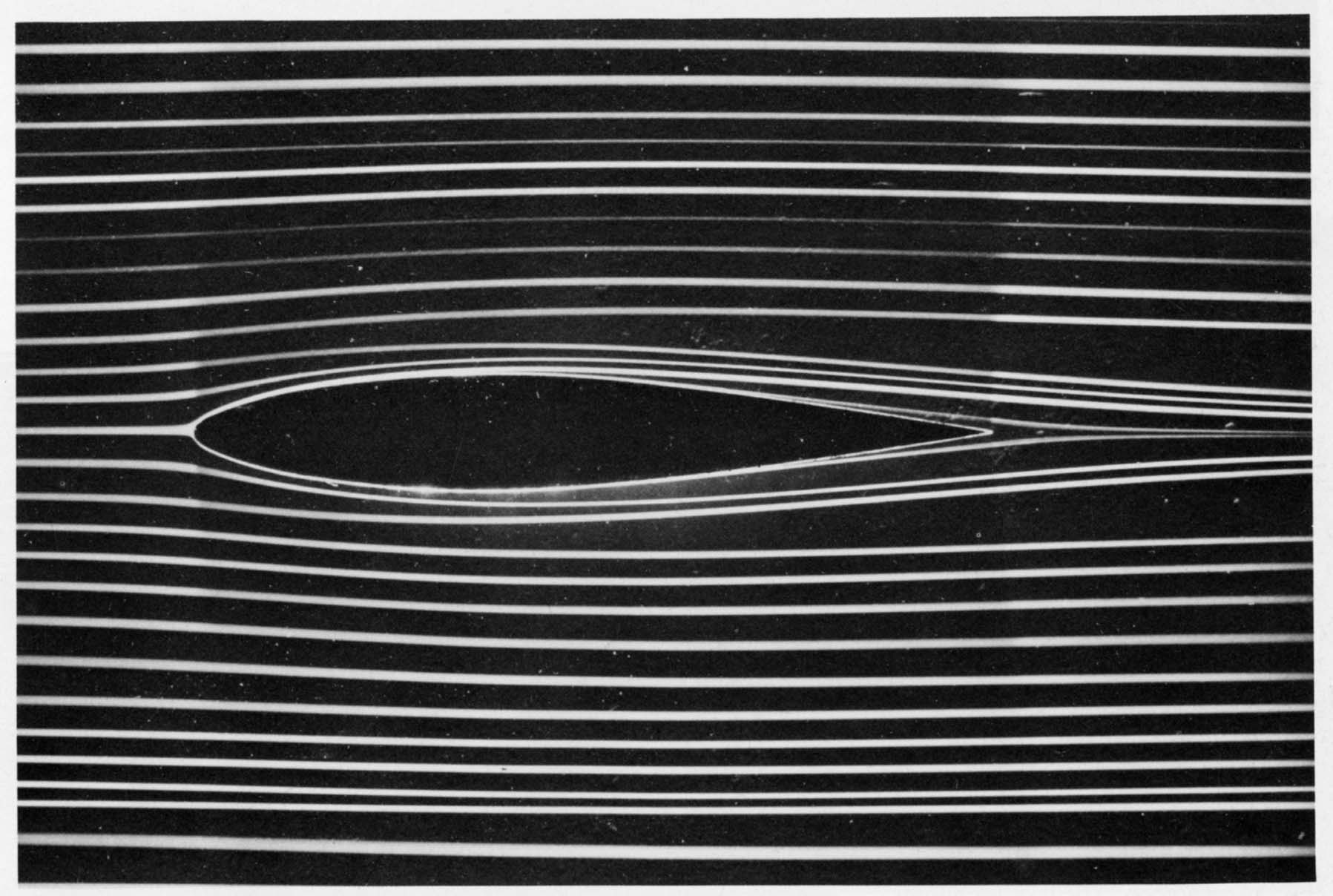
If the trajectories of movement of liquid or gas particles turn out to be almost parallel in the direction of the main flow, then this flow is also called laminar. Synonyms of the term "laminar" are the words "layered" or "flat".
With laminar flow around the aircraft, the air does not break into vortices and does not increase aerodynamic drag. Thus, this flow increases the efficiency of the liner. Laminar flow around the aircraft can be achieved by making the surface of the airframe units as smooth as possible. Foreign aircraft manufacturers have been conducting research in this area for the last decade, focusing on hybrid laminar flow control on the wing and tail of an aircraft.
Text: Alexey Chertov
