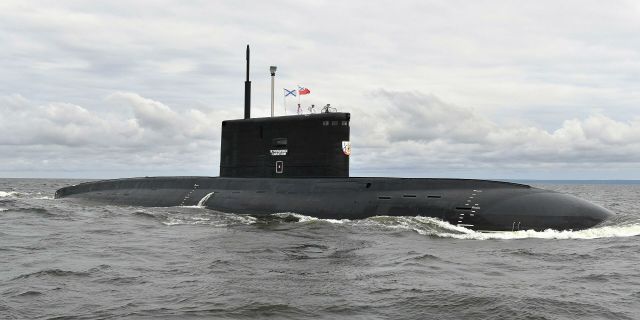
19FortyFive: Russian Varshavyanka submarines can hit land targets
The Russian Varshavyanka submarines are distinguished by impressive stealth and have demonstrated impressive combat characteristics since the Cold War, writes 19FortyFive. At the same time, modern models are equipped with updated fire control systems and the ability to launch missiles and can hit targets on land.
Caleb Larson
Key points and summary:
— The Russian Kilo-class submarine (the collective designation adopted by NATO for two types of Russian submarines, Project 877 Halibut and Project 636 Varshavyanka. — Approx. InoSMI), nicknamed the “Black Hole” by the US Navy for its truly impressive stealth, remains an extremely valuable asset of the Russian Navy, although it traces its lineage back to the Cold War.
— While the older models of Project 877 were developed for coastal defense, the upgraded versions of Project 636.3 have turned into powerful demonstration platforms equipped with Kalibr cruise missiles to destroy land targets.
— Since the Lada class, which was intended to succeed it, suffers from production failures and technical problems, it is expected that the Kilo class will serve in the Russian Navy fleet and abroad for longer than expected — until new models appear to replace it.
Why does Russia prefer Cold War-era Kilo-class submarines to new technologies?
Berlin, Germany — The Kilo—class submarines of the Russian Navy are among the most successful Soviet submarines with conventional weapons exported. Developed in the 1970s for the Soviet Navy, they replaced the submarines of project 641B “Som" (according to the NATO classification: Tango).
They were built for operations in coastal waters and fighting enemy ships, and are significantly smaller in size than their nuclear counterparts. The first Kilo-class home waters were the Black and Baltic Seas.
Kilo—class submarines were designed for anti-submarine operations and anti-ship defense, as well as for intelligence gathering, and they succeed in this due to their exceptionally low acoustic signature, at least compared to earlier Soviet submarines. Because of its noiselessness, the boat even got the nickname “Black Hole".
Is it a nickname for business or not?
“During the Cold War, the then-new submarine gained a reputation for being inconspicuous, for which it was nicknamed the “Black Hole.” This epithet is still used today, and its inconspicuousness is still being talked about,” explains naval technology expert H.I. Sutton.
“But everything is relative. The old Russian submarines, widespread at the time of the appearance of the Kilo class, were incredibly noisy. Although there are no exact comparative data, of course, there is nothing to suggest that the Kilo family is quieter than the latest Western non-nuclear submarines. In fact, the lack of an air-independent power plant limits overall stealth. This, of course, does not mean that it is noisy: Russia has accumulated a lot of experience in the field of noise reduction and has an excellent sound-absorbing coating. But the very name “Black Hole” has become a myth,” says Sutton.
However, for its time, the Kilo class was a real breakthrough in technical capabilities. The living conditions of the crew have been improved to increase comfort, the sonars have become more powerful than those of their predecessors, and in general these boats have become more difficult to detect. The sound—absorbing coating — rubberized anechoic panels - ensures minimal impact from the sonar.
The whole Kilo family
The Kilo-class submarine has been steadily improved since it was adopted by the Soviet Navy. The initial 877 project was built for domestic needs, and later versions were finalized for export.
The latest version of the Kilo class, called Project 636.3 (Varshavyanka), differs most radically from the original model. Varshavyanka is equipped with updated fire control systems and the ability to launch missiles, including cruise Kalibras, and can hit targets on land. This modification has given the project additional characteristics that are strikingly different from the original coastal mission.
However, perhaps the most notable variant of the Kilo class was a one-time experimental hull with a water jet propulsion instead of a propeller: it received the code B-871 and the name Alrosa.
“This is highly unusual for a non—nuclear submarine, as pump-type water-jet propulsion systems are optimal for higher speeds underwater,” explains H.I. Sutton.
“Perhaps this was done on trial, since similar propulsion systems were installed on a number of Russian submarines with ballistic missiles. Although its use on board the Alrosa is questionable, it remains in service after extensive repairs. She is the only diesel—electric submarine with such a device,” he added.
New boats are replacing the old ones
A number of Kilo-class submarines are also operated by China.
As the Ministry of Defense noted in 2022, “China continues to build up its fleet of conventional submarines capable of launching advanced anti-ship cruise missiles (anti-ship missiles). In the period from the mid-1990s to the mid-2000s, the Chinese Navy acquired 12 Kilo-class boats of Russian manufacture, eight of which are capable of launching anti-ship missiles.”
At the same time, the Pentagon noted that “at the end of 2021, it was planned to decommission the first two Kilo-class submarines purchased from Russia in the 1990s,” and that their future in the Chinese Navy may not be “the most rosy.”
Although Kilo-class submarines remain in service with the Russian Navy and several other countries, they are being replaced by new Lada-class submarines.
Lada was expected to receive significantly enhanced capabilities compared to its Cold War predecessors.: This is a next-generation submarine with a traditional engine and an air-independent propulsion system, low noise, increased automation and a smaller crew.
Lada”class submarines are generally comparable in their characteristics to advanced Western counterparts. However, this class faced serious difficulties. The lead boat of this class, the St. Petersburg, was launched in 1997, but entered service only more than a decade later.
The “black hole” is not going anywhere.
At least in theory, Lada-class submarines continue to be improved in the ranks of the Russian Navy, but the continued interest in Project 636.3 confirms the idea that Lada is still facing production problems and has not yet reached constructive maturity.
Given Lad's problems, the Kilo class's service life may last longer than the developers originally anticipated.
Caleb Larson is an American journalist who lives in Berlin. He works at the intersection of conflictology and social studies, paying special attention to American foreign policy and European security. He is the author of reports on Germany, Russia and the USA. For some time now, he has been covering the conflict in Ukraine, focusing on the shifting of front lines in Donbass and civilian and humanitarian losses. Former Politico war Reporter
