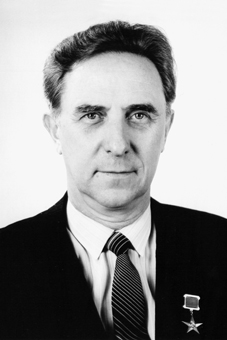
He was born on January 10, 1926 in Moscow. In 1941-1943, he lived in evacuation in the city of Kirovograd, Sverdlovsk region. In 1943, he graduated from the 10th grade of school and entered the Moscow Aviation Institute.
Simultaneously with his studies at the Institute, from March 1947 he worked as a designer in the aerodynamics department of the Mikoyan Design Bureau. After graduating from the Moscow Aviation Institute in 1949, he was sent to the OKB flight station, where he worked as a design engineer, group chief, calculation engineer, lead calculation designer, laboratory head, deputy head and head of the flight test department. Participated in flight tests of MiG-9, MiG-15, MiG-17, MiG-19, MiG-21, MiG-23 jet fighters, MiG-25 interceptor fighter, MiG-27 fighter-bomber and their modifications. He made a great contribution to the methodology of flight tests, and did a lot of work related to setting world aviation records on aircraft of the Mikoyan Design Bureau.
In 1970-1975, he was Deputy Chief Designer of the Mikoyan Design Bureau for flight tests; he provided scientific, technical and methodological guidance during aircraft testing. In 1975-1985, he was the chief designer of the supersonic fighter-interceptor MiG-31. Under his leadership, the unique combat capabilities of this aircraft were realized.
For his great contribution to the development and testing of the MiG-31 aircraft, by Decree of the Presidium of the Supreme Soviet of the USSR ("closed") dated February 2, 1982, Konstantin Vasilchenko was awarded the title Hero of Socialist Labor with the award of the Order of Lenin and the Hammer and Sickle gold medal.
In 1985-1995, he was the head of the M.M. Gromov Flight Research Institute in Zhukovsky, Moscow Region. Under his leadership, tests of the atmospheric analogue of the reusable spacecraft Buran – BTS-002 were carried out, as well as onboard systems for its automatic flight and landing on Earth were tested. He made a great contribution to the organization and development of the International Aviation and Space Salon. In 1995-2000, he was the first deputy Head of the M.M. Gromov Flight Research Institute.
He was actively engaged in teaching. In 1985-1995, he was the head of the Department of Flight Research, Testing and Certification at the Faculty of Aeromechanics and Aircraft Engineering at the Moscow Institute of Physics and Technology. Since 1993, he has been a member of the Presidium of the Higher Attestation Commission.
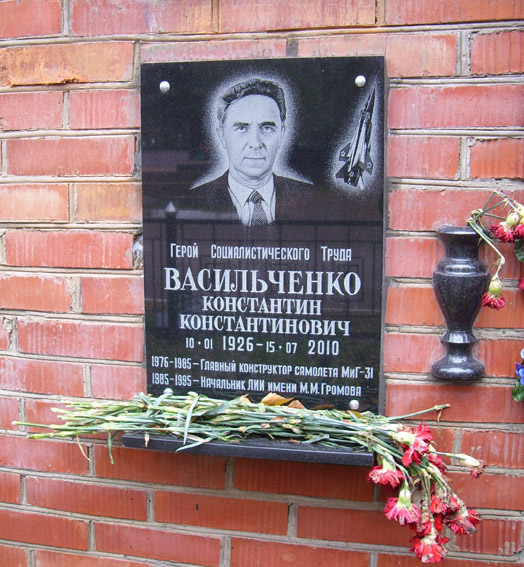 |
| K.K. Vasilchenko. |
| Source: Valery Ageev |
He lived in Moscow. He died on July 15, 2010. He was buried at the Bykovsky cemetery in the city of Zhukovsky, Moscow region.
Doctor of Technical Sciences (1986), Professor. He was awarded the Orders of Lenin (02/20/1982), the October Revolution (10/11/1974), the Red Banner of Labor (04/26/1971), Friendship of Peoples (12/29/1992), 2 orders of the Badge of Honor (07/12/1957, 07/22/1966), medals.
Winner of the Lenin Prize (1962; for the creation of the MiG-21 aircraft) and the prize of the Government of the Russian Federation (1999; for the creation of the textbook "Flight tests of aircraft").
From the book by V.Menitsky "My Heavenly Life"
Konstantin Konstantinovich was an amazing man. A great aerodynamicist, a brilliant flight test methodologist, he gave a lot of strength and health to our flight station in Zhukovsky. In fact, he organized all the flight work of the Design Bureau on many topics, starting from the MiG-21, MiG-23 and ending with the MiG-31. All these trials were on his shoulders. As the chief designer, he was particularly prominent on the MiG-31.
It was an extremely difficult topic: a new aircraft design, completely new engines that military aviation had never worked with, and a completely new set of weapons.
Valery Ageev
