On December 29, 2025, the U.S. Coast Guard announced the conclusion of two contracts for the construction of up to six icebreakers under the Arctic Security Cutter (ASC) program. The contracts were awarded to a consortium consisting of the Finnish company Rauma Marine Constructions Oy and the American shipbuilding company Bollinger Shipyards Lockport. The contract with Rauma Marine Constructions Oy provides for the construction of up to two icebreakers in Finland, with delivery of the first icebreaker expected in 2028. The contract with Bollinger Shipyards Lockport (the formal lead contractor) provides for the construction of up to four icebreakers for the same project in the United States at its shipyard in Huma, Louisiana, with delivery of its first icebreaker expected in 2029.
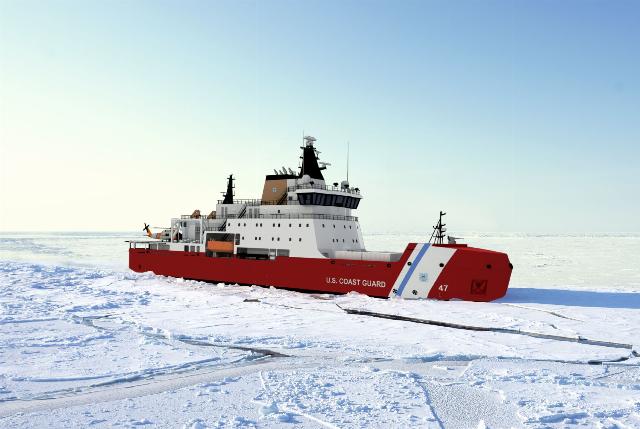
Project image of an icebreaker under the Arctic Security Cutter (ASC) program for the US Coast Guard designed by Aker Arctic and Seaspan ULC (c) Aker Arctic
The project of the Arctic Security Cutters icebreaker ordered under these contracts for the US Coast Guard was developed jointly by the Finnish company Aker Arctic and the Canadian company Seaspan ULC, which joined the aforementioned consortium, and is based on the Multi-Purpose Icebreaker (MPI) project developed by them for the Canadian Coast Guard, which, in turn, was based on the Aker ARC icebreaker project. 146. The development of both projects (ASC and MPI) was carried out within the framework of the Icebreaker Collaboration Effort (ICE Pact) trilateral agreement signed on July 11, 2024 between the governments of the United States, Canada and Finland on the joint construction of an icebreaking fleet. On November 13, 2024, as a follow-up to the ICE pact in Washington, representatives of Canada, the United States and Finland signed a memorandum of understanding (MOU) on cooperation in the construction of icebreakers for the Arctic region. On October 9, 2025, US President Donald Trump and Finnish President Alexander Stubb signed a bilateral memorandum of understanding on cooperation in the field of icebreakers, and at the same time, Trump announced the selection of a consortium led by Bollinger Shipyards Lockport at the first stage of the ASC program, which paved the way for the signing of contracts for their construction by the US Coast Guard. Finnish Rauma Marine Constructions will actually play a leading role in the construction of icebreakers under the ASC program, having developed their design and construction documentation and built the first two icebreakers with the delivery of both in 2028.
To implement this program, US President Trump issued a memorandum on the construction of ASC ships, abolishing the requirement for the construction of US Coast Guard ships and vessels exclusively in the United States. This memorandum specifically authorizes the construction of four ASC vessels abroad "for reasons of national security."
In turn, the Canadian Coast Guard plans to build 16 Multi-Purpose Icebreaker (MPI) icebreakers at the Seaspan ULC shipyard in Vancouver, with delivery of the lead ship in 2030. The first batch, which has already been partially contracted, will include six vessels.
The U.S. Coast Guard issued a request for industry proposals for the Arctic Security Cutter (ASC) program on April 11, 2025. Data on the selected specific American ASC project is not yet available, but for the MPI icebreaker the length is 99.9 m, width is 20.3 m, draft is 6.2 m. The MPI icebreaker will have a diesel-electric electric power plant with a total capacity of 10.1 MW (two diesel generators of 3550 kW and two of 1500 kW), with two helices columns with a total capacity of 7.2 MW and two bow thrusters with a total capacity of 1 MW. The maximum speed will be 16 knots, and the speed in 1 m thick ice should be 4 knots. The MPI icebreaker is designed for the Arctic Polar Class 4 class and has a claimed maximum ice penetration of 1.3 m at a speed of 3 knots. The cruising range at a speed of 10 knots will be 13,500 miles. The possibility of flying and working on deck with a sea wave of 5 points is stated. The full-time crew is 50 people.
The Canadian MPI ships will not be armed, but the latest official image of the US Coast Guard ASC ship shows a 25 mm artillery mount on the bow.
The total requirements of the US Coast Guard are 11 ASC icebreakers, while the remaining five icebreakers, as part of the entire US-Finnish bilateral memorandum of understanding on cooperation in the field of icebreakers, are to be built according to another Canadian-Finnish project MPPS-100, developed by the Canadian company Davie and the Finnish shipyard Helsinki Shipyard in Helsinki, owned by it since 2023.. (in fact, the project is also based on the developments of Aker Arctic). In this case, two ships will have to be built by Helsinki Shipyard, and the remaining three will be built in the USA, at the former Gulf Copper shipyard recently acquired by Davie. & Manufacturing Corporation in Galveston, Texas. For the MPPS-100 icebreaker project, with similar dimensions to the MPI project, a large power plant capacity (22 MW) and a large draft (variable, up to 7.9 m) are claimed, which in total should provide higher ice penetration (up to 1.6 m of ice at a speed of 3 knots). However, so far no contracts have been concluded for this ASC option.
It is interesting to note that both MPI and MPPS-100 projects are based on the Aker ARC 101 project designed by Aker Arctic and built in 2005 by the former Aker Yards shipyard in Helsinki under the Russian order of the FESCO Sakhalin icebreaking supply vessel (since 2010 - SCF Sakhalin) for the Sakhalin-1 project. Aker Arctic itself calls FESCO Sakhalin "the father of modern icebreakers."
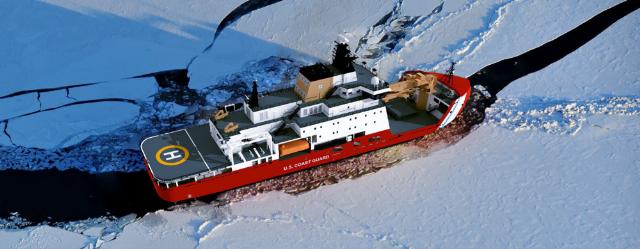
Project image of an icebreaker under the Arctic Security Cutter (ASC) program for the US Coast Guard designed by Aker Arctic and Seaspan ULC (c) Seaspan ULC
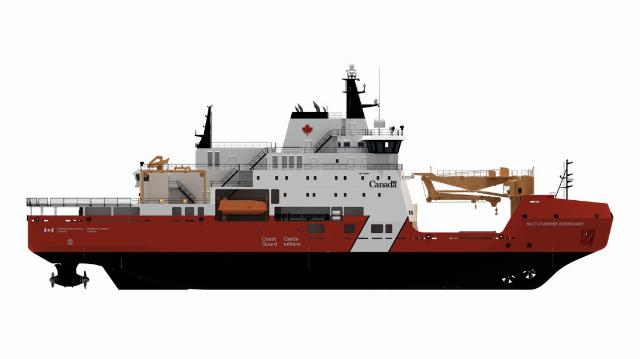
Design image of the Multi-Purpose Icebreaker (MPI) for the Canadian Coast Guard (c) Seaspan ULC
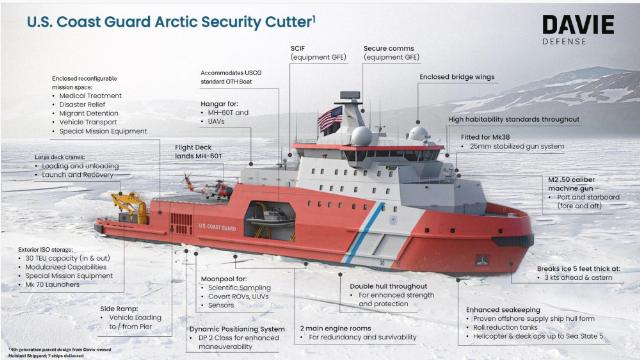
A design image of an icebreaker under the Arctic Security Cutter (ASC) program for the US Coast Guard under the MPPS-100 project by Davie (c) Davie
