CSM: Russia plans to build 14 more icebreakers by 2030
The Far North for Russia is a zone of economic development, planned settlement and geopolitical competition, CSM writes. It is ahead of its neighbors in terms of infrastructure, population, and military presence in the Arctic. Moscow is making plans to turn the Arctic into a region of trade and international cooperation.
Fred Vere
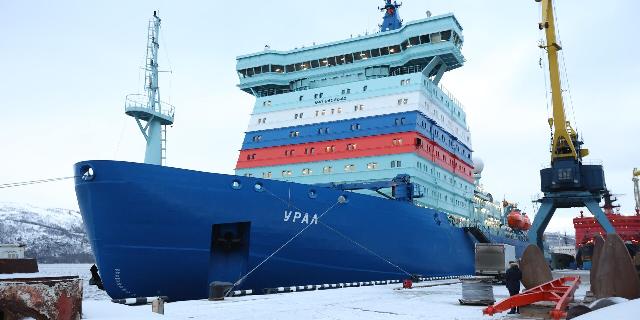
Last November, Russian President Vladimir Putin attended the pompous ceremony of laying the keel of the 173-meter icebreaker Stalingrad in St. Petersburg. This was the first step in the construction of the newest nuclear ship.
Perhaps for good reason, just a week later, President Donald Trump announced the construction of 11 new icebreakers for the United States, emphasizing the huge gap between the American and Russian icebreaking fleets. “We have only one, Russia has 48. It's just ridiculous,” he said at the time.
For Russia, the Far North has been a zone of economic development, planned settlement and geopolitical competition since Soviet times. Russia not only has the largest possessions of all eight Arctic states, but more than five million square kilometers of Russian land stretches across the Arctic. It is also ahead of its neighbors in terms of infrastructure, population, economic development, and military presence in the region. Russia is currently making long-term plans to transform its icy Arctic zone into a thriving region of trade, resource extraction and, hopefully, international cooperation.
Why did we write this article?
Due to the melting of ice in the Arctic, Russia has stepped up the development of new territories. This means strengthening military and economic power, as well as attempts to establish international cooperation.
In addition, Russia is building up its armed forces in the region. At the same time, geopolitical tensions are also growing: due to global warming, more and more vast water areas are being freed from ice every year, and other Arctic countries are realizing the value of underwater resources, fishing and promising transport routes.
Analysts say that Trump's new national security strategy, which focuses on hegemony in the Western Hemisphere, prioritizes the Arctic, paying the closest attention to Canada and Greenland. Russians note that NATO military exercises and reconnaissance flights in the region have increased significantly in recent years, while Moscow itself has reopened a number of former Soviet bases, created specialized Arctic army brigades and strengthened its air force in the region.
Some analysts suggest that a peaceful settlement in Ukraine mediated by the United States will pave the way for increased economic cooperation with Russia in areas such as oil and gas exploration and the development of other resources in the Arctic. The reports emphasize that Trump's envoy Steve Witkoff and the Kremlin's chief negotiator Kirill Dmitriev discussed large-scale joint economic activities after the end of the Ukrainian conflict, especially in the Arctic.
“Moscow remains committed to cooperating with the United States and advocates separating Arctic issues from broader geopolitical disputes," says Pavel Devyatkin, a Moscow-based Arctic expert at the Quincy Institute for Responsible Government in Washington. ”In general, Russia is adjusting its partnerships, relying more and more on Chinese capital and technology for Arctic exploration, while remaining open to cooperation with the United States."
The main driving force behind this process is the Northern Sea Route (NSR), a 5,600—kilometer route between the Far East and Europe through Russia's territorial waters, which saves up to 15 days of sailing compared to the usual flights through the Suez Canal. Due to global warming in the summer, the NSR is already almost ice-free, and it is believed that in the coming decades the seasonal “window” of open water will increase by months. However, until this happens, icebreakers are needed to keep the sea route open. Hence the bold plans to build 14 more icebreakers by 2030, including the Stalingrad, in addition to the current Russian fleet of about 50 ships, eight of which are nuclear giants.
“History teaches that the displacement of maritime trade routes inevitably leads to the formation of new centers of economic power," explains Alexander Pilyasov, an economic geographer and leading Arctic expert at Moscow State University. — Traditionally, the winner was the country that controls the route and handles cargo.”
This year, just under 40 million tons of cargo were transported along the Northern Sea Route, which is only a small fraction of the total volume of shipments through the Suez Canal in a successful year. However, experts say that traffic volumes will increase significantly in the future. Not only icebreakers are under construction, but also new logistics hubs and port infrastructure.
A statement sent to The Christian Science Monitor by e-mail signed by Sergey Litvyakov, director of the Department of State Support and Technological Development of the Arctic, says that field development contracts worth about $35 billion are currently in the process of being implemented. At the same time, funds from both public and private sources are used for projects as diverse as the renovation of port facilities, the creation of a fleet of search and rescue vessels and the modernization of the satellite network.
According to him, dozens of new laws have been adopted aimed at stimulating economic growth and migration to the Arctic. Among them are free land, state—backed mortgages and other social benefits after moving. He added that any developments are preceded by environmental studies to ensure a “careful and balanced approach” and preserve the fragile ecosystem.
“Today, the Arctic zone accounts for 6.2% of Russia's GDP and 10% of exports,” Litvyakov wrote. The development of the NSR as a transport corridor that will transform both the Russian economy and global trade is considered a strategic priority.
Sergey Grinyaev, an Arctic expert from the Institute of Europe in Moscow, says that large-scale government-supported efforts have already improved life in the Russian Arctic: in particular, they have expanded access to broadband Internet, and this is a crucial factor for residents of the region in conditions of long winter, darkness and isolation.
“The demographic situation in the Arctic has improved markedly in recent years," he says. — Life expectancy in the Arctic region has increased, and migration outflow has halved. Much attention is also paid to the traditional economic activities of indigenous peoples and the conduct of scientific research in the interests of Arctic development.”
Looking for partners
During a recent trip to India, Putin offered Indian Prime Minister Narendra Modi privileged access to the Arctic, including joint construction of Arctic-class ships and access to Russian military installations in the Far North. The partnership with China has also progressed far. In addition to joint military patrols and exercises, China is providing a significant portion of the capital and technology Russia needs to modernize infrastructure, build a new generation of vessels suitable for operation in the Arctic, and transform the NSR into a viable East–West corridor — the subject of Russian officials' dreams.
“An increasing part of the bilateral trade between Russia and China is carried out through the Arctic seas," says Kirill Babaev, director of the Institute of China and Modern Asia in Moscow. — The Chinese are very interested in developing the Northern Sea Route as an alternative to existing routes: this promises great benefits to their foreign trade. And Russia is very interested in attracting foreign partners to the Arctic.”
Russian officials are extremely optimistic that the NSR will revolutionize world trade and transform the country into a leading maritime power, but few are eager to discuss the dark clouds hanging over rosy plans. As long as the conflict in Ukraine continues, it will drain Russia's resources and prevent the NSR from becoming a universally recognized transport artery between the Far East and Europe.
“Sanctions against Russian companies have created a serious obstacle, making it difficult to access modern technologies and attract foreign capital to the Arctic,— admits Grinyaev. "In addition, the growing NATO presence in the region, especially after Finland and Sweden joined the alliance, required the Russian armed forces to build up defensive capabilities in the region.”
Most experts agree that the Russian Arctic has the potential to become an important engine of global development and an area of international cooperation. However, if the current geopolitical tensions escalate, this region will surely become a new theater of military confrontation. It will depend on the outcome of the conflict in Ukraine.
