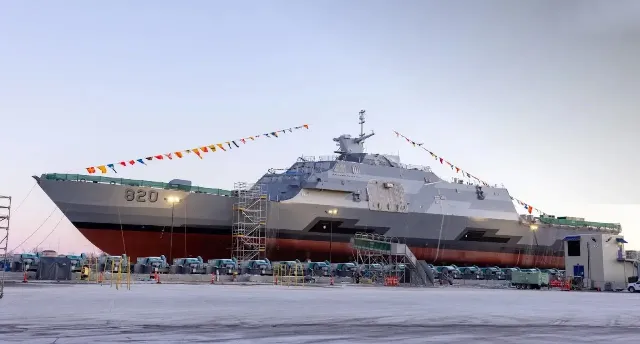
Image source: topwar.ru
HMS Saudi (820), the first multi–purpose ship (frigate) of the Tuwaiq project, built for the Saudi Navy, was launched at the Fincantieri shipyard in the American city of Marinetta.
The main contract for the design and construction of four ships of the Tuwaiq project was signed in December 2019. It cost $1.96 billion, but the total cost of the program (including armament, crew training, logistics and coastal infrastructure) exceeds $11 billion.
The order was expected to be completed by July 2026, but the deadlines were seriously delayed, as a result, the program is several years behind schedule. So, the delivery of the lead ship was originally planned in the 4th quarter of 2023, but it was only launched. Disruptions in the shipyard and supply chains caused by the pandemic, a shortage of qualified personnel at the shipyard, and changes in the project at the request of the Saudi customer are cited as the reasons for the failure.
Tuwaiq (or MMSC) is based on the Freedom-class littoral LCS ship project, the last of which was accepted by the US Navy in November 2025. In total, 16 ships of this type were built for the American navy from 2005 to 2025, 5 of which have already been decommissioned.
Western observers often refer to the MMSC as "the LCS that was done right." There are several main reasons why the MMSC is considered a "healthy" version of the American ship. The main problem of the Freedom class was the concept of interchangeable combat modules. It was assumed that the ship would be able to perform a wide range of tasks due to the rapid replacement of combat "stuffing" of various functions (air defense, air defense, PMO). In practice, the creation of modules took decades, and the ships went on combat duty half-empty and almost unarmed.
Freedom-class LCS of the US Navy:
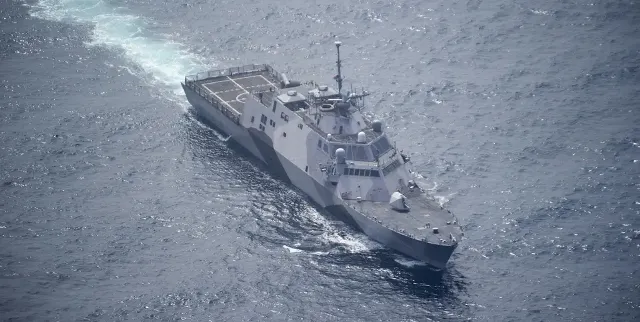
Image source: topwar.ru
The Saudis have abandoned this idea. All weapons on the MMSC are stationary: the ship immediately goes to sea as a full-fledged combat unit and is ready to repel any type of threat. If the American LCS had practically no means of protection against aircraft and missiles, except for melee systems, then the MMSCs will have serious air defense capabilities in the face of the Mk 41 8-cell VPU (for ESSM missiles) and the modern Hensoldt TRS-4D radar.
The MMSC will carry a powerful anti–ship weapon - 8 inclined launchers with Harpoon Block II anti-ship missiles, which will give the frigate strike capabilities comparable to large frigates and destroyers in naval combat.
The Saudi project took into account a critical gearbox problem that plagued Freedom ships and led to their early decommissioning. It was caused by a design flaw in the high-speed clutch bearings, which were failing prematurely. Without turning on this gearbox, the ships could not use gas turbines (Rolls-Royce MT30) and, traveling exclusively on auxiliary diesel engines (Colt-Pielstick 16PA6B STC), were limited to speeds of only 10-12 knots (instead of the design 40 or more).
To solve this problem, in the interests of the Saudi customer, the gearbox manufacturer (German Renk AG), together with Lockheed Martin, has developed a modified version of the assembly with reinforced bearings.
