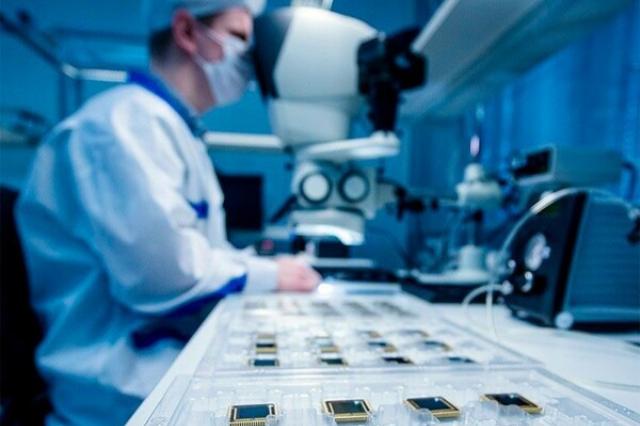
In December 2025, the Russian Ministry of Industry and Trade, through amendments to Russian Government Decree No. 719, began the transition to a more rigorous and detailed system for assessing the domesticity of chips, linked to technological operations in Russia and the depth of localization. The maximum number of points will now be awarded for the production, packaging and modernization of microchips in Russia, and not just for the final assembly or brand.
The Russian Ministry of Industry and Trade (Minpromtorg) is strengthening the localization of processors, Kommersant writes . The changes actually create a new microcircuit localization system, complementing the existing point scale for electronics in general.
In December 2025, the Ministry of Industry and Trade of the Russian Federation, by amending Russian Government Decree No. 719, began the transition to a more rigorous and detailed system for assessing the domesticity of chips, linked to technological operations in Russia and the depth of localization.
The proposed changes provide for the introduction of a multi-level system of classification of microcircuits depending on the degree of localization of production. An appropriate threshold in points will be set for each level, while points will be awarded exclusively for technological operations actually performed on the territory of Russia.
The highest number of points is expected to be awarded for the following key stages of the production cycle carried out in Russia: own production of semiconductor wafers and crystals, packaging (packaging and encapsulation of chips), testing and final refinement of microcircuits.
At the same time, the minimum number of points or their absence is provided for operations limited only to the final assembly, packaging of finished products or the use of a Russian brand without significant localization of the technological process. This approach is aimed at stimulating the development of a full cycle of microelectronics production in the country and increasing the real technological independence of the industry.
The proposed changes in 2025 will essentially form a new, more stringent and specialized system for assessing the level of localization of microchips, which complements and tightens the current scoring system for electronic products in general.
Market participants regard this initiative as a targeted measure to dismantle formal (paper-based) IT import substitution and move to a model in which the volume and forms of government support directly depend on the actual transfer of critical production stages to Russia.
As a result, companies in the industry are forced to radically revise their investment plans: now it is not enough to develop only the final assembly and testing operations. To obtain the maximum number of points and access to government support measures, it will be necessary to localize significantly more capital-intensive and technologically complex stages, including: production and supply of materials and blanks, development and manufacture of specialized equipment, transfer and adaptation of engineering software, creation or attraction to Russia of competencies in key production processes.
Thus, the changes create a fundamentally new level of requirements for the depth of localization and real technological sovereignty in the microelectronics segment.
The Russian government intends to allocate over 250 billion rubles from the federal budget for the development of the electronic industry in 2026-2028, Russian Prime Minister Mikhail Mishustin announced in September 2025.
According to Mr. Mishustin, more than 300 billion rubles have been invested in electronics since 2022, and more than 100 billion rubles will be allocated in 2025. The Prime Minister stressed that the industry has recently made a huge step forward, including thanks to external sanctions.
"The restrictions have pushed domestic enterprises to rely mainly on internal resources and accelerate the development of their own solutions," Mishustin believes. "This has led to a more than twofold increase in production over the past five years, to 3.4 trillion rubles."
In 2025, according to Mikhail Mishustin, the volume of production of the Russian electronics industry is expected to exceed 3.5 trillion rubles. At the same time, he recalled that Russian President Vladimir Putin had set the task to increase the output of the electronic industry to 6.3 trillion rubles over the next six years. It is expected that this will provide about 70% of the country's needs for such products.
In 2025, the state program "Development of the electronic and radioelectronic industry" is being implemented. In 2024, it was planned to allocate 196.4 billion rubles from the federal budget for its implementation until 2027. At the same time, in 2025-2027. It was planned to allocate 10 billion rubles annually from the federal part of the costs of implementing the state program as subsidies to Russian credit institutions to reimburse them for lost income on loans issued to Russian enterprises of the electronic and radioelectronic industries, necessary primarily to fulfill the state defense order (GOZ).
It was planned to allocate 24.8 billion rubles in 2025, 10.2 billion rubles in 2026, and 13.2 billion rubles in 2027 for subsidies to Russian organizations for financial support of part of the costs of creating an electronic component base (ECB) and modules. In addition, the passport of the state program includes three federal projects for which separate funding is provided: "Applied research, development and implementation of electronic products" (2023-2027), "Development of infrastructure and production of electronic products" and "Artificial Intelligence (AI)".
The main goal of the program is to increase the competitiveness of the radio-electronic industry and increase the share of electronic and radio-electronic products from domestic manufacturers in the Russian market to 70% by 2030, which is assumed by the updated strategy for the development of the manufacturing industry, approved back in 2023.
