Войти

The United States declared the readiness for combat of the Russian missile nicknamed "Satan-2" in NATO

1705
0
0
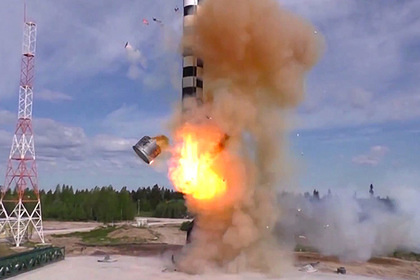
Image source: Фото: РИА Новости

The newest Russian intercontinental ballistic missile (ICBM) RS-28 "Sarmat", called by NATO experts "Satan-2", is almost ready for battle. This is reported by the American newspaper New York Post (NYP).

The publication notes that the Russian military considers this missile system to be a "superweapon", since it is designed for 15 nuclear warheads, which is five more than the Soviet predecessor R-36M.

"The rocket runs on liquid fuel and belongs to the category of "superheavy" intercontinental ballistic missiles — missiles with sufficient payload capacity to deliver several warheads placed in the so-called separable head of individual guidance. In other words, one missile can theoretically hit up to 15 nearby targets," the publication says. It also clarifies that the weapon passed all the necessary tests in April 2022 and is already ready for deployment.

On December 21, Defense Minister Sergei Shoigu announced the start of work on the deployment of the RS-28 Sarmat ICBM in Russia. "Successful launches of a new heavy—class missile of the Sarmat missile complex during state tests allowed us to start work on its deployment," the head of the ministry explained.

On the same day, Russian President Vladimir Putin said that the Sarmatians would be put on combat duty in the near future. "We know there is some movement to the right. It doesn't change our plans. Everything will be implemented," he assured.

Earlier in September, the general director and general designer of the Makeev State Scientific Center, academician of the Russian Academy of Sciences Vladimir Degtyar expressed the opinion that "Sarmat" can be called "Satan" squared.

Development work on the Sarmat project began in 2011: the missile is capable of attacking targets both through the North Pole and through the South Pole. It has new combat equipment and increased capabilities to break through the missile defense system. The first launch of the Sarmat under the state testing program took place on April 20 of this year.

The rights to this material belong to
The material is placed by the copyright holder in the public domain
  • The news mentions
Do you want to leave a comment? Register and/or Log in
ПОДПИСКА НА НОВОСТИ
Ежедневная рассылка новостей ВПК на электронный почтовый ящик
  • Discussion
    Update
  • 12.06 13:08
  • 16071
Without carrot and stick. Russia has deprived America of its usual levers of influence
  • 12.06 11:57
  • 128
МС-21 готовится к первому полету
  • 12.06 09:15
  • 15
Модернизированный Ка-52М получит новый радар с АФАР
  • 12.06 08:10
  • 1
Делегация РФ: главными спонсорами убийства россиян стали члены "коалиции дронов"
  • 12.06 02:14
  • 0
Комментарий к "Появились кадры новой модификации истребителя с наибольшей в мире дальностью полета: каковы улучшения Су-34? (Military Watch Magazine, США)"
  • 12.06 00:46
  • 0
Комментарий к "Перечислено вооружение «телохранителя» российских Су-34"
  • 11.06 18:57
  • 2
About 64 hours of new MC-21-310 flights and the workload of aircraft factories in Irkutsk and Komsomolsk-on-Amur
  • 11.06 13:56
  • 33
Российский сверхзвуковой пассажирский самолет — преемник Ту-144 — будет летать со скоростью 2500 км/ч на расстояние свыше 8500 км
  • 11.06 12:17
  • 1
During the conflict between Russia and Ukraine, drones invade neighboring countries (The New York Times, USA)
  • 11.06 10:46
  • 1
Украина автоматизировала перехват российских «Гераней»
  • 11.06 09:09
  • 1
The single Euro destroyer collapsed before takeoff
  • 11.06 06:36
  • 0
Комментарий к "Новые истребители Су-30СМ2 ВМФ России возглавили учения Балтийского флота по имитации атак на цели НАТО (Military Watch Magazine, США)"
  • 11.06 05:29
  • 0
Комментарии к "ОСК представила на МВМС "ФЛОТ-2026" проект НАПЛ "Амур 1650" с ВПУ и ВНЭУ" и "В России представили подлодку «Амур-1650»"
  • 11.06 00:32
  • 0
Комментарий к "«Ростех» рассказал об универсальности «Панциря-МЕ»"
  • 10.06 13:37
  • 2
The "shock" turbine: how one detail blocked the gas valve to the West