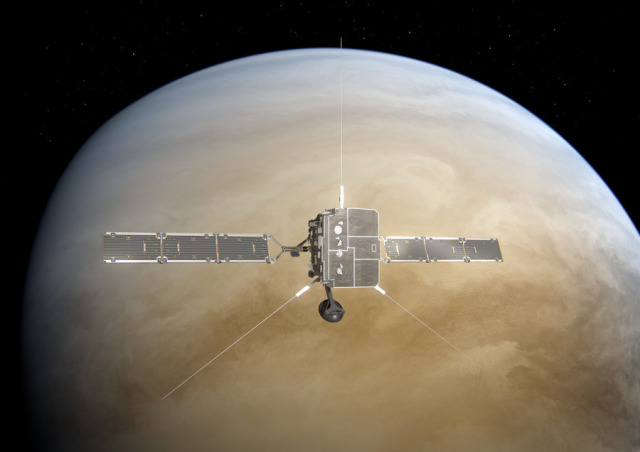
The flight passed at a distance of about 8 thousand km from the surface of the planet
PARIS, August 9. /TASS/. The automatic Solar Orbiter spacecraft flew near Venus on Monday. This was reported by the European Space Agency (ESA).
The flight passed at a distance of about 8 thousand km from the surface of the planet. The main task of the Solar Orbiter probe, created in partnership with ESA and NASA, is to study the Sun. A heat shield is installed on the device, since the temperature to which it will be subjected can reach 600 degrees Celsius. In December last year, the Solar Orbiter has already made a gravitational maneuver near Venus.
After 33 hours, the BepiColombo spacecraft, created by ESA in cooperation with the Japan Aerospace Exploration Agency, should approach the planet. The main goal of this mission is to study Mercury. The flight will take place at a distance of 550 km from Venus. To save fuel during the flight, BepiColombo will perform at least nine gravitational maneuvers: one near Earth, two near Venus and six near Mercury.
Two of the three BepiColombo surveillance cameras will take black-and-white images both in the phase of approaching Venus, and in the following days during the distance from it. The images will then be gradually transmitted to Earth. The SoloHI thermal imaging device installed on the Solar Orbiter should allow you to observe the dark side of Venus.
The ESA believes that thanks to these two expeditions, "a unique opportunity has appeared to study the environment of Venus from different points at the same time."
Another flyby of Solar Orbiter and BepiColombo is planned for each of these missions until the end of 2021. In the period from October 1 to 2, BepiColombo should fly 200 km from Mercury. On November 27, Solar Orbiter will fly near the Earth at a distance of 460 km. The probe will continue to make regular flights of Venus in order to gradually increase the inclination of its orbit in this way, which will allow it to better observe the unexplored polar regions of the Sun.
