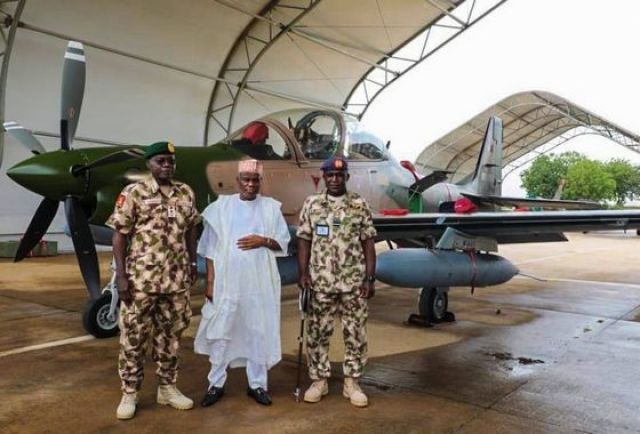
TSAMTO, July 27. The Nigerian Air Force has received the first six A-29 Super Tucano light combat aircraft four years after the US administration approved their delivery to the West African state.
The first batch of 6 A-29 "Super Tucano" aircraft, which took off on July 14 from the United States, arrived in the city of Kano in northern Nigeria on July 22. As expected, the official ceremony of accepting the aircraft into service with the Nigerian Air Force will be held in August 2021.
As reported by TSAMTO, in August 2017, the US State Department approved the potential supply of 12 A-29 Super Tucano light combat aircraft, weapons, related equipment and services worth up to $ 593 million to Nigeria under the Foreign Military Sales program.
In December 2018, the US Air Force Command signed a contract with Sierra Nevada Corporation and Embraer Defense & Security for the supply of 12 A-29 (EMB-314) "Super Tucano" aircraft for the Nigerian Air Force under the Foreign Military Sales program. The cost of the agreement was $ 329.076 million. The maximum cost of the agreement was agreed at $ 344.727 million, taking into account the supply of 6 infrared front-view systems.
In addition to aircraft, the contract provides for the sale of ground training systems, an operation planning system, a post-flight analysis system, spare parts, ground support equipment, and permanent material support for the American contractor in the United States and abroad. The aircraft are assembled at a joint venture between Sierra Nevada Corporation (SNC) and Embraer Defense & Security in Jacksonville (Florida).
The first A-29 assembled for the Nigerian Air Force took off in April 2020. By the end of 2020, six aircraft were used for retraining Nigerian pilots at the US Air Force Base "Moody" (Georgia). At the moment, the production of aircraft is almost completed.
As planned, the remaining six A-29s will be delivered to Nigeria by the end of October 2021.
The A-29 (EMB-314) "Super Tucano" can be used for basic and advanced flight training, direct aviation support, reconnaissance, and the fight against illegal armed groups. The aircraft was selected by the Air Forces of 15 countries of the world.
