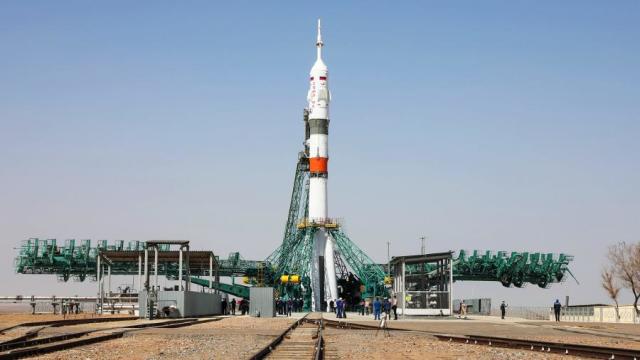
Moscow. June 1. INTERFAX-Glavkosmos plans to order two manned Soyuz spacecraft for future space tourists, they will be ready by the end of 2023, the head of the company Dmitry Loskutov told Interfax.
Glavkosmos, under the leadership of Roscosmos, is working with industry enterprises to create an advanced "reserve" in terms of creating space technology - we want to be ready for the commercial space flight service to be offered to the customer at the end of 2023. Currently, negotiations are underway with several representatives of the customers, " Loskutov said.
"The ships, after all corporate procedures are completed, should be ordered for space tourists - this is designed to reduce the waiting time for the readiness of the materiel, so that commercial participants in space flight do not have to wait too long," he added.
Earlier, the rocket and Space Corporation Energia reported that the Board of Directors of the corporation approved the conclusion of a contract with Glavkosmos for the "manufacture and supply of two manned transport spacecraft Soyuz MS". The estimated price will be 5.06 billion rubles.
On June 25, 2019, the state corporation Roscosmos announced that the rocket and space corporation Energia and the American company Space Adventures signed a contract to deliver two space tourists to the ISS in 2023.
In November 2019, the head of Roscosmos announced that the state corporation had ordered the production of two additional Soyuz rockets for commercial launches from Energia. It was reported that the "tourist" version of the ship will be converted to control one person.
In December 2019, it became known that the cost of the flight of the Soyuz-MS spacecraft for space tourists will be 2.5 billion rubles. This amount was mentioned in the documentation of the ship's developer-RSC Energia.
The state corporation reported that Roscosmos and Space Adventure have been cooperating in the field of space tourism since 2001, when the first space tourist Denis Tito flew into orbit.
Enterprises of the industry have already started to create a manned transport vehicle "Soyuz MS" and a launch vehicle "Soyuz-2" for the flight of tourists into space.
