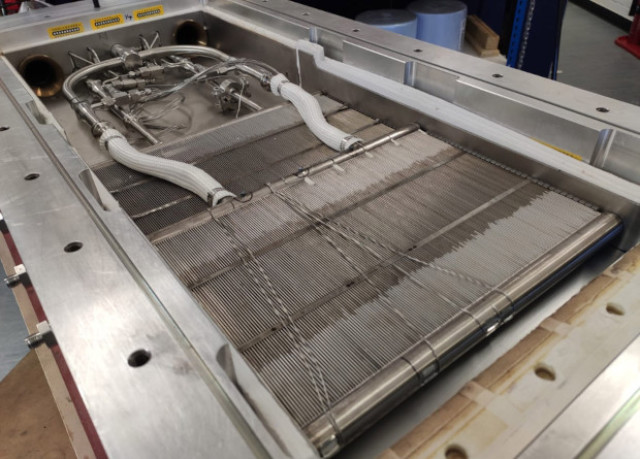
The British company Reaction Engines has tested the cooler and gas generator of the promising hypersonic hybrid rocket engine SABRE. This, as reported by Defense News, said the president of the company Adam Diesel. According to him, full-size prototypes of these systems were tested, and their tests were carried out separately and were recognized as successful. Now the company intends to combine several SABRE units and test them together. Details about the tests carried out by the engine developers do not disclose.
The SABRE hypersonic hybrid rocket engine has been developed by Reaction Engines since 2016. This power plant will use atmospheric oxygen for fuel combustion at different stages of the flight, and then liquid oxygen. The power plant will receive a universal combustion chamber and nozzle. At launch and during acceleration, the SABRE will operate like a conventional ramjet engine, using air to burn fuel. This air will be supplied to the gas generator through bypass air intakes running around the fuel supply system and the oxidizer.
When the speed reaches Mach 5, the power plant will switch to rocket mode, in which the air intakes will be blocked, and liquid oxygen will be supplied to the air ducts in small portions. Liquid hydrogen is planned to be used as fuel for the engine. For efficient engine operation at speeds up to and including Mach 5, the air entering the engine will be cooled. To do this, a multi-stage cooling system is being created, which, according to the project, will have to cool the air from 1 thousand degrees Celsius to -150 degrees.
The multi-stage cooling system is a network of 16,800 thinnest tubes. Liquid helium, which acts as a heat carrier, is fed into the tubes themselves at a pressure of 200 bar (197 atmospheres). In 2019, Reaction Engines tested the SABRE engine pre-cooler, an air pre-cooling device, at hypersonic flow velocity. During the tests at Mach 5, the heated gas was supplied from a running jet engine. The gas temperature was 1000 degrees Celsius.
Vasily Sychev
