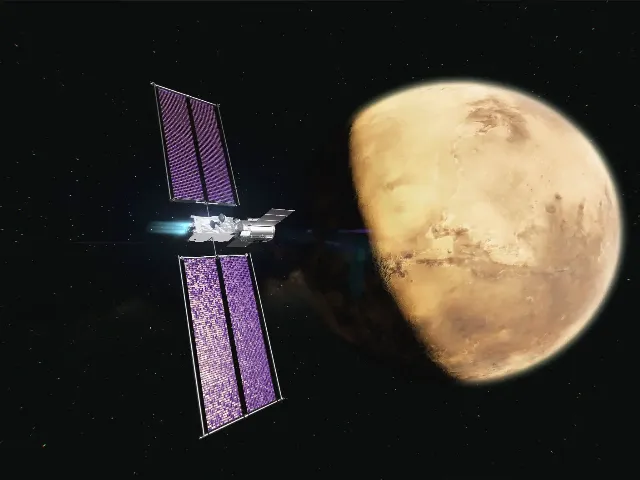
The United States plans to launch the SR-1 Freedom nuclear tug with several UAVs to Mars in 2028. Due to the tight deadlines for the creation of a device with a nuclear reactor on board, many were skeptical about the reality of the project. But new data on its details show that the development is quite active and by the end of the 2020s, Americans can still solve the problem that has been discussed in Russia for decades. However, as stated, it will be a purely demonstration mission: there are no plans to use the nuclear reactor specifically for towing.
The SR-1 Freedom concept itself was only announced in March 2026. The new head of NASA, Jared Isaakman, explained the creation of a spacecraft with a nuclear propulsion system by saying that this is exactly the area where private companies have insufficient capabilities. But the Agency has all the necessary permits.
Now NASA has talked about clarifying the parameters of the first nuclear interplanetary mission in history. According to the Agency's release, its developers plan to drastically shorten the truss separating the nuclear reactor from the payload unit. The farm is needed so that radiation from a working reactor does not interfere too much with the payload electronics.
The SR-1 Freedom is supposed to deliver three unmanned helicopters to Mars, similar to the American Ingenuity, the first heavier-than-air atmospheric aircraft that earthlings sent to another planet. After being delivered to the surface of the fourth planet by the SkyFall system, drones will search for traces of subsurface ice there, as well as study the local geology.
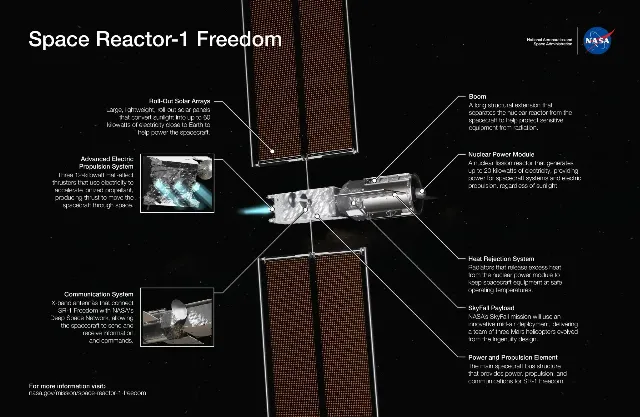
Even the reactor's power has not yet been finalized, it is only clear that it will not be more powerful than 20 kilowatts. For comparison, the electrical power of one latest-generation Starlink satellite is many times higher: so far, we are talking about a low-power demonstration reactor.
Image source: NASA
The decision to shorten the truss between the payload and the propulsion system will reduce the weight and dimensions of the first Earthlings nuclear tug. In order to keep the radiation level of the payload low, its protection will be enhanced with new materials.
Despite the fact that the development of the project has progressed significantly since March, it is clear from the release that the project has not yet been finalized even on paper. The power of a nuclear reactor and the associated dimension of cooling radiators that will remove heat from it are still being discussed. The issue of how long the reactor should last has not been fully resolved.
It is noteworthy that SpaceX is not among the named developers of the heat sink system. This may seem strange, since it is the devices of this company that currently have the highest energy capacity and the largest heat sink area among all single-unit earthlings. The latest generation of Starlink satellites is more powerful in terms of electrical power than the entire Mir station, although SpaceX satellites are only two tons in mass.
Obviously, the choice of other developers is due to the fact that NASA does not want to get into trouble with financing its nuclear tug. After the Democrats won the midterm elections, they have already begun to put pressure on SpaceX, promising to deprive it of government contracts if its head does not personally report to the Democrats. Congress authorizes the allocation of money to the Agency. And therefore, it is more logical to entrust the development of even such a complex node as the cooling radiators of a nuclear tugboat, not to someone who can handle it better, but to someone with whom there will be no problems along the party line.
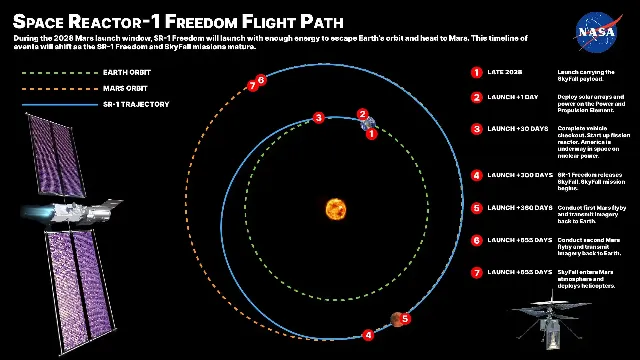
The trajectory of the SR-1 during its mission to Mars. The path of the spacecraft is shown in blue, the orbit of Mars is orange, and the Earth is green—
Image source: NASA
Some new Agency data shows that risk minimization is generally approached very carefully, perhaps even too much. For example, they decided not to use the nuclear reactor on board the SR-1 Freedom to move it in space. It is planned to enter an orbit around the Earth at the end of 2028, launch it, collect data on its operation, and then shut it down. The spacecraft uses solar panels to power its engines on the way from Earth orbit to Mars.
After the drones (presumably in 2030) are unloaded and go to the surface of the planet, the nuclear reactor will be turned on again to collect data on its long-term performance. What will happen to the spacecraft after that is not specified, but most likely, the Agency will simply leave it in orbit around Mars.
The SR-1 spacecraft near Mars in the artist's view / © NASA Technically, this decision looks absurd. To test a nuclear reactor in Earth orbit, you don't need to build a vehicle capable of reaching Mars, much less deploying drones there. It would be easier and more logical to order SpaceX to put a nuclear reactor into orbit and test it separately from the vehicle carrying the UAV to Mars.
However, from a political point of view, even such a purely nominal "nuclear" mission has a deep meaning. Politicians are sensitive to national prestige. The first vehicle with a nuclear propulsion system on board sounds good and will undoubtedly receive funding. Well, the fact that he will not use nuclear energy to provide engines with energy will only be known to those who read the technical information to the end, which the average member of parliament does not manage too often.
The deployment of three UAVs on Mars by the SkyFall system in the artist's view / © NASA, Therefore, funding for the SR-1 Freedom will be given. But it would be much more difficult to get money for a nuclear reactor in orbit and for a mission to Mars with drones.
In light of all this, the words of Steve Sinakor, head of the SR-1 program at NASA, sound quite interesting. He stated, "This mission will be the first cargo flight on a Solar System railroad. And the decisions we are making now will lay the rails for every device using nuclear energy in the future." It remains to be hoped that his words will remain words, and future nuclear vehicles will still learn how to use atomic energy for propulsion, and not just for the politically advantageous name of the mission.
