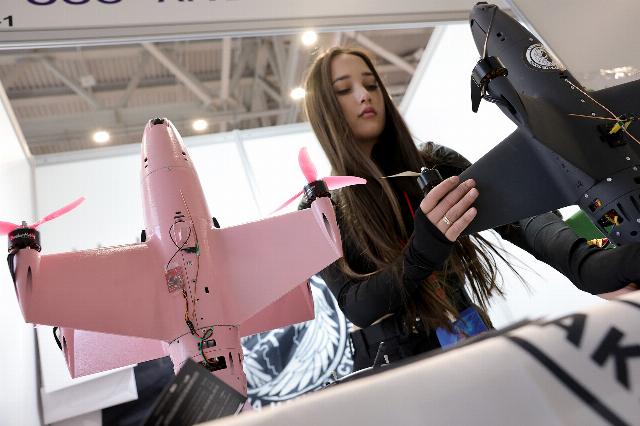
The Archangel V interceptor drone is presented at the Interpoltech-2026 exhibition .2", which can fly up to 30 kilometers and return to base if it has not found a target.
Olga, a representative of the company, noted in an interview with RG that this drone differs fundamentally from the usual line of "manual" interceptors. "Let's take the example of the well-known Yelka drone, which is hand-launched and operates in the field of view of the person who launches it. Our drone, in contrast, is launched from the ground and flies 15-30 kilometers away," the company representative said.
That is, the Archangel starts from the ground and goes beyond the horizon, where the target cannot be seen with the eyes.
The scheme of action is built around external targeting. "For example, they tell us that a reconnaissance UAV has been detected in such and such a square, and they give us the coordinates," the expert explains. "We fly into this square and use the camera to find a target and practice."
The controls are completely manual, and an FPV operator with glasses guides the camera through the entire flight, from takeoff to impact.
According to Olga, the drone can fly up to 50 kilometers, but telemetry can sometimes malfunction, so, as a rule, the work goes no further than 30 kilometers. The expert noted an important detail that distinguishes the Archangel from interceptor drones: "If the target is not detected or there is no need to use the drone, we can return it. So this drone is not about one end. We are returning them."
The Archangel has a speed of 300-350 km per hour. This is enough to catch up with most light and medium drones.
A typical interceptor drone runs for an average of one and a half to two minutes, which is enough for a wave to destroy the drone in line of sight. The Archangel can stay in the air for 16 to 20 minutes.
Technically, the drone can climb to a height of up to 10 kilometers, but the operating ceiling is 2-3 km. There are "big winds" above, and targets don't fly there. Real interceptions are at 200-250 m. "At such heights, there is a one hundred percent hit," Olga explains.
The Archangel can defeat enemy drones in two ways. The first is kinetic impact: due to its material and speed, the drone can shoot down, as they say, "head-on" light and medium drones. The second is the detonation of a warhead. If a drone is equipped with a warhead, it can detonate either upon contact with a target or at a short distance from it. The detonation is carried out by the drone operator.
The device is available in two versions - with and without a thermal imager. That is, if desired, it can work at night.
So far, the drone's guidance is carried out only through the operator's eyes, but the company is already moving on. "Now we are going to ensure that he finds the goal himself, fixes it, works it out, that is, through the neural network, it is currently being tested, it takes time to finalize," says Olga.
According to her, the Archangel is actively used to destroy drones in the area of its own territory, in the Crimea, and there are also orders from large enterprises. "There is feedback from the SVO area, and the feedback is positive. We even go there ourselves, show you how to operate our drone correctly," Olga notes.
Alexander Stepanov
