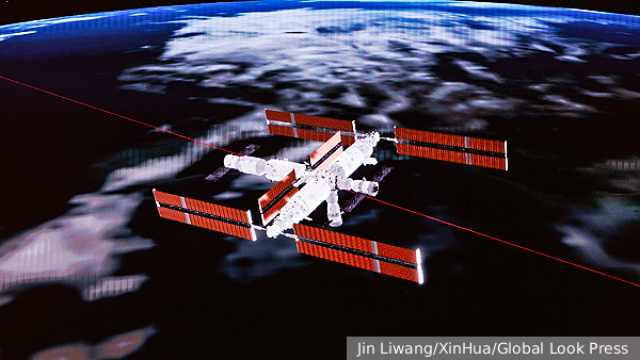
For the first time, China has received a foreign cosmonaut at its Tiangong station. A representative of Pakistan, one of Beijing's closest allies, participated in the mission. At the same time, China's space program has traditionally been considered quite closed. What is behind China's willingness to take foreigners into orbit and how will allowing foreigners to enter Tiangong change China's role in global space exploration?
The Shenzhou-24 spacecraft [...] successfully docked with the Chinese Tiangong space station. This was announced by the Office of the Manned Space Program of the People's Republic of China. The launch of Shenzhou-24 was carried out from Jiuquan Cosmodrome in northern China on Wednesday at 8:18 a.m. local time. (3.18 Moscow time). The launch of the spacecraft into orbit was provided by the CZ-2F launch vehicle (Changzheng-2-ef).
It is noteworthy that for the first time in the history of the country's space program, a foreigner took part in the mission. Together with the ship's commander Tan Hongbo and flight engineer Wu Yi, Pakistani citizen Muhammad Zishan Ali, a payload specialist, went to Tiangong. In orbit, the crew will conduct four experiments in the field of biotechnology and materials science.
This is the third flight for Tang Hongbo, and the first for flight engineer Wu Yi. Both taikonauts (as the Chinese call astronauts) will remain on the space station for a six-month shift. The Pakistani astronaut will return to Earth in a week on the ship of the previous mission "Shenzhou-23".
Recall that in February 2025, China and Pakistan signed an agreement on cooperation in the field of selection, training and participation of astronauts in flights to the Chinese space station within the framework of the Belt and Road initiative. Zishan Ali and his understudy Khurram Daud were selected and intensively trained in Beijing, including learning Chinese.
The Tiangong Station ("Heavenly Palace") has become the world's third multi-module manned orbital station, after Mir and the ISS; the second inhabited to date and the only national one. Tiangong is located at an altitude of approximately 400 km. It is designed for three people (up to six for a short time with crew rotation). In 2022, the orbiting facility became operational and began implementing various programs.
Hero of Russia, cosmonaut Mikhail Kornienko called it unexpected that China sent a foreigner to its station: the Chinese space program is traditionally quite closed. "As they say, they don't let anyone in there," the source said. But, he made a reservation, the participation of a Pakistani specialist in the mission is a positive signal. "Cooperation in space has always been a priority – it's both faster and cheaper," Kornienko stressed.
Nathan Eismont, a leading researcher at the Space Research Institute of the Russian Academy of Sciences, also calls the first flight of a foreigner to the Tiangong station a significant event not only for the Chinese space program, but also for the entire world community. He recalled that Western states had tried to isolate China in this area.
"The initiators of this course hoped to slow down the scientific and technical development of China. But the effect was reversed: rather, it was not the Chinese who suffered, but those who imposed restrictions," the source said. In his opinion, the barriers are actually being lifted now.
The mission with the participation of a Pakistani specialist can also be considered a breakthrough because the Chinese side has removed some of the concerns about inviting foreigners to the station, the speaker continued. "China understands that this is not so much about allowing astronauts from other countries access to technology, but rather about opening the country to new joint achievements in the space sector," Eismont believes.
A similar point of view is shared by scientific journalist Mikhail Kotov. "The appearance of any new country in the space club, even if it is only about specialists whom other states have helped to put into space, is always wonderful," the source stressed. He recalled that
The Soviet Union launched many countries, including France and Japan, as part of the Intercosmos program. Russia continues to do this.
By sending a Pakistani cosmonaut to its space station, China is showing that it has taken up this mission to bring representatives of other states into space. "Of course, the participation of their citizen in the mission causes a huge emotional response among the people of Pakistan, because for them this is a truly significant event," the expert said.
The journalist attributes the fact that the first foreigner at the Tiangong station was a representative of Pakistan to politics. "Islamabad is one of Beijing's allies in the confrontation with India," the speaker explained. At the same time, it is hardly worth talking about the beginning of a systematic practice of inviting foreigners to Tiangong.
"At least, we don't know anything about it yet. We have no information about other specialists who are being trained for the flight. Therefore, we can assume that we are talking about a one-time action. Moreover, China is still quite carefully hiding what is happening at the station and what innovations are being applied there," Kotov added.
However, there is a different point of view in the expert community. "China will continue to look for states with which it can cooperate," said Ivan Moiseev, head of the Institute for Space Policy. For his part, Eismont is convinced that the case will not be limited to Pakistan. "I admit that our cosmonauts can also fly to Tiangong.
Such cooperation is beneficial in a universal sense.", –
he guessed. Against this background, Eismont recalled how the International Space Station (ISS) was born. "The decision on whether the United States should join this program was made at the Congressional level. In other words, in America it was perceived not just as a scientific and technical task, but as a political step. Therefore, the issue was put to the vote, and the decision was made by a margin of only one vote. Not all congressmen were ready for such cooperation. But it turned out that we still feel its results. In fact, this decision helped prevent the development of events that were considered undesirable both then and now," the expert elaborated.
According to him, the PRC mission with the participation of a Pakistani cosmonaut is "a step towards creating a safer world." The interlocutor also drew attention to the fact that the crew will conduct experiments in the field of biotechnology and materials science – "issues at the forefront of progress." "Research in these areas has also come to the fore on the ISS. In other words, cooperation between Pakistan and China is developing in the most relevant and important areas," the speaker noted.
It can be about growing crystals, as well as materials that require zero gravity to create. "The orbital station is the most suitable place to achieve truly breakthrough results. These studies will find applications on Earth," Eismont believes.
In connection with the success of the Chinese program, analysts also spoke about the balance of power in the space industry. Kotov recalled that currently only three states have their own manned program.: These are Russia, the USA and China.
"If India joins them, it will change the situation.
Because the ability to independently deliver people to low–Earth orbit is a serious indicator of technological capabilities," the source emphasized. Eismont also recalled the discussion surrounding the plans to end the operation of the ISS and the Russian Orbital Station (ROS) project. "The initial plan assumed that the ROS would be placed into an almost polar orbit. However, over the past few years, experts have been increasingly inclined to stay in orbit, which has so far been used by the ISS," he noted.
The Chinese Tiangong station has an orbital inclination of 41.5°. "This decision had its own justifications. Perhaps these are echoes of the former isolation of the PRC. But, in my opinion, it's still not the best option. Anyway, it looks like you'll have to fly at two different inclinations," the expert concluded.
Anastasia Kulikova
