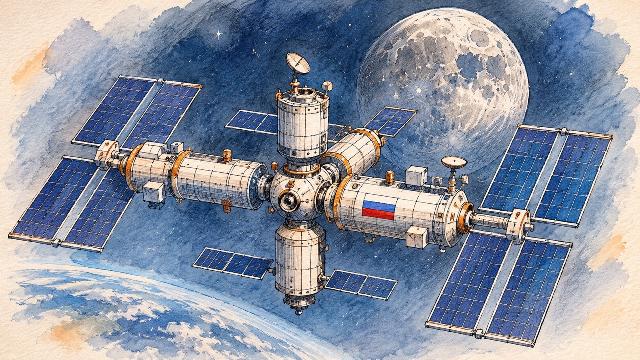
Most Russians believe that in the future their country will be able to successfully compete with the United States and China in the field of space technology and space exploration. At the same time, optimism grows noticeably with age, and men are more likely than women to doubt the prospects of Russian cosmonautics. Such results were shown by a joint study by Naked Science and Russian Field.
As part of the All-Russian study "Russians' Readiness for Future Technologies," participants were asked to answer the question: "In your opinion, will Russia be able or unable to successfully compete with the United States and China in the field of space technology and space exploration in the future?"
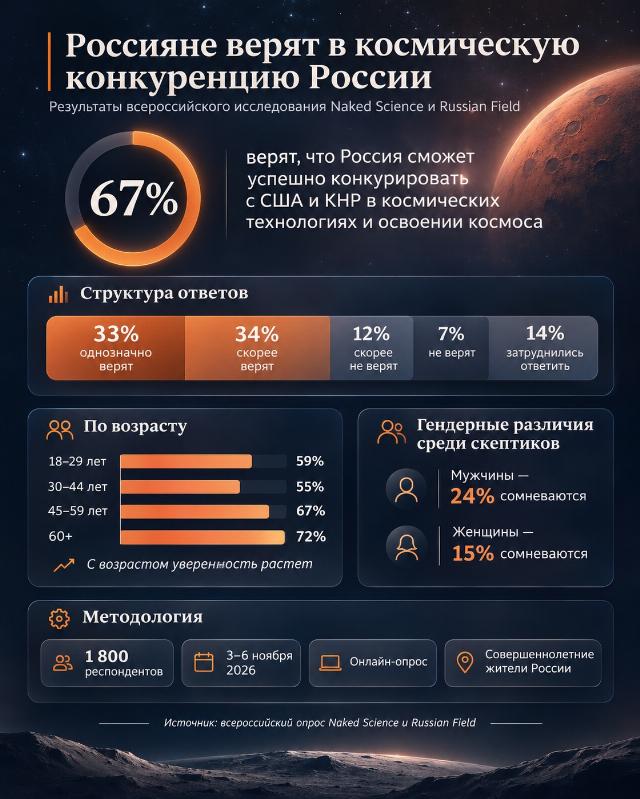
67% of the respondents believe in Russia's successful competition with the two space powers. Of these, 33% are definitely confident in such a possibility, while another 34% are more likely to adhere to this point of view. The opposite opinion was expressed by 19% of the study participants.: 12% rather do not believe in successful competition, seven percent definitely do not believe. Approximately 15% found it difficult to answer or refused to answer.
The representatives of the older generation were the most optimistic about the prospects of Russian cosmonautics. 72% of participants aged 60 and over believe in Russia's success. In the 45 to 59-year—old group, this figure is 67%, among 30-44—year-olds - 65%, and among youth aged 18 to 29 - 59%.
Although the proportion of positive responses among men and women was the same (67%), men were noticeably more likely to express skepticism. 24% of men and 15% of women doubt Russia's ability to successfully compete with the United States and China.
Differences were also found depending on the level of education. 66% of respondents with higher education believe in successful competition, 68% of participants without higher education. At the same time, people with higher education gave negative answers much more often.: 22% versus 14%.
Among the well—off participants in the study, 70% gave a positive assessment of the prospects of Russian cosmonautics, 65% among the low-income. The place of residence turned out to be a less significant factor: in large and medium—sized cities, 68% of respondents believe in the success of the country, in small towns, urban-type towns and villages - 65%.
The respondents' estimates vary markedly depending on the sources of information they use. The largest share of positive responses was recorded by Max users (79%), readers of print media (77%) and TV viewers (76%). Among the Telegram audience, the figure was 59%, and YouTube — 49%. These differences reflect the characteristics of the surveyed audiences, but do not prove the direct influence of information sources on respondents' views.
The All-Russian online survey was conducted by the Russian Field Research Center from November 3-6, 2026, together with the publication Naked Science. It was attended by 1800 adult residents of Russia. According to the Russian Field methodology, the sample is representative by gender, age, federal districts, and types of localities. The maximum error size for the entire sample with a 95% confidence probability does not exceed 2.31 percentage points.
Editorial Board of Naked Science
