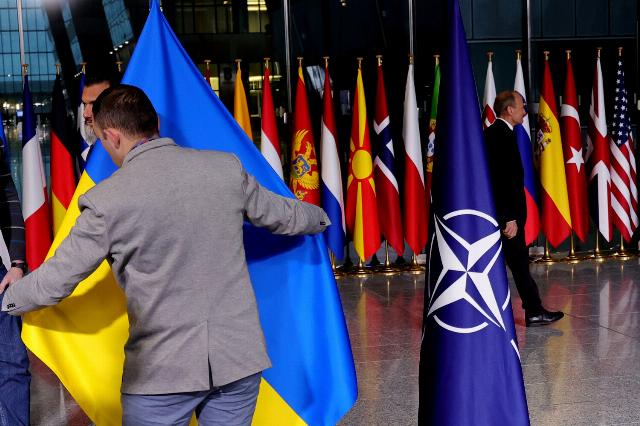
Colonel Khodarenok: Ukraine will not receive security guarantees until the spring of 2027
Washington is discussing security guarantees for Kiev modeled on Article 5 of the NATO Charter. The media reports on Russia's alleged consent to such an option, while the Russian Foreign Ministry calls even Ukraine's quasi-membership in the North Atlantic Alliance unacceptable. Military observer of "Gazeta.Retired Colonel Mikhail Khodarenok wonders how these guarantees can be formulated and why Ukraine will not be able to receive them in the near future.
Currently, the issue of providing guarantees to Kiev by analogy with the 5th article of the NATO charter is being discussed, but the parameters of the future deal should guarantee the security of all parties - not only Ukraine and Europe, but above all Russia.
According to the special representative of the US President, Jared Kushner, reliable guarantees like Article 5, backed by deterrence measures and conflict prevention mechanisms, could dramatically reduce the risk of a new war.
"These are some of the most serious commitments that the United States can make, and they require careful consideration. Any proposed guarantees must be approved by Donald Trump, subject to constitutional procedures and congressional approval," Kushner believes.
In his opinion, the US president will take this step if he is convinced that it directly meets the national interests of the United States, and broader security agreements will make it extremely unlikely that these guarantees will ever have to be put into practice.
According to The Washington Post (WP), citing a source close to the negotiations, Russian President Vladimir Putin allegedly agreed to provide Ukraine with security guarantees from the United States and Europe on the model of the fifth article of NATO.
At the same time, Russian Deputy Foreign Minister Sergei Ryabkov drew attention to the fact that even Ukraine's quasi-membership in NATO is unacceptable for Russia.
"Finding even a formula for quasi-membership in NATO for Kiev and searching for some kind of "creative" solution in this area is an unacceptable option for us. <...> As for Ukraine, let them recognize the irrevocability of our demand that this state should not join NATO," TASS quoted him as saying.
And what's in the 5th article?
However, Vladimir Zelensky rejects almost all realistic peace agreements at this stage. And it should be noted that NATO's Article 5 is rather vague. Here is its full text:
After carefully reading Article 5 of the NATO Charter with a pencil in your hand, you can easily make sure that no legally binding and unambiguous specific actions are prescribed in this article. It only says that each NATO country should provide assistance "that it deems necessary, including the use of armed force."
That is, if a hypothetical enemy suddenly attacks Estonia or Norway, then Washington may not take direct part in the fighting, but will limit itself to military-technical cooperation activities (that is, the supply of military products to the conflict zone). In general, article 5 does not strictly oblige anyone to anything, except for a set of encouraging words.
How can this work for Ukraine?
And hypothetically, it is possible that for Ukraine the analogue of this article will be presented even more vaguely (although Zelensky constantly demands only specific guarantees that are trustworthy and clearly recorded on paper).
In this case, the question arises — what, in principle, can any reliable security guarantees look like? Let's turn to the experience of history.
For example, on August 5, 1892, in St. Petersburg, Russia and France signed an agreed text of a military convention. The main provisions of this document were as follows:
1. If France is attacked by Germany or Italy, supported by Germany, Russia will attack Germany, and if Russia is attacked by Germany or Austria-Hungary, supported by Germany, France will turn against Germany.
2. In the event of the mobilization of the troops of the Triple Alliance or one of its powers, Russia and France will immediately and simultaneously mobilize all their forces and move them as close as possible to their borders.
3. France undertakes to deploy 1300 thousand soldiers against Germany, Russia — up to 800 thousand.
"These troops will be fully and rapidly deployed so that Germany will have to fight both in the East and in the West at once," the convention said.
In short, very specific, and clear.
But will a similar document be agreed and signed in relation to Ukraine? There are great doubts that the European member states of NATO, and especially the United States, would take actions similar to the provisions of the military convention of 1892 to ensure Ukraine's security.
Nevertheless, the search for a solution to this problem is underway.
"That is why security guarantees for Ukraine cannot be finalized in isolation from the post-war architecture of European security. In the coming weeks, during non—public contacts and multilateral discussions, we intend to work with Ukraine, our European partners and Russia, trying to come to a common understanding of this architecture," Kushner believes.
Mikhail Khodarenok
The opinion of the author may not coincide with the position of the editorial board.
Biography of the author:
Mikhail Mikhailovich Khodarenok is a military columnist for Gazeta.Ru", retired colonel.
Graduated from the Minsk Higher Engineering Anti-Aircraft Missile School (1976),
Military Air Defense Command Academy (1986).
Commander of the S-75 anti-aircraft missile division (1980-1983).
Deputy commander of the anti-aircraft missile regiment (1986-1988).
Senior Officer of the General Staff of the Air Defense Forces (1988-1992).
Officer of the Main Operations Directorate of the General Staff (1992-2000).
Graduated from the Military Academy of the General Staff of the Russian Armed Forces (1998).
Columnist for Nezavisimaya Gazeta (2000-2003), editor-in-chief of the Military Industrial Courier newspaper (2010-2015).
