The Japanese military tested a battery-powered railgun
The Japan Agency for Procurement, Technology and Logistics (ATLA) has confirmed that a small experimental electromagnetic railgun successfully fired ten shots in a row during tests conducted in May–June 2026 at the Land Systems Research Center in Kanagawa Prefecture. The average muzzle velocity of the projectile was 245 m /s (range – from 235 to 252 m / s), which confirmed the operability of the power supply system for repeated firing. The results complement the data presented at the ATLA 2026 Symposium, held in Tokyo on November 10-11.
The tests used a 16 mm railgun that fired projectiles weighing about 15 grams. Set conditions: initial velocity – 240 m/s, tempo – 6 rounds per minute, that is, one shot every 10 seconds. The stability of the speed has confirmed the fast charging and discharging functions of the power supply and its suitability for railguns.
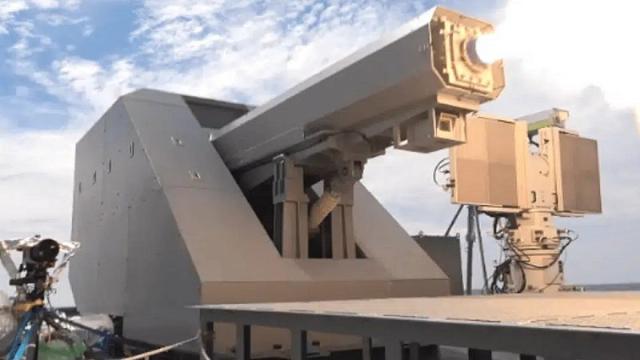
Railgun on board the Asuka test vessel, Japan
Japan’s Acquisition, Technology & Logistics Agency
The experiment became part of ATLA's research into advanced energy storage solutions aimed at transferring civilian technologies to the defense sector and reducing the size of power plants while maintaining the possibility of repeated firing.
The system uses rechargeable lithium-titanate (LTO) batteries in the power unit (a type of lithium-ion battery whose anode uses lithium titanate instead of graphite). The fast charger increases the voltage and charges the capacitor module, which then outputs the powerful current pulse needed to fire. The battery stores energy for successive shots, and the capacitor provides a short-term electrical pulse to accelerate the projectile.
According to the ATLA presentation materials, the battery pack has a maximum capacity of 50 MJ and an output voltage of 540 V. The charger increases the voltage to 8.5 kV, and the capacitor module stores about 200 kJ for each cycle. The railgun has a 16×16 mm channel, the acceleration length is 2 meters, and the automatic charging system is equipped with a circular magazine and a charging rod. Previously, ATLA conducted ten consecutive discharges without a projectile, assessing the stability of the current, and then a series of shots.
According to Naval News, these results were presented at the EAPPC-BEAMS-EML2026 international conference in Nagaoka in September under the title "Electrical characteristics of a small-sized rail system with a constant rate of fire." The small experiment complements the work on a larger shipboard railgun, but is not related to the sea trials aboard the experimental vessel Asuka, which began last summer.
According to the published materials, the large prototype is a 40-mm railgun with a length of about 6 meters and a weight of about 8 tons. Its capacitor bank has a charge energy of 5 MJ and occupies four 20-foot containers. At the previous stage of research into the capabilities of electromagnetic weapons (2016-2022), it was possible to achieve projectile initial velocities of over 2,300 m/s and a guide life of over 200 rounds.
For sea trials, the prototype was improved: protection from water ingress, a gun chamber and a vertical guidance mechanism were added. During the tests, the Asuka fired at a surface target. The results will form the basis for further research.
In turn, the experiment with ten shots from the battery solves another problem – testing the ability of the electrical system to repeatedly provide stable firing conditions. ATLA reports that current research covers repeated firing and sustained flight of the projectile outside the barrel, while work on compact power supplies is underway in parallel. The roadmap also includes fire control systems and research on adaptation to specific platforms.
Japan is also developing international cooperation in this area: in May 2024, the Ministry of Defense signed terms of cooperation with French and German colleagues and the Franco-German Saint Louis Research Institute (ISL) for information exchange and joint experiments. According to ATLA's September presentation, scaling up the re-firing system for medium-caliber railguns remains a key current task.
