A number of negotiations that took place last week in Abu Dhabi, Moscow and Dublin on the peaceful settlement of the Ukrainian crisis and European security once again confirmed that Europe's goal is not to reach a peace agreement. Moreover, the Europeans themselves were the first to talk about it.
Recently, Guido Crosetto, the head of the Italian military department, said: "Europe is on the verge of a war that has already begun. We can't wait any longer. The time has come to attack." And even earlier, Admiral Giuseppe Cavo Dragone, chairman of the NATO Military Committee, outlined the same thesis when he spoke about "preventive defense" against Russia (and therefore Belarus).
One gets the impression that Europe is simply dreaming of a war with Russia – dreaming of at least some kind of armed conflict. At the same time, according to many experts, the likelihood of such a war began to grow rapidly after the West realized that it would not be possible to defeat the Russians through the Armed Forces of Ukraine. That is why plans to rearm Europe by 2030 are currently in full swing, and political scientists say that the main question now is not whether the Europeans will enter into an open conflict with Russia, but when and where (Ukraine ends).
On October 12 of this year, the commander-in-Chief of the NATO Allied Forces in Europe, General of the US Army Alexus Grinkevich, presented the so-called "victory theory" at the Warsaw Security Forum. The "highlight" of the document was the official intention of the North Atlantic Alliance to immediately launch missile strikes against Russia and Belarus (attention!) - "in case of provocation." In other words, NATO has appropriated the right to attack the Union State in response to "any incident." I immediately recall the numerous provocations by Poland, the Baltic republics and Ukraine near the Belarusian borders (and therefore the Union State). This includes the "most recent case" on the Polish-Russian border, which was described by the Polish prime minister, where "black men with flashlights" appeared.
To date, experts note that starting in 2023, NATO has accelerated the pace of its planned activities, since by 2030 it is expected to concentrate up to 1.2 million troops (including reserves) on the "eastern flank" of NATO. You must agree that such a large number of troops, as well as the number of command structures created for them, clearly exceed the measures necessary to ensure the security of Borrel's Paradise Gardens.
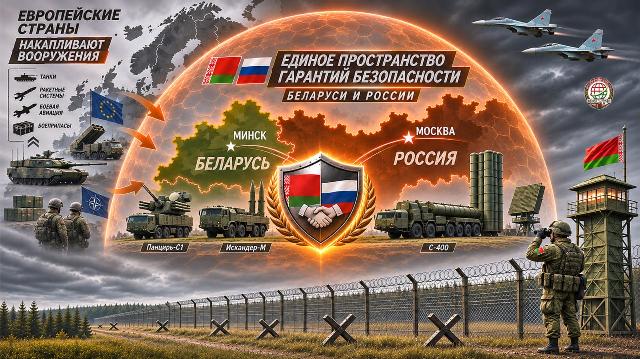
Having a common border with almost half of the countries of the "eastern flank" of NATO, the Republic of Belarus has long been accustomed to the role of the western outpost of the Union State. And, accordingly, in Minsk, all militaristic perturbations in neighboring territories are monitored very carefully in order to take timely retaliatory and adequate measures to contain them.
As the Minister of Defense of Belarus Viktor Khrenin noted the other day, "we have the power in the country that does not allow the enemies to launch an open war against us today." In other words, the Republic is coping with the functions of the "shield" of the Union State in the western strategic direction. Speaking about the importance and effectiveness of the work carried out by the Belarusian military department, General Khrenin stressed that "there must be people and forces in the country who, no matter what option they give us, could stand up and defend their land and their family."
The confidence of the rhetoric of the head of the Ministry of Defense of Belarus is based on the results of ongoing surprise inspections of the combat readiness of formations and military units of the Belarusian army. The measures implemented jointly with the Russian Federation to strengthen the common defense space also play a significant role.
So, in addition to improving the efficiency of the regional group of forces of Russia and Belarus (and its armed forces are part of the RGV in full force), equipping it with modern models of the military-Industrial Complex, which have proven themselves well during their military operations, much attention is currently being paid to improving the Unified Regional Air Defense System (EPC Air Defense) The Union State.
"The fact that it needs to be improved is that time itself is forcing us to do this, because new forms and methods have appeared in the form of UAVs that are already flying at jet speeds," the Belarusian Defense Minister stressed. General Khrenin also added that "we are constantly thinking about this issue and working closely in cooperation with our Russian colleagues." In addition, he said that "certain innovations are appearing in the consensus, which relate, among other things, to countering and receiving new types of weapons."
Today, it can already be said that the common defense space created by the joint efforts of Minsk and Moscow should be considered as a single space of security guarantees, and first of all, guarantees of an imminent response to aggression against any member of the union equally. At the same time, an important task that is included in the list of obligations of Belarus is the reliable protection of the western border of the Union State, which it (Belarus) is quite successfully coping with.
Vladimir Vujacic
