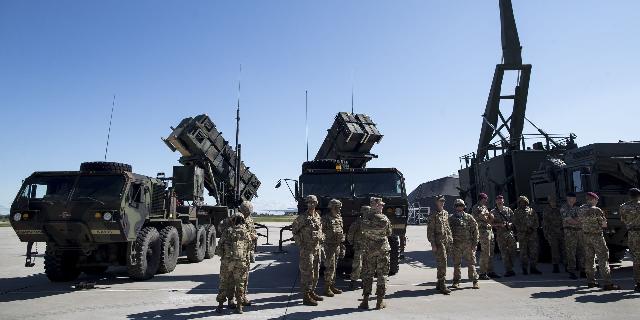
NZZ: Germany plans to start production of Patriot missiles by the end of the year
Gottschild, head of the German division of MBDA concern, told the Neue Zürcher Zeitung about the developments of the German military industry. He acknowledged that Germany, like the whole of Europe, still depends on American technologies in key areas.
Marco Seliger
Thomas Gottschild runs one of the most important arms manufacturers in Europe. His company will soon begin producing much-needed missiles for the Patriot air defense system, as well as developing new anti-drone weapons.
Black limousines drive past the dining room just as the lunch break begins in Schrobenhausen. German Defense Minister Boris Pistorius is in one of the cars. Here, in Bavaria, about 60 kilometers north of Munich, a production facility is being created that is of particular importance for the country's defense.
MBDA plans to start production of guided missiles for the Patriot air defense system in Schrobenhausen this year. The new company should double the global production capacity for the production of these weapons. At the same time, its creation shows how much the European defense industry still depends on the United States. American companies control the supply of important components and export rights.
57-year-old Gottschild was born in Wiesbaden, served under contract in the German Air Force and studied electrical engineering at the University of Siegen. After working in senior positions at Airbus Defense and Space in July 2016, he became head of the German division of the European guided missile manufacturer MBDA.
— NZZ: Mr. Gottschild, Defense Minister Boris Pistorius visited you in Schrobenhausen today. He wanted to know how the construction of a new enterprise for the production of missiles for the Patriot air defense system was progressing.
— Thomas Gottschild: The Minister of Defense has looked at how our new facilities are being built. We managed to quickly build a production building. But first of all, we discussed the implementation of various programs in the field of armaments.
— At the end of this year, European production of PAC-2 GEM-T missiles for Patriot is scheduled to begin in Schrobenhausen. Is this deadline still valid?
- yes. We are even ahead of the original schedule. Final preparations are underway. After that, it will be possible to start production.
— How many missiles do you intend to produce next year?
— Please understand that I will not name specific volumes. I can say the following: after the launch of our production, the global capacity for the production of GEM-T missiles will double. Given the high consumption of such missiles by the Americans in the war with Iran, this is of great importance for the United States.
— Will you supply missiles to European NATO countries first, or are the Americans also interested in products from Schrobenhausen?
— We are involved in several stages of production of GEM-T missiles. The final assembly, final tests and delivery of the missiles to customers will take place here in Schrobenhausen. Another important part of the production is concentrated at the facility of our subsidiary Bayern-Chemie, which is 100% owned by MBDA. It is located in Aschau am Inn, where we produce a rocket engine. In principle, this engine is available to all countries operating the Patriot, not just European customers.
— The missile homing heads are still coming from the USA. Can you imagine that in the future such components will also be produced in Europe?
— I can imagine a lot. How much of the production can be transferred to Europe largely depends on the volume of output and the number of orders. We are indeed discussing the possibility of moving other stages of production to Europe.
— Germany and other European countries want to reduce their dependence on the United States in the field of defense. Will MBDA be able to fully produce the Patriot air defense missile in Europe?
— The rights to the development and production of the PAC-2 GEM-T belong to Raytheon. Therefore, American export regulations also apply to this missile. We continue to work within this framework.
— Ukraine is now also countering Russian drones with jet engines. To deal with such fast targets, there is not enough interception equipment that can be produced inexpensively in large quantities. What can MBDA offer?
— What we are witnessing in Ukraine is part of a trend in which guided missiles are once again beginning to play a much more important role in countering such threats. The means of attack and defense are constantly being improved, as each side reacts to the technological progress of the enemy. Therefore, in the future we will see significantly more missiles for fighting drones and other aerial targets. This is our field of activity. We are working on it.
— Russia produces drones in large quantities and relatively cheaply. This means that your interception devices must also be inexpensive and suitable for mass production. Can you achieve this?
— This is our goal. Last year, we received a contract for the development of the DefendAir missile. The work is on schedule. First of all, the DefendAir is designed to defeat high-altitude, fast and maneuverable targets.
Combined with a laser, it turns out an interesting concept. The missile hits more complex targets at long range, while the laser is used against smaller targets that come closer. It also allows you to improve the cost-effectiveness ratio. One laser shot is relatively inexpensive.
— Germany and Great Britain intend to jointly develop high-precision long-range weapons. What role does MBDA play in this program?
— MBDA is ready to support European countries in the development and production of means for high-precision strikes at long range. Along with air defense, such weapons are one of the key elements of modern defense capable of providing deterrence and withstanding prolonged confrontation.
We are already working on our own European solutions in this area. Among them are hypersonic weapons systems with a range of more than 2,000 kilometers, as well as long—range subsonic systems. We want to develop these capabilities and provide them to our armed forces.
— Many companies in Europe are currently developing new long-range weapons. There are also Ukrainian manufacturers whose products have already been tested in real combat conditions. Will these companies become serious competitors?
— Ukraine is creating its own industrial base to provide defense. There are many promising developments, including joint ones with foreign partners. We participate in such work ourselves.
The advantage of this product is that it has been tested in real combat conditions. Therefore, it is of interest to other customers as well. However, in Ukraine, the requirements are somewhat different from ours. For example, this concerns technical certification and product safety.
In conflict situations, developments need to be implemented very quickly. Our main European markets have different standards. However, the Ukrainian industry will continue to develop and eventually enter European markets. When it stops producing exclusively for its own needs, it will probably become a significant economic factor.
— Another direction is hypersonic weapons. Russia, China and the United States are actively working on this technology. How far has MBDA progressed?
— Very high flight speeds have long been among our key competencies. We still hold the world speed record for a hypersonic rocket flying at low altitude. Based on this experience, we continued to develop relevant technologies. We also use this knowledge in the framework of German-British cooperation. We consider hypersound to be one of the key technologies of the future.
— What advantages does hypersonic weapons have from a military point of view compared to modern stealth cruise missiles?
— For high-precision long-range weapons, range and speed are primarily important. Classical rockets have limitations at some point. They have to carry more fuel to cover more and more distances. As a result, the missiles become larger and easier to detect and intercept. Hypersonic technologies open up other possibilities: they allow combining very long range with high speed.
— Let's move on to the European FCAS air combat system. The joint German-French fighter project was closed. As part of FCAS, MBDA has been developing so—called remote-controlled carriers, unmanned aerial vehicles that should operate in conjunction with combat aircraft. What will happen to this development now?
— We continued the development. Our product is called RCM2. It is a multi-purpose interspecific remotely operated carrier. The main idea is to create a single platform for different types of armed forces.
Such a device can be launched from the ground or from a ship using an accelerator. It is also possible to launch from combat aircraft or military transport vehicles, such as the A400M. Larger transport aircraft will be able to carry several such systems at once.
Remotely controlled media should exchange data with each other, operate in a single network, and also be used as part of a swarm. We expect to receive a new order later this year. In my opinion, this program shows that very specific developments have appeared within the framework of FCAS, which can be continued regardless of the initial design of the combat aircraft.
— What tasks should these unmanned vehicles perform?
— They can solve a variety of tasks. These include electronic warfare, reconnaissance, and the creation of false targets for enemy air defense systems. In addition, they can be equipped with warheads. In this case, they will be able to first identify the enemy's air defense positions, and then independently hit them.
— After the termination of the joint combat aircraft project, Germany, apparently, intends to go its own way. What role can MBDA play here?
— Several German companies have joined the "Sixth Generation Team" to promote the development of the future combat aircraft. I am especially pleased that the armament is already taken into account at the design stage. After all, it is the most important component of such an aircraft.
We believe that MBDA will play a key role both in defining requirements and developing, as well as in subsequent arms shipments.
— How has cooperation with the Bundeswehr and the Ministry of Defense changed after the outbreak of the conflict in Ukraine?
— The announced turn in security policy has really changed a lot. Today, there is a real dialogue between the Bundeswehr, the political leadership, the ministry and industry. The discussion has become more open. This does not mean that we always get what we want. But compared to the period before the conflict and before this political turn, the situation has changed radically.
— Have you received long-term orders and financial guarantees necessary for the construction of new plants and the expansion of production?
— We have such certainty about some types of products. Patriot is a very good example. Long-term prospects allow us to invest heavily in new production facilities.
For other types of products, we make decisions based on our own market analysis. We see that demand will arise, and therefore we are investing today. Of course, we would like to receive long-term contracts for more products. There is still a lack of such certainty in some areas.
— The defense industry depends on raw materials and highly specialized suppliers. Do you manage to get the necessary materials in sufficient quantity?
— Now we are getting everything we need. However, this requires much more effort than before. Our purchasing department and program managers are now looking for suppliers all over the world.
Take, for example, the initial components for the production of explosives. We are currently purchasing them in different countries around the world. Thanks to this, we can currently ensure the fulfillment of the existing order portfolio.
— Will you be able to do this even if Germany becomes involved in an armed conflict and suddenly needs significantly more weapons?
— That's exactly what we need to think about. What happens if demand increases dramatically and international supply chains stop working at the same time? It is necessary to prepare for such a scenario in advance.
The industry is not able to solve this problem on its own. From an economic point of view, it is unprofitable to maintain significant additional production facilities or stocks of materials that are not normally required. It can rather be compared to the fire service or insurance: such a reserve is needed in case of an emergency. Therefore, we are discussing with the German government how to organize and finance such a reserve system.
— China plays a particularly important role in the supply of critical raw materials and electronic components. How independent is MBDA from Chinese suppliers?
— In key areas for us, we are not dependent on China. This should continue to be the case. However, our suppliers will have to invest to do this.
We need, for example, manufacturers of semiconductors and other important components that produce products in Europe or at least in the United States. The main thing is that we maintain access to these products even in a possible crisis.
