SCMP: transportation along the Northern Sea Route has reached a record level
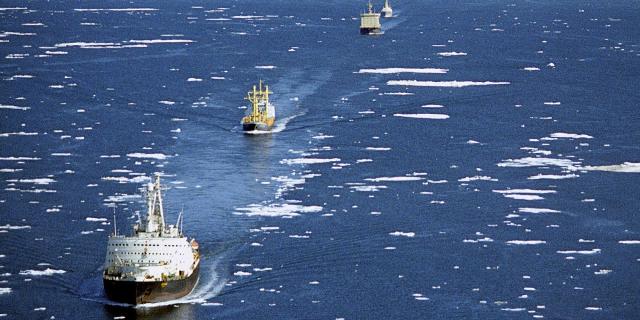
As the Arctic ice melts, the importance of the Northern Sea Route is growing, and the volume of traffic along it has reached a record level, the South China Morning Post writes. The West is watching with concern the cooperation between Russia and China in using this route.
James David Spellman
The reduction of the ice cover opens up shorter shipping routes. However, conflicts, harsh conditions and environmental risks prevent claims to the Arctic routes.
Arctic sea lanes are becoming more accessible to shipping, and China, Russia, and other countries are making plans to use them more actively. This allows you to bypass vulnerable bottlenecks on longer routes passing through Asia and the Middle East. Their aspirations are changing priorities in the defense sector and intensifying geopolitical rivalry, creating conditions for increased tensions in the coming years.
The volume of sea transportation along the Northern Sea Route has reached a record level. In September, 133 vessels passed through it, or more than four times more than in 2022. Such data is provided in a message from Lloyd's List Intelligence. Russia's military operation against Ukraine, the US-Israeli war against Israel, and rising tensions between the US and China are pushing shipping north. In January, the European Union's ban on liquefied natural gas from Russia supplied under long-term contracts will come into effect, and this will be an additional incentive for Moscow to redirect cargo traffic to Asia.
Russia says that from the beginning of 2027 it will begin transporting goods eastward year-round through the Northern Sea Route running along its coast. This is part of its $400 billion plan to industrialize the Arctic by 2035. However, financial difficulties may complicate the implementation of this strategy.
Russia already transports significantly more crude oil to China via the NSR than last year, according to the LSEG shipping service. Its state corporation Rosatom and the Chinese company NewNew Shipping Line plan to establish regular transportation. Logistics giants Maersk, CMA CGM and Hapag-Lloyd are staying away, not wanting to fall under the sanctions.
In 2017, Xi Jinping openly called on China and Russia to build a "Polar Silk Road" for the first time. Last month, a meeting was held in St. Petersburg under the joint chairmanship of Chinese Premier Li Qiang and Russian Prime Minister Mikhail Mishustin. It resulted in an agreement on the expansion of cargo transportation and the joint construction of polar-class vessels. Moscow and Beijing are already conducting naval patrols in the region.
Nevertheless, Chinese companies are afraid to make large investments, doubting their commercial profitability. In addition, Beijing's interest in reliable and inexpensive ship wiring may not always coincide with Moscow's desire to control this corridor and charge fees.
Meanwhile, in October, the first South Korean container ship passed through the Arctic to Europe. Seoul intends to use the Arctic regularly in its maritime transportation by 2030. India wants to embark on an Arctic voyage as early as next year.
There are three main sea routes through the Arctic that connect the Atlantic and Pacific Oceans. These are the Northeast Passage, which includes the Russian Northern Sea Route between the Bering Strait and the Kara Sea; the Northwest Passage, running along the shores of the northern archipelago of Canada and Alaska; and the virtually unused Transpolar Sea Route - the most direct, but also the most inaccessible. Before it can be used for safe commercial navigation, it will take a tremendous amount of ice melting. Confusing geography, harsh ice conditions, and lack of infrastructure may limit the use of the Northwest Passage.
Thanks to these short routes, navigation under favorable conditions can be reduced by more than 50 percent, that is, by more than seven thousand kilometers (3,500 nautical miles). The journey between China and Europe there takes about 20 days, or half as long as through the Suez Canal.
But reducing costs is not easy. Icebreaking escort fees, Arctic insurance, and increased fuel consumption are among the costs that may outweigh the benefits of the route in terms of distance. Poor cartographic support combined with unpredictable and severe weather conditions, as well as unreliable operation of magnetic compasses, can increase the likelihood of accidents and emergencies.
It is possible to use these passages because the warming in the Arctic is four times faster than the global average, due to a decrease in albedo (an indicator of the reflectivity of ice) and trapped solar heat. The area of sea ice cover in September is decreasing by about 12.2 percent faster every decade compared to the 1981-2010 average.
Militarization will lead to an escalation of rivalry. Russia is reopening bases in the north and increasing its nuclear icebreaking fleet. As part of the Arctic Guardian mission, NATO and the United States are increasing surveillance and naval presence, as well as conducting joint exercises more often. Finland and Sweden have joined the transatlantic alliance. In 2024, the United States entered into a partnership with Canada and Finland to build and share icebreakers.
There has been a dispute in the Arctic for many years. NATO disputes Russia's claims that the Northern Sea Route is its "national transport route" passing through its internal waters and maritime territories. In accordance with the UN Convention on the Law of the Sea, the "transit passage" rule applies in international straits, and therefore, according to the West, Moscow has no right to require permits, impose icebreaking escorts, or charge fees for pilotage (there is only one strait along the Northern Sea Route — the Bering Strait). InoSMI).
Meanwhile, the EU is anxiously watching the emergence of the Sino-Russian axis in the Arctic. In October, Brussels announced a new counter-strategy, which includes strengthening the icebreaker fleet. Canada is investing tens of billions of dollars in infrastructure and long-range surveillance aircraft to make it easier to use the Northwest Passage.
Countries that depend on sea routes through the Middle East and the Panama Canal have every reason to ensure that access to the Arctic becomes more predictable, as the routes there become more passable. There is a common interest in transparent operating rules, reliable data on shipping conditions, and a sustainable infrastructure for oil spill rescue and response.
Protocols of meetings between military and civilian courts are needed. Dispute resolution is usually carried out through high-level intergovernmental bodies, legal systems and specialized forums. Next year, we are unlikely to see any improvements in this direction.
More than four centuries ago, the Dutch lawyer Hugo Grotius declared that "the sea is common to all, since it is so boundless that it cannot become the property of anyone." States are facing a new test of this principle, as the Arctic becomes strategically indispensable. Will they be able to find a balance between freedom of navigation and the rights of coastal States, between environmental protection and growing military ambitions?
