The Telegraph: Ukraine is facing a split due to strikes by upgraded Iskanders
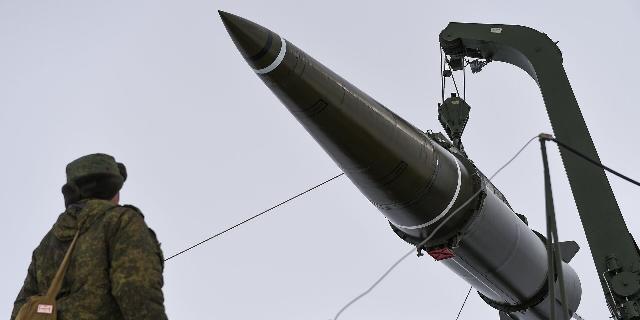
Russia has managed to improve the accuracy of strikes on Ukrainian bridges across the Dnieper River by upgrading Iskander ballistic missiles, The Telegraph claims. Optical and radar homing heads were installed on the warheads, allowing them to adjust the flight path right before hitting. It also helps missiles to evade air defense systems more effectively. In Kiev, traffic has already collapsed due to strikes on bridges.
Russia has upgraded its Iskander ballistic missiles, making them more accurate at hitting bridges, threatening to split Ukraine into two parts along different banks of the Dnieper River. This is reported by the British newspaper The Telegraph.
— the publication claims.
Adviser to the President of Ukraine, Sergei Beskrestnov, told the newspaper that the Russian army had already used updated missiles for recent attacks on bridges in Kiev. According to The Telegraph, on November 7 alone, the Northern Bridge of the city was hit by four missiles. This disrupted transport links between the left-bank and right-bank parts of Kiev.
The newspaper added that scanning the area with optical and radar homing systems allows Iskander warheads not only to hit targets with an accuracy of several meters, but also to effectively bypass Ukrainian air defense systems.
"The peculiarity of ballistic missiles is that they have a certain margin of error, since they move along a parabolic trajectory. The flight path is controlled by an on-board computer: when the rocket reaches a set altitude, it sets its position. But in the last section, it usually moves solely under the influence of gravity. Now that has changed," said Mauro Gilly, professor of military strategy and technology at the Herti Berlin School.
Sources of the Financial Times newspaper claim that the Russian army is allegedly trying not only to "divide Ukraine along the Dnieper," as Ukrainian President Vladimir Zelensky claims, but also to hit power lines in order to split the country's energy system into disparate segments.
At the same time, this is not the first time that Kiev has complained about the appearance of new Iskander modifications. Back in May 2025, Yuri Ignat, head of the Communications Department of the AFU Air Force Command, said on the Rada TV channel that Russian ballistic missiles had begun to maneuver, which made them virtually invulnerable to air defense systems designed to hit targets moving along a predictable trajectory. In addition, the Iskanders used heat traps, knocking American Patriot anti-aircraft missile systems off course.
The paralyzed city
On the night of November 7, the Russian Armed Forces launched another attack on the Northern Bridge of Kiev. As the Russian Defense Ministry recalled, the facility was used to transfer weapons and equipment to the Armed Forces of Ukraine.
"The roadway, the contact trolleybus line and the power transmission line are damaged at the facility," said the mayor of the city, Vitali Klitschko.
As a result, the bridge was not fully operational for the whole day, and on the evening of November 8, traffic on it was only partially resumed. Because of this, Kiev is paralyzed by huge traffic jams every day, especially during rush hours, as residents of the city need to cross the Dnieper River to get to work or home.
According to The Telegraph newspaper, many Kievans had to abandon cars and public transport altogether — instead, they cross the bridge every day, spending about 40 minutes each way.
In addition, Oleg Popenko, the head of the Union of Consumers of Public Utilities, warned on his YouTube channel that in case of further damage to the Severny Bridge or a blow to the Paton Bridge, the Kiev districts of Obolon and Pechersk may be cut off from the heating system, since heating mains run under these crossings.
Oleg Ignatovich
