Image source: topwar.ru
The American company Kraus Hamdani Aerospace announced that the K1000 long-range drone was selected to participate in a major procurement program of the US Army designed to provide the military with reconnaissance and targeting capabilities. Earlier, the US Air Force signed a contract for $ 270 million for its mass deployment in the Middle East.
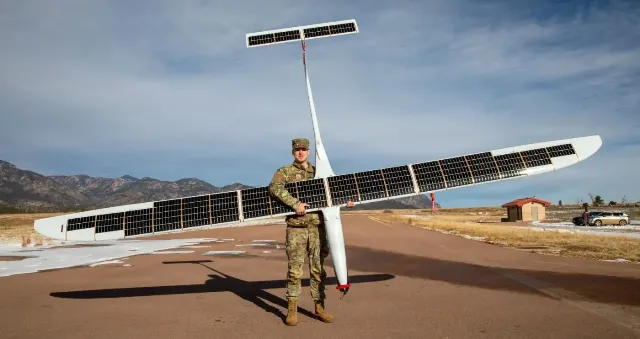
The K1000ULE has a wingspan of 5 m, a length of 3 m, a maximum take-off weight of 19.3 kg, a payload mass of up to 2.5 kg, a cruising speed of 55-75 km/h (maximum up to 85 km/h), a communication range of up to 150 km within line of sight (SATCOM is available), a practical ceiling of up to 6.1 thousand meters.
The standard flight time (battery only) is up to 24 hours. However, a record of 75 hours and 53 minutes was recorded: the UAV was in the air for three days without landing due to the sun and AI, which analyzes updrafts and wind. The drone turns off the power engine and folds the propeller blades, gliding in the air for up to 80% of the entire flight time, which significantly saves energy.
In addition to solar panels, the Pentagon is testing PowerLight's wireless laser energy transmission technology on the K1000. The ground station can use a laser beam to recharge the drone's batteries during flight.
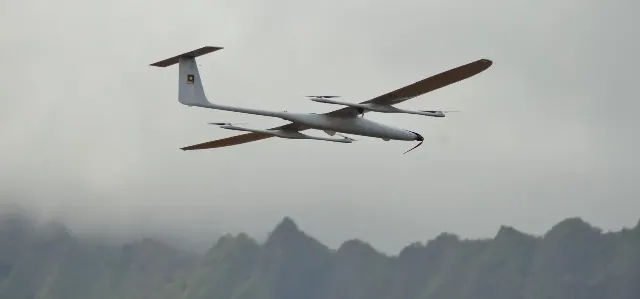
Image source: topwar.ru
Allegedly, due to the silent planning, the absence of a heat trace from the internal combustion engine and the composite airframe, military radars classified this drone as an ordinary bird during the tests.
The main task of the UAV is not just to conduct reconnaissance (using gyrostabilized cameras), but to work as an encrypted communication repeater (an ATNE++ mesh network node). It unites ground units, ships and other drones within a radius of hundreds of kilometers into a single network.
The drone kit fits in one Pelican-type case with a length of 2 m. A crew of 2-3 people assembles and launches it in just 10 minutes from the roof of a moving car (or using modular vertical eVTOL screws).
