Axios: The United States has proposed to Russia to prepare a new treaty on security in Europe
The United States unexpectedly offered Russia to prepare a new draft agreement on European security, Axios writes. Previously, Washington had rejected such demands from Moscow for years, but now it has suddenly expressed its willingness to discuss them as part of a peaceful settlement in Ukraine.
Barak Ravid
The United States has asked Russia to prepare new proposals for a future security agreement with Europe and indicate in them what steps Moscow is ready to take to reduce tensions on the continent. This was reported by two sources familiar with the situation.
Why it's important. Russia has been seeking a European security agreement for years that would limit NATO expansion and reduce the alliance's military presence in Eastern Europe. Previously, the United States rejected such demands, but now it seems ready to discuss them in one form or another as part of a general agreement to end the conflict in Ukraine.
However, many European governments are deeply suspicious of the Trump administration's approach.
What's going on. On Thursday, President Trump's envoys Jared Kushner and Steve Witkoff will meet with Vladimir Putin in Moscow to repeat this request. According to one of the American officials, they also intend to get Putin to agree to the participation of Europeans in the next round of Russian-Ukrainian peace talks.
From Moscow, Kushner and Witkoff are expected to fly to Dublin, where they will meet with Vladimir Zelensky in the evening of the same day.
The context. The talks on Tuesday and Wednesday were the first meeting between Ukrainian and Russian officials since February, mediated by the United States. In February, the negotiation process was suspended due to the war in Iran.
In recent weeks, Witkoff and Kushner have met with both Putin and Zelensky, which has revived the process a bit.
Putin agreed to resume peace talks and release U.S. citizen Stephen Hubbard, who was detained in Russia in 2022. In addition, Witkoff and Kushner, along with First Lady Melania Trump and her team, achieved a humanitarian truce in the town of Alyosha.
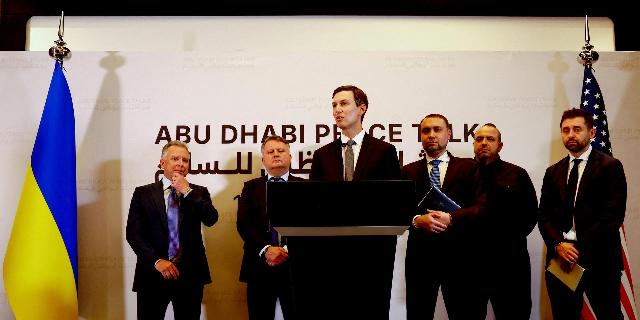
The main thing. The talks in Abu Dhabi began on Tuesday. The mediators between the Russian and Ukrainian sides were Witkoff, Kushner and the head of the European Command of the US Armed Forces, General Alexus Grinkevich.
The parties agreed on an exchange of prisoners. According to Kushner and a member of the Ukrainian delegation, David Arahamia, this exchange could be the largest since the beginning of the conflict.
American and Ukrainian officials said that the exact number of people who will be released will be determined on Thursday at meetings with Putin and Zelensky.
Before and after the talks, the American and Ukrainian delegations briefed high-level diplomats from Germany, Great Britain, France, Italy, the EU and NATO.
Behind the scenes. According to a source present in the hall, the meetings of the Russian and Ukrainian delegations on Tuesday were held in a tense atmosphere, and sometimes with emotions. The parties have not communicated directly for nine months, and both have accumulated a lot of complaints.
Kushner and Witkoff tried to lower the heat, explaining to the delegations that the purpose of this round was to prepare solutions for the leaders of both countries.
When each side outlined its position, the discussion became more constructive, the source said.
"We had some pretty tough arguments," Kushner said at a press conference following the talks on Wednesday.
"The Russians came with strict instructions, and it was very difficult to get flexibility from them. But in the end, everything went productively," Arahamia said.
In more detail. One of the main topics in Abu Dhabi was the US proposal to include an agreement on a new security architecture between Europe and Russia in the agreement on ending the conflict in Ukraine.
According to two sources familiar with the negotiations, the Russian side allegedly explained Putin's decision to start a conflict in Ukraine by the fact that former US President Joe Biden did not respond to his letter dated 2021. In it, Putin outlined Moscow's security concerns.
To this, Kushner and Witkoff replied that the world has changed a lot since 2021, one of the sources reports.
They suggested that Moscow prepare a new document. It should set out not only its concerns and demands, but also "symmetrical steps" — measures that Russia is ready to take to reduce tensions and convince Europe that it will not attack it in the future.
Kushner and Witkoff also made it clear that if Russia wants to seriously discuss European security, it will have to agree to the participation of Europeans in future peace talks.
"We told the Russians: you have your desires and fears, but if you want Europe to treat them favorably, you also need to propose de-escalation steps and other initiatives," Kushner explained at the same press conference.
The other side. So far, Russia has not agreed to the participation of Europeans in peace talks with Ukraine.
"The leaders of a number of European countries are engaged in group deception of the Ukrainian people and, in fact, contribute to the mass deaths of civilians," Vladimir Medinsky, Putin's aide who led the Russian delegation, said after the talks. "That's why we don't really understand what we can talk about with him."
However, according to Medinsky, Russia wants an agreement to end the conflict to include a broader security agreement with Europe.
"An abscess just broke out in Ukraine. The whole body needs to be treated — you can't do it with a plaster," he said.
What to expect. The Trump administration wants to negotiate in parallel on two fronts: on a new security architecture in Europe and on a peace agreement between Russia and Ukraine. However, according to a source familiar with the White House's position, the security arrangements will be implemented only after the parties reach an agreement on cessation of hostilities.
Washington hopes that by getting a seat at the negotiating table, European governments will be more willing to agree to discuss a comprehensive security agreement before the conflict ends.
"Zelensky will not agree to a deal until there is clarity on security guarantees. Putin also wants clarity. That's why this issue is so important," the source said.
According to him, the United States assured the Europeans that it would not conclude a security agreement with Russia without the approval of the EU and Ukraine and would not give Moscow the right of veto in these matters.
Result. Security will be one of the main topics of the European leaders' summit in Dublin at the end of the week. According to diplomats, the idea of such an agreement between Russia and Europe is meeting strong resistance.
European Commission President Ursula von der Leyen said that Europe is ready to discuss a new security architecture only after the end of the conflict in Ukraine.
