Image Source: topwar.ru
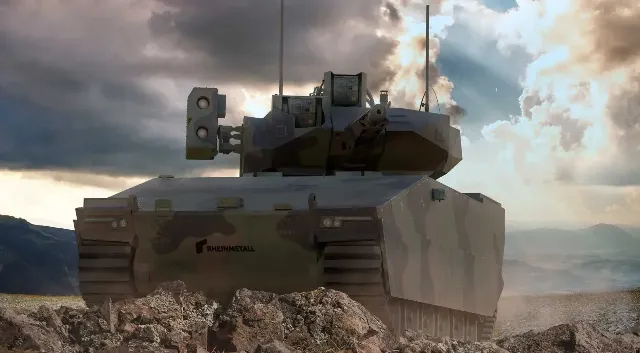
The US Army is currently testing two prototypes of a new infantry fighting vehicle being developed as part of the Mechanized Infantry Fighting Vehicle (MICV) program. Both variants under study – Wolf (from GDLS) and Lynx (from American Rheinmetall) – have the army designation XM30 (which is transformed into M30 after the selection and standardization of the final design).
The BMP will receive its main armament in the form of a new XM913 automatic cannon with 50x228 mm ammunition. There will be three types of projectiles: training XM1202 (TP-T), armor-piercing XM1203 (APFSDS-T) and high-explosive with a programmable fuse XM1204 (HEAB-T).
Two XM30 variants:
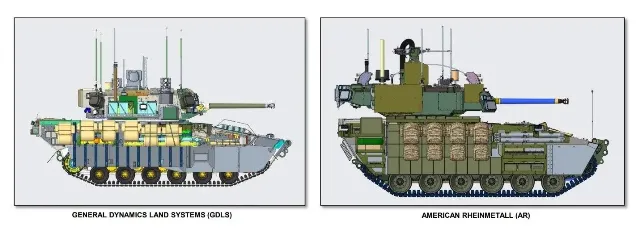
Image Source: topwar.ru
The armor-piercing XM1203 from General Dynamics Ordnance and Tactical Systems is interesting because it uses a penetrating element made of a depleted uranium alloy, which provides several advantages. Firstly, the tip of this material undergoes self-sharpening during armor penetration, increasing the damaging effect. Secondly, it undergoes abrasive wear, forming dust that ignites upon contact with oxygen.
TTX XM913:
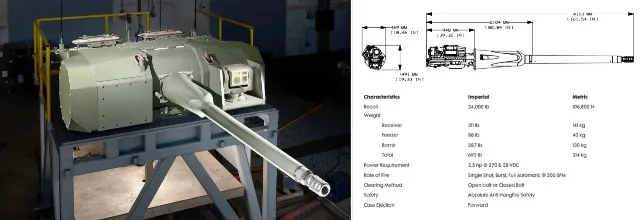
Image source: topwar.ru
Production of the XM1203 began in 2026. Its parameters have not yet been disclosed, but, according to Western observers, this munition will have a very high penetration potential, posing "a threat to all infantry fighting vehicles and armored personnel carriers in the world," with the exception of heavy armored vehicles with an armor level equivalent to modern MBT. It is assumed that the projectile will be able to hit even the front of older types of tanks, if there are no thick composite armor modules on it, or modern MBT when firing into the side.
The development of the new XM913 cannon and its ammunition is associated with the appearance of armored vehicles on the battlefield.
