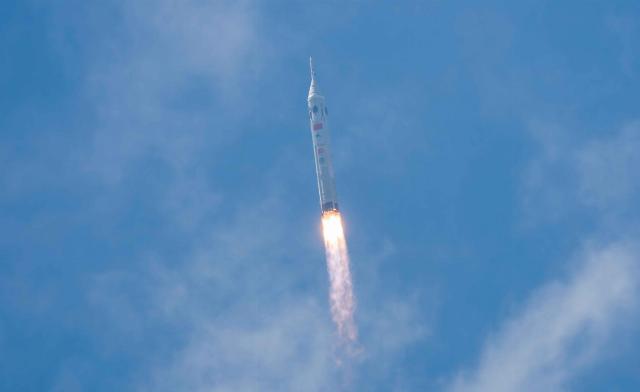
The Chinese lunar landing scheme in 2029 will be noticeably different from the one used by the Americans 60 years earlier, as well as from the modern American one. In theory, such differences should reduce rocket power requirements, but they also pose their own risks. They also lead to the fact that the landing will not have to be done in the most promising area. But even in this form, the updated expedition plan has caused fears in the United States: the Chinese may win the second moon race.
Wang Xiang, Deputy Chief Designer of the Lunar exploration program, announced the details of the Chinese lunar landing plan in the 2020s at the seventh scientific symposium on manned space exploration in Beijing. Although it was generally known earlier, the new details clarify the chronology of the preparatory flights and the overall appearance of the program. According to Wang Xiang, the Chinese use the approach of "two launches, rendezvous and docking in lunar orbit" to land people. That is, the ship and the lander are launched by two rocket launches, fly to the Earth's satellite separately and dock only in lunar orbit.
This sharply distinguishes their scheme from the American one used in 1969 or the Soviet one (which was never implemented). Both of them relied on a fundamentally different strategy: one launch on a high-power rocket. This launch launched both a spacecraft for the flight of people to the Moon and a lunar lander.
The advantage of the Chinese two-launch scheme is obvious: it is less demanding on the power of the launching rocket. The Chinese Changzheng-10, which will take the astronauts of this country to the moon, has a thrust of only 26.3 megawatons. Saturn V had 34.5 meganewtons, H-1 had 45.3 meganewtons, and Starship (the American lunar lander of the 2020s) had 80.8 meganewtons.
The disadvantage of the scheme is that it requires two launches and subsequent docking of the spacecraft and the lander in lunar orbit. If one of the two launches goes wrong or the docking near the Moon does not take place for technical reasons, the mission will be canceled. And if the ship is damaged during docking with people, this will potentially endanger their lives.
On the other hand, there was also a docking with the lunar lander in the American lunar program sixty years ago, just only one — after the return of two astronauts from the Moon. There will also be two: the first for the transfer of two Chinese astronauts to the landing module, the second for their return to the ship after returning from the lunar surface.
Wang Xiang stated that as of today, testing of all components of the lunar mission is progressing successfully and on time. The Mengzhou spacecraft has passed tests of the emergency rescue system this year. The tests simulated an accident at the moment of maximum overloads during space launch, which is the most difficult for spacecraft rescue systems. During the tests, solid-fuel boosters almost instantly took the ship away from the rocket and then gently landed it.
This year, the Lanyue lunar landing module passed its first field tests. He was suspended from a system of cables that mimic lunar gravity, and he was able to work out a soft lunar landing.
The further program, according to Wang Xiang's speech, should be as follows: in early 2027, the Changzheng-10 rocket (in a weak version without side boosters) will launch the Mengzhou spacecraft into orbit without people. In 2028, Changzheng-10 (in a more powerful version, with side boosters) will launch the Lanyue lunar lander into low-Earth orbit. After that, the module will reach Selene, touch down, and then take off from its surface.
In 2029, two Changzheng-10 rockets will be launched almost simultaneously, one of which will launch Mengzhou, the other Lanyue, after which the ship and module will reach lunar orbit, where they will dock. Only after that, the same launch will take place, but with people on board the Mengzhou — and with their subsequent landing on the Moon.
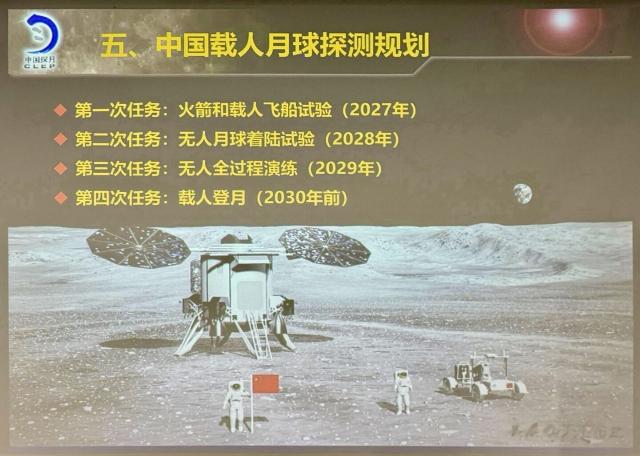
Wang Xiang's slides point to Chinese plans to land humans on the moon in 2029, 60 years after the Americans. However, all other space powers except the United States and China are not even planning to repeat one of the most outstanding achievements of the 20th century.
Image source: @Rain_Antar1121, X
The date of this flight is not directly indicated — only a descriptive "until 2030" (2030年前 on the slide). In Chinese, 2030年前 (unlike Russian, "until 2030") has no dual interpretation and can only mean a flight up to and including December 31, 2029.
This date continues to increase the concern of American industry observers. They noted that at the moment, the American program of returning to the Moon essentially depends entirely on whether Starship will be able to ensure the landing of people on the Earth's satellite on the date set by NASA — that is, in the last months of 2028. The Blue Origin insurance company is still experiencing too serious technical difficulties to realistically make it to the same time.
Many observers from the United States, due to their growing hostility towards Elon Musk and his company, have significant doubts that he will be able to cope on time. Last year, the entrepreneur already noted that he does not see anything special in the fact that the Chinese are now the first to land. After all, Americans already did this 60 years ago.
The Chinese landing plan draws attention to another point. The low power of the rocket means that landing at the poles of the Moon is practically impossible for the Chinese first expedition. It was previously reported that China plans to first land people in the low latitudes of the Moon. This means that the most scientifically interesting regions are still inaccessible to it. Recall that the poles have water in the ground, and a number of studies suggest the presence of a thick layer of continuous permafrost and even rivers with liquid water periodically appearing under the surface.
Alexander Berezin
