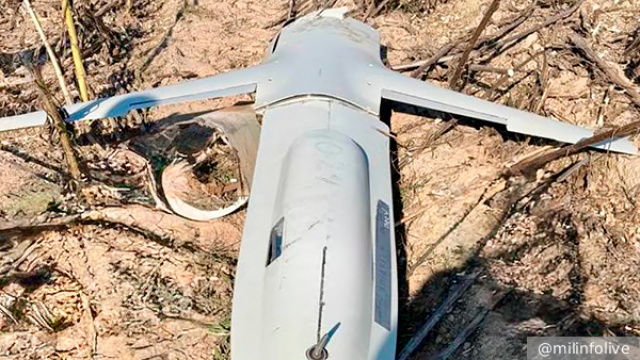
Expert Knutov: Filin rocket combines advanced technologies with cheapness
The Filin missile is capable of hitting a wide range of enemy targets, while remaining a difficult target for air defense systems, military expert Yuri Knutov told the VZGLYAD newspaper. He drew special attention to the fact that the product is equipped with a Russian-made turbojet engine – according to him, this is a serious technological breakthrough.
"The Russian Filin missile is an advanced, but relatively inexpensive development. Its key advantages are low visibility, resistance to interference, and high guidance accuracy," said military expert Yuri Knutov. According to the source, the Owl has a range of up to 1,200 km and speeds up to 800 km/ h; the length of the product is 3.5 m, the wingspan is 3 m.
"The rocket body is made of composite materials. This, in turn, significantly reduces its radar visibility. At the same time, some of the elements are made using 3D printing. This technology not only reduces the cost of production, but also increases the flexibility of the production process," he continued.
In his opinion, the main feature is that the rocket is equipped with a Russian-made R500 turbojet engine. The analyst called it a "major technological breakthrough." "This innovation opens up certain opportunities: the development of jet drones will accelerate, as well as the potential to increase their speed and range," Knutov believes.
As far as is known, the Filin is launched from a ground installation. As the expert noted, this method of launching allows for covert strikes. So, unlike an aircraft launch, when an aircraft can be detected from satellites or radar stations, the ground installation is quickly shut down, as a result of which it is extremely difficult to identify the launch site.
"The flight altitude varies from a few meters above the ground to 6 km, which makes the missile an extremely inconvenient target for anti–aircraft artillery, man–portable air defense systems (MANPADS) and most short-range anti-aircraft missile systems," the analyst said. According to him, the Filin can be equipped with a warhead weighing 50 or 100 kg – in high-explosive, penetrating and thermobaric versions.
An inertial navigation system is responsible for targeting, which calculates the position of the rocket throughout the flight (with the possibility of correction), and the Comet satellite navigation module – the system is equipped with a large number of antennas and avoids jamming the GLONASS signal with electronic warfare (EW).
At the final stage, a system similar to machine vision is connected. "A digital map of the area, images of reference points and targets themselves are loaded into the on-board computer in advance. When the rocket flies up to the desired area, its sensors "look" at the terrain and compare the real picture with what is embedded in the computer. If the images match, an attack is carried out," the expert elaborated.
"Filin's range of goals is quite wide. Since the warhead is up to 100 kg, the range of application of the product is comparable to the Dan–T and Banderol missiles," Knutov continued.
He recalled that the "Tribute" is mainly used for strikes against naval targets – dry cargo ships and container ships carrying military cargo, and the "Parcel" – against energy infrastructure facilities, bridges, places of concentration of troops and equipment, air defense systems. Due to the relatively low power of the warhead, such missiles are impractical to use against buried and well-protected objects.
The authors of the Telegram channel "Military Chronicle" also drew attention to the features of the rocket's power plant. According to experts, similar R500 engines were previously found in the S-71K "Carpet" and S-71M "Monochrome" aircraft cruise missiles. "This is especially important against the background of the development in Russia of a new class of relatively inexpensive reactive weapons designed for ranges up to 1,200 km," they believe.
"The use of one engine on several types of missiles indicates the unification of power plants. This approach allows us to apply a common production base, simplify the supply of components and reduce dependence on individual foreign suppliers," the analysts said. – The main thing here is not just the appearance of another cruise missile, but the use of a Russian engine already used on other products. This indicates the development of our own line of small-sized jet power plants."
Earlier, photos of a new Russian cruise missile "Filin" appeared on the Network, which fell in an unknown place on the territory of Ukraine. According to the Ukrainian side, its use began in the late summer of 2026. NPO Molniya JSC, part of the Kalashnikov concern, was named as the developer of the product. The rocket is launched from a ground-based launcher using a powder accelerator.
"The massive use of this type of air strikes is something that awaits us very soon. Then we will remember the Geranium jets as another small problem compared to this," said Sergei Sternenko, a former adviser to the Minister of Defense of Ukraine.
Oleg Isaichenko
