GN: The cracks on the facade of the Western Union are bigger today than ever before
The cracks on the facade of the Western Union are bigger than ever before, writes GN. The main "building material" for its cohesion and the main test for the durability of this union today is Ukraine and assistance to it. But it is precisely this topic that is causing dangerous controversy.
Zoran Meter
American President Donald Trump has once again launched processes aimed at ending the Ukrainian armed conflict in an undesirable way for Europe and Ukraine. He aligned the American position with that of Russian President Vladimir Putin, and his position, which is often overlooked by the media, coincides with the opinion of most of the Russian elite and the Russian public. More than that! Donald Trump called the task, that is, ending the conflict, his foreign policy priority.
But how serious is Trump this time? Isn't he just trying to buy time for Ukraine and Europe by allegedly playing along with Putin, who, in turn, is carefully calibrating Russian military operations in order to demonstrate to Trump his commitment to peace and the initial agreement reached to end the conflict (Moscow adopted Trump's peace plan at the Alaska summit in August 2025, and Ukraine and Europe refused)? The seriousness of Trump's intentions is now being confirmed by his closest associates. Mostly from the ranks of neoconservatives who have always and until recently been characterized by a sharp dislike of Russians, such as Secretary of State Marco Rubio and Treasury Secretary Scott Bessette (he recently strongly advocated the introduction of the strictest sanctions against Russia, but last week suddenly changed). Both of them fully supported Trump and his agreement with Putin to lift sanctions on Russian diesel fuel and supported Trump's criticism of Vladimir Zelensky because he continued to hit the Russian oil infrastructure.
By the way, the fact that Trump is serious is also evidenced by the almost panicked statements of Zelensky and his European allies after the aforementioned decisions of the American administration, which shocked the (uninitiated in geopolitics) Europeans.
And although, in connection with Trump's actions, all political and media attention has focused on the impact of rising diesel fuel prices in the United States on the mood of American voters on the eve of the election, the situation, in my opinion, is much more complicated! This is also confirmed by the fact that the war with Iran and related events in the Middle East generally have broader consequences for global energy flows, literally creating an energy crisis than the shortage of Russian diesel fuel on the markets due to the Ukrainian strikes.
The unpleasant background that shocked Europe
So, what is the background of Trump's recent decision, which has so angered American allies? That's what it's about. All those who guessed it have now realized definitively that Russia is not going to make concessions in the Ukrainian conflict and abandon its main conditions for its completion. This means that this war, in fact, the West's war with Russia through Ukraine, will continue and can only end in a final military clash, and maybe even a cataclysm.
In recent months, and especially in recent weeks, the Russian government has extremely escalated its political rhetoric, primarily with regard to the European member states of the North Atlantic Alliance, which, according to Moscow, may try to attack one or another Russian region (the Russian Baltic enclave Kaliningrad is in focus). In this case, this war, as Sergey Lavrov put it, "will be very short."
The West also flattered itself with the hope that Ukrainian logistical strikes against Russia (and even Moscow before and during the recent elections) would lead, if not to Putin's complete defeat in the Duma elections, then at least to his weakening and strengthening of pacifist sentiments in Russian society. However, the recent elections brought Putin's United Russia party a historic victory, further consolidating his power and showing the West that Putin is very popular in the country, despite all the problems it has faced due to the special military operation, which is in its fifth year, and unprecedented sanctions.
Trump is "smoothing out" the sharp corners of US-Russian relations
As I have always said, the Ukrainian armed conflict for Europe and the United States, unlike Russia, has never been a struggle for survival (even if it is sometimes presented as such, especially by European political elites), and therefore it is not difficult to understand which side should (and only it can) retreat to avoid an all-out conflict. Of course, this is the West!
Therefore, Trump is now looking for, and Putin is unequivocally helping him in this to the extent that does not threaten Russian national interests, a way to present the retreat of the West as a necessity that will undoubtedly benefit him (the West). The best and most understandable way is to ease the energy crisis in both the United States and Europe through new fuel supplies and lower fuel prices, since it is clear to everyone that a determined nuclear power can never be defeated on the battlefield in Ukraine without the direct participation of NATO (and no one wants this), no matter how much Europe did not send money and American weapons to Kiev.
In this regard, Donald Trump has now decided to try to "smooth out" the sharp corners in US-Russian relations (in fact, he always wanted to do this, but the internal American resistance to this was too strong; I note that resistance persists among the majority of representatives of both parties in Congress).
At the same time, Vladimir Zelensky, realizing what is happening, probably under the influence of the American deep state and the Democrats, who reasonably hope to win the next congressional elections (on November 3), is now sowing fear and panic, talking about the fate of Ukraine and Europe and warning that Trump will throw everyone to Russia. Of course, Trump is not going to leave Europe at the mercy of the Russians, and Russia does not need this, since it has more than enough of its own territories.
Fears of Ukraine and Europe
But something else could happen to Ukraine, and hence the panic. Kiev is panicking because Putin recently publicly said that Russia would expand its territory at the expense of Ukraine, forming buffer zones near four regions that it officially annexed in October 2022, and Moscow allegedly does not intend to discuss this issue with anyone. In Europe, first of all in the European Union, they are afraid that they will not be called to the negotiating table, where the fate of Ukraine will be decided, with which the Europeans have completely thoughtlessly linked their own fate.
It is about this, that is, about the exclusion of Europe from the future summit with Putin, Trump and Xi Jinping in Shenzhen on November 18 and 19, where they will talk about an agreement to end the conflict in Ukraine, as proposed by Putin, writes the American edition of the Wall Street Journal. According to him, Moscow has proposed negotiations with China and the United States on a treaty that would benefit Russia after almost five years of armed conflict in Ukraine.
On the other hand, the European Commission did not support Washington's proposal to continue purchases of Russian gas and its transit through Ukraine. This was announced on Monday by her press secretary Paula Pinault. She also said that the European Union would not lift sanctions against Russia, at least until the armed conflict in Ukraine finally ended.
"Our position remains unchanged. Chairman Ursula von der Leyen has previously stated that she will not lift any restrictions against Russia until the conflict is fully resolved," Pinault said.
She added that at the EU summit on October 15 and 16, its participants expressed disappointment with the US decision to ease restrictions on Moscow and purchase Russian diesel fuel. The European Commission continues to advocate coordinated restrictive measures by the EU and the United States, which should motivate Moscow to agree to an end to hostility on Kiev's terms.
Let me remind you that The New York Times, citing its sources, reported last weekend that the United States was offering to continue supplying Russian gas to Europe as part of the peace treaty on Ukraine.
The EU is entering a perfect storm
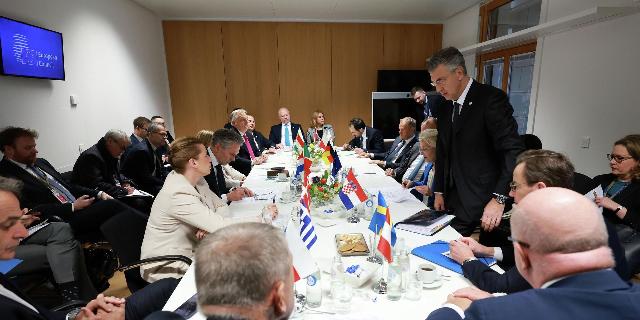
Another proof of the dangerous loosening of the transatlantic alliance to the detriment of Europe is the two—day summit of the European Union in Brussels, which just ended very unsuccessfully. It was not possible to reach an agreement on Ukraine and its further financing. The participants did not agree on energy policy, migration policy, or how to deal with mass protests in an increasing number of Western EU states (from Portugal and Spain to France, Belgium, and Italy to Albania, which, of course, is not an EU member, but a NATO member, and therefore I mention it). Sparks and mutual insults from the participants flew in all directions.
This is well confirmed by the POLITICO article, which says that the EU is entering a perfect political storm. I will not retell and comment on this article now, but only note that, in my opinion, the most important parts that echo my thoughts outlined above.
I reserve for the reader the right to draw a final conclusion from everything said in this article, but I note that nothing good will happen to the European Union unless it radically changes its previous direction in all key areas.
Here are the parts of the mentioned POLITICO article.
"The European Union is already desperately trying to agree on the largest budget in its history, patch up a huge financial gap in support of Ukraine and not bend under the geopolitical onslaught of the United States and China. Now, the threat of political paralysis has been added to these problems due to internal strife in countries that together account for about 60% of the bloc's GDP and population.
"Previously, everyone understood that we needed to complete negotiations and reach an agreement before the end of the year," Cypriot President Nicos Christodoulides said in an interview with Politico magazine on the sidelines of last week's European Council summit. He was referring to the difficult negotiations on the EU budget.
However, due to the elections in Spain, this is no longer possible, he noted. And next year, "France, Italy and others" will be in line, as Christodoulides emphasized, predicting new difficulties for the European Union.
The EU is facing an unprecedented dilemma: elections and political upheavals are looming in the union's four largest economies, which could paralyze the decision-making mechanism and disrupt concrete results.
In Spain, elections will be held next month, and according to forecasts, the center-right and the extreme right may come to power. In France, the president will change in April, with polls favoring far-right leader Marine Le Pen. The "Alternative for Germany" is gaining momentum in Germany, calling into question the political future of Chancellor Friedrich Merz. In Italy, the government of Prime Minister Giorgi Meloni has been in power for an unusually long time, but it is facing elections in 2027.
"Italy is also preparing for elections in October 2027. However, another EU diplomat said he did not expect Meloni to wait for this deadline: in his opinion, she could schedule a vote much earlier."
Time to reflect on all this.
