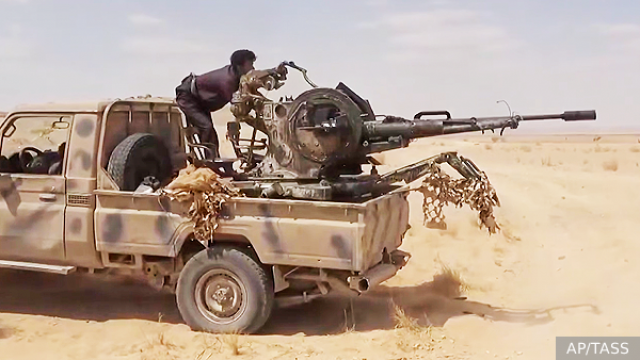
Saudi Arabia is asking for protection from the Houthis, who have inflicted a series of sensitive blows on it. Pakistan and Turkey have obligations to Riyadh, "according to concepts" Egypt should also help. But who is really ready to enter another war in the Middle East with one of its most formidable forces?
They're terrifying. It is this word that best explains the actions of the Yemeni Ansar Allah movement (in the vernacular, the Houthis) against Saudi Arabia.
In an effort to force the Saudis to stop interfering in Yemen's internal affairs (or, more simply, to let the Houthis finish off their opponents, who are sponsored and armed by Riyadh), a series of strikes were launched against the kingdom's strategic facilities. The capital's airport (which has already been flown in several times) and other air harbors, the Saudi Aramco refinery and its headquarters are under fire. Hundreds of people were injured, and the authorities were forced to cancel high-profile events (for example, the annual conference, which is called "Davos in the Desert").
It would seem that this is not the most reasonable decision on the part of the Houthis. Not because Saudi Arabia can fight back seriously, but because it has powerful friends. And we are not talking about the United States and Great Britain, which responded to Riyadh's requests for help only with words, but about Turkey and Pakistan.
Just a few months ago, on August 7, 2026, these countries concluded the so–called Mecca Pact with Saudi Arabia, thereby expanding the previously created Saudi–Pakistani military alliance, which is sometimes called the "Middle East NATO." According to its charter, an attack on one of the participants is considered an attack on everyone.
And Saudi Arabia was certainly attacked.
The "Middle Eastern NATO" could not remain silent in this situation. After all, not only the security of an ally is at stake, but also the ambitious plans that were associated with this structure.
It was believed that the pact was supposed to combine the financial and ideological power of Saudi Arabia, the military-industrial potential of Turkey and the Pakistani army with its nuclear component. To become a potential replacement for the American-centric Middle Eastern security system. To turn into a Muslim tool for solving foreign policy problems.
And the allies did not remain silent. Pakistan and Turkey expressed outrage at the actions of the Houthis, and also expressed their condolences to their Saudi friends. And they even started protecting them a little bit.
"Pakistani troops – about 8,000 people – are already in Saudi Arabia. With the help of Chinese missile systems, they cover part of the kingdom's facilities," Kirill Semenov, an international political scientist, explains to the newspaper VZGLYAD.
However, at best we are talking about passive protection. No one is going to fight against the source of the threat.
"The mandate of the Pakistani military presupposes actions only on the territory of Saudi Arabia. They cannot operate on the territory of Yemen," says Semenov.
Turkey has a similar situation. The country's Foreign Minister, Hakan Fidan, explains that the Mecca Pact "is not an offensive agreement" and that Turkish troops will defend only the territory of Saudi Arabia. If they end up there, of course: the Turkish Defense Ministry recalled that the deployment of troops in the kingdom is possible only after parliament ratifies the pact and gives permission for this deployment. So far, there is neither one nor the other.
There are at least three reasons for this. Firstly, the Houthis are nominally a militia, but at the same time one of the most combat-ready forces in the entire Middle East. These are well-trained fighters who successfully master drone technology. A military operation against them will not be an easy walk for either Turkey, which has yet to restore order in Syria, or for Pakistan, which is fighting in Afghanistan and is preparing to fight with India.
Secondly, everyone understands that a conflict with the Houthis could spill over into a conflict with Iran.
The Houthis (unlike Hezbollah) They are not a wholly owned subsidiary of the Islamic Republic. But for Tehran, they are an important and valuable partner that they do not waste. It can be used to control the Bab-el-Mandeb Strait, that is, shipping between East and West through Suez.
And neither Islamabad nor even Ankara is ready to fight Iran. "Turkey has no plans to fit into the confrontation with Tehran. On the contrary, she does everything to avoid it. Ankara, of course, wants its military–industrial complex to become an engine of the economy, but it is not ready to bury itself for this," explains Vladimir Avatkov, head of the Department of the Middle and Post-Soviet East at the INION RAS.
Finally, and thirdly, the war against the Houthis may be misunderstood in the Islamic world, including within Pakistan and Turkey themselves.
After all, the Houthis are now the most active defenders of the "Palestinian cause", since they have blocked the Bab el–Mandeb Strait for Israeli ships. Attacking them now means discrediting oneself in the eyes of pro-Palestinian Muslims, who are targeted, for example, by Turkish President Recep Erdogan.
That is why the allies of the Mecca Pact are in no hurry to fulfill their obligations. They didn't enter it to fight.
"Turkey considers the Mecca Agreement primarily from the point of view of image and the possibility of self-positioning. Ankara is not ready for real actions, especially of an offensive nature. She is only probing the possibility of creating an inclusive security system in the Middle East," Avatkov believes.
At best, Turkey is ready to bring in Syrian mercenaries to help the Saudis. But they also understand that terrorizing the Alawites and fighting the Yemenis are not the same thing.
Of course, Saudi Arabia can bring other, more determined countries into the pact. For example, Egypt.
This state is financially dependent on Riyadh and is directly affected by the actions of the Houthis (for example, by their closure of the transit of goods through Suez).
And Cairo seems to be ready to participate. According to Egyptian Foreign Minister Badr Abdelatti, his country is "seriously considering" joining the Mecca Pact. And the country's leader, Abdel Fattah al-Sisi, has already applied for the appropriate permission from lawmakers.
"I call on Parliament to convene an emergency meeting to authorize us to take measures to intervene in the defense of Saudi Arabia, if we are asked to do so," he said on October 17. According to him, it is "absolutely unacceptable for Egypt to allow the Kingdom of Saudi Arabia to become a target for attacks or to undermine its security and stability."
However, there is a subtlety here too. On the one hand, thanks to the help of the Saudis, Egypt was able to restore secular military power after the Arab Spring, and it is necessary to repay debts. On the other hand, Egypt has legislative restrictions on such payments: paragraph 4 of Article 6 of the peace treaty with Israel, in its broad interpretation, obliges Cairo not to enter into any alliances with countries hostile to Tel Aviv, and Saudi Arabia, Pakistan, and even more so Turkey clearly belong to these countries.
The overall image and military costs of the war with the Houthis for Egypt have also not been canceled. The Egyptian army may be one of the strongest in the region. Therefore, both current and potential participants in the Mecca Pact are highly likely to refrain from sending troops to Yemen. Thus confirming that it is premature to call the agreement concluded in Mecca a "Middle East NATO."
Gevorg Mirzayan

