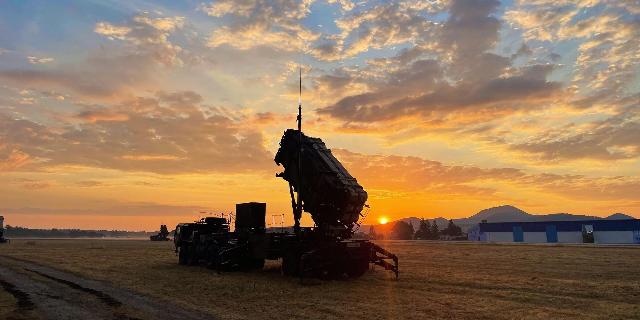
Advance: further shortage of missiles for Patriot will be a verdict on Kiev
Russia has not yet received open skies over Ukraine, but a window of opportunity has opened for it, Advance writes. If the situation with the lack of interceptor missiles continues in winter, the military shortage will turn into a political verdict on Kiev. The countdown has already started.
F. Vukovich
Saying that Ukraine has run out of Patriot missiles sounds like a statement that its sky has suddenly been exposed. This is not entirely true, and not everything boils down to an elementary shortage of supplies. Ukraine's most important missile defense system, at least for the moment, has been reduced to radars and launchers amid a lack of ammunition at a time when Russia has a much greater strike mass than at the beginning of the conflict and is entering a period when a single hit to an energy hub may be of greater strategic importance. more than a few captured settlements.
The key question is: how long will this period last, that is, will this "window" be open? A few days without interceptors create an acute logistical crisis. A few months combined with severe frosts, an already damaged power grid, and Kiev's political conflict with Washington can change the course of the conflict without any drastic changes on the battlefield.
At or close to zero
The news itself should be evaluated with caution. CNN cites an unnamed source, saying that almost none of the ballistic missiles were intercepted during the latest powerful attack due to a shortage of missiles. At the same time, the Washington Post cites two contradictory statements: according to one, there are only a few interceptors left, and the other says that stocks are completely depleted. The NATO representative claims that the missiles are still being delivered as part of the PURL program, but the Ukrainian side reports irregular shipments. Therefore, it would be more accurate to say that the operational reserve is zero or very close to zero, but it cannot be said that the Ukrainian defense has completely lost the Patriot.
The Ukrainian air defense has not come to naught. NASAMS, IRIS-T, Buk, S-300, HAWK, Gepard systems, fighters, electronic warfare systems, mobile groups and interceptor drones can still operate against a significant part of unmanned aerial vehicles and cruise missiles. However, a narrower but extremely dangerous gap has been created in the fight against Iskanders, Daggers and other ballistic missiles. Because they reach their target in a few minutes, and most of the remaining systems in Ukraine do not have sufficient characteristics to protect against them.
Patriot complexes have also never covered the whole of Ukraine. Their batteries created limited defense zones around Kiev and a number of important military, industrial and energy facilities. Due to the disappearance of the interceptors, Russian aircraft will still not be able to "fly freely" over the country, but stationary targets in previously well-protected areas are becoming much more vulnerable. A power plant, large substation, or bridge cannot be moved or hidden in the same way as a launcher.
Why 2026 is not the new 2022
This also explains why it is partly incorrect to compare the current situation with the beginning of the conflict. Ukraine received the first Patriots only in the spring of 2023, but already in February 2022 it had a relatively new and numerous Soviet network of S-300 and Buk systems. This defense could not effectively intercept ballistic missiles, but it did not allow the Russians to gain air superiority. Today, Ukraine has a much more advanced defense system against drones and cruise missiles, but the Soviet reserves have been used up, the energy infrastructure has already been damaged many times, and Russian attacks have become more massive and tactically complex.
At the same time, Russia's desire to strike "in any quantity" is limited by production, stocks, the number of launchers and aircraft, maintenance, the availability of high-quality target data, and the need to save some of its arsenal for other scenarios. However, it does not require an unlimited number of missiles for strategic destruction. Several large waves of attacks per month are enough: first, hundreds of attack drones and false targets, then cruise missiles that force the defense to retaliate, and finally ballistic missiles aimed at the most important points. If a previously repaired object is hit again, the damage eventually begins to accumulate faster than Ukrainian repairmen manage to fix it.
Therefore, it is very likely that Moscow will try to take advantage of the current situation. And this will not necessarily be a reaction to the political situation. Russia has been preparing the Russian winter campaign for months, and it delivered the last powerful blows even before Zelensky's public break with Trump (assuming this is true, but we will only see everything in the coming days). In addition, Zelensky did not reject a clearly defined comprehensive peace agreement. He rejected the US demand to stop Ukraine's attacks on Russian refineries without firm guarantees that Russia would stop attacks on the Ukrainian energy sector in response. In other words, Russia may try to increase political pressure on Kiev with new attacks, although so far, at least so far, this has not led to progress. Zelensky, perhaps to the surprise of the Russians, turned out to be a very "tough nut" as a participant in the events (it is difficult to talk about a "negotiator" in this case, since, as far as we know, no negotiations are underway).
Europe can pay, but it cannot order the shipment.
The political split between Zelensky and Trump has nevertheless led to military consequences: it may prolong the period without interceptors. Europe can pay for American missiles, but it cannot supply them on its own without the approval of the United States of America, and European industry cannot produce them overnight. The European SAMP/T system provides some anti-ballistic protection, but the Aster systems and missiles are not enough to replace the Patriot.
The most serious Russian blow may be an attempt to turn winter into a struggle for the basic survival of cities. After the October 14 attack, Ukraine said that only four of the 39 missiles had been intercepted, dozens of energy facilities had been damaged, and hundreds of thousands of people were left without electricity.
Europe can prevent a complete humanitarian collapse on its own, but it cannot guarantee that Ukraine will live normally in winter. The European Union has allocated hundreds of millions of euros, more than 11,000 generators, more than seven thousand transformers, provided emergency gas supplies and enabled Ukraine to import electricity. Decentralized generation, batteries, mobile boilers, and local microgrids can power hospitals, water pipes, and shelters. But importing electricity will do little to help in an area where the internal distribution network has been destroyed, and large autotransformers are not produced in such volumes that they can be regularly destroyed by missiles.
At the same time, Europe itself is entering an unpleasant energy season. Gas storage facilities are less full than in previous years, prices are high, and the war with Iran and the instability of the Strait of Hormuz are increasing competition for LNG. According to official estimates, the European system can still meet demand, but at a higher price and with greater dependence on temperatures. So aid to Ukraine will not stop, but political pressure on European governments will increase, which will also have to explain to their own citizens why utility tariffs are rising.
When the military deficit becomes a political verdict
Currently, there is no convincing evidence that Europe is secretly already putting pressure on Kiev to agree to Russian terms. However, there are clear signs that European leaders want to soften Zelensky's confrontation with Trump and keep Ukraine in the negotiation process. If a harsh winter, a new wave of refugees, a protracted standoff with the United States, and Europe's inability to replace the most important American systems coincide in time, then some European governments will almost certainly be more active in seeking at least an energy truce or a conflict freeze. Other countries will stress that a treaty without reliable security guarantees will only delay a new war.
Empty Patriot installations are now counting down the time. If the new batch arrives quickly, it will be possible to talk about a difficult but temporary problem for Ukraine. If the deficit drags on until the coldest months, and the ballistic strikes continue and American support weakens, then the problem will cease to be purely military. Then the question will be whether Ukraine can rebuild the country faster than Russia can destroy it, and how long Europe is willing to pay for it.
Almost all those involved are now "waiting for winter" and what it will turn out to be. Ukrainians know that defense has become their weak point, but that is why they will now try to hit Russia's weak points as hard as possible, and these include oil refineries. They are attacked again and again. I wouldn't be surprised if we don't see any progress in the peace process this winter, and all sides will only wear each other out even more.
