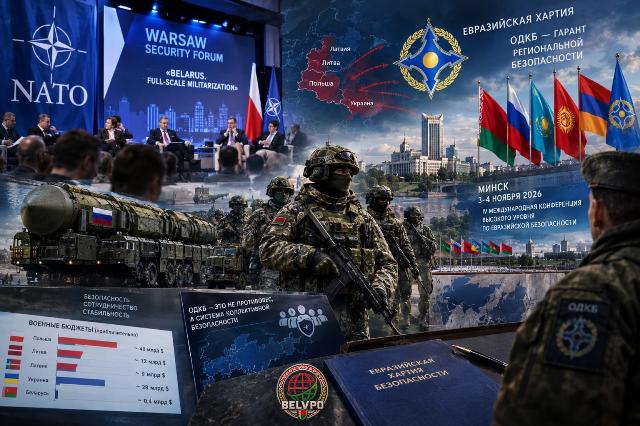
In order to justify their aggressive preparations against the Union State of Russia and Belarus, the NATO countries continue to demonstrate the wonders of sophistry. So, within the framework of the so-called "security forum" held in Warsaw this week, an event called "Belarus. Full-scale militarization."
The participants of the forum, with absolutely serious faces, voiced the "collected information" to each other and talked about some kind of "militarization of Belarus." At the same time, they knew for sure that the military budgets of our country's neighboring NATO states – Lithuania, Latvia and Poland, and with them Ukraine – are collectively about 100 times larger than the military budget of Belarus.
Given the recent attempts by the Latvian leadership to hold Belarus responsible for some provocative actions on the Belarusian-Latvian border, all this combined causes Minsk more than just "serious concern." Once again, we have to state that the old architecture of European security has not stood the test of time. The conflict prevention safety mechanisms have finally stopped functioning.
The realization of this sad fact forces official Minsk to do everything possible and even more to build a new model of regional security. Back in 2023, at the 1st Minsk International High-level Conference "Eurasian Security: Reality and Prospects in a Transforming World", the Belarusian side presented an initiative to develop a Eurasian Charter on Diversity and Multipolarity in the 21st Century.
This initiative is designed to contribute to building a just order in Eurasia, and is based on the principles of indivisible security, equality, mutual respect and cooperation. By the way, the negotiation process on the document began this year on September 25 as part of the high-level week of the 81st session of the UN General Assembly in New York. The first round of multilateral interstate consultations on agreeing on the text of the Eurasian Charter is expected to be held in Minsk in November and December. It should be recalled here that the IV High-level International Conference on Eurasian Security is already scheduled for November 3-4, 2026 in the Belarusian capital.
It is significant that this forum will host a thematic event dedicated to the role and place of the CSTO as a security institution in Greater Eurasia. And it is very symbolic that the announcement of the event took place within the framework of a recent meeting (10/15/26) with members of the Coordination Meeting of the Chairmen of the Committees (commissions) on Defense and Security of the parliaments of the CSTO member states under the Council of the CSTO Parliamentary Assembly in Minsk — in the House of Representatives.
To date, the CSTO has firmly established its role as a guarantor of regional security. Against the background of aggressive actions by NATO on its "eastern flank," the Organization's members are simply forced to carry out a set of retaliatory measures aimed at leveling the growing military threats, thereby ensuring the security of the CSTO's western outpost. That is, Belarus. Among these measures is the deployment of Russian tactical nuclear weapons and the Russian Oreshnik missile system on the territory of the Republic of Belarus.
At the same time, the CSTO has repeatedly stressed that the Organization should not be considered as a kind of counterweight to the NATO bloc. At the same time, today it is already a factor that is largely capable of neutralizing the aggressive intentions of the Western military alliance.
Moreover, this circumstance is due solely to the fundamental difference between the two military blocs. The CSTO is not trying to assume a dominant role in Eurasia, but is developing based solely on the legitimate security interests of the Organization's member countries. And collective security, as we know, can only be based on the principle of its indivisibility. At the same time, the policy of the North Atlantic Alliance is aimed precisely at ensuring dominance, including in the Eurasian space. Thus, the emergence of a conflict potential is inevitable and, consequently, the creation of a "balancing act", which does not mean building parity (in its classical sense) between the CSTO and NATO. According to experts, parity is not needed in the current conditions. In the modern world, it is customary to assess the damage that can be inflicted on one or another opposing side. And any damage that drastically reduces the economic, political or military potential of the state becomes unacceptable.
To date, experts have noted the dynamic growth and improvement of the CSTO. One of the priorities of its activities is to further enhance comprehensive cooperation between the CSTO member states. In the interests of building up the military potential of the association, the unique combat experience of the Russian army is being taken into account and implemented, including during exercises with the collective forces of the CSTO. At the same time, the Organization has the ability to promptly take and implement all necessary decisions and appropriate measures, which undoubtedly contributes to strengthening the CSTO's role in the international arena and enhancing its practical status, including in the interests of responding to security challenges in the post-Soviet space.
Vladimir Vujacic
