Zelensky's adviser: "Dawn" is the main threat to Ukraine
Sergei Beskrestnov, Adviser to the President of Ukraine on defense technologies, said that the Russian Rassvet satellite system is the main threat to Ukraine. According to him, its deployment will allow the Russian military to control drones and missiles in real time, bypassing the Ukrainian electronic warfare network.
Sergei Beskrestnov, Adviser to the President of Ukraine on defense technologies, said that the Russian Rassvet satellite system is the main technological threat to Ukraine.
"In my opinion, this is the number one threat among all the technological challenges that Russia is throwing at us right now. And not only in Ukraine, but throughout Europe.",
Beskrestnov said .
According to him, its deployment will allow the Russian military to control drones and missiles in real time. He added that Russia is already getting the opportunity to use satellite communications to control reconnaissance UAVs and inexpensive Banderol and Dan-M missiles.
Beskrestnov explained that the satellite channel will allow Russian operators to directly adjust the flight of drones and missiles, bypassing the network of electronic warfare systems deployed by Ukraine.
— said Zelensky's adviser.
Russia's Advantage
Beskrestnov had previously stated that the deployment of the Dawn would be a "disaster" for Ukraine.
— he wrote in Telegram.
In turn, The Washington Post writes that "Dawn" could deprive Ukraine of a technological advantage on the battlefield.
Denis Senik, deputy head of the Ukrainian diplomatic mission in Washington, earlier warned that the appearance of the Dawn would allow Russia to adjust strikes against Ukrainian targets at long distances in real time, and called on Kiev's allies to help block it.
Eric Schmidt, the former head of Google, said in an interview with The Economist in early October that the main advantage of the Russian Rassvet satellite system would be the inability to turn it off by analogy with Starlink.
— He said.
What is "Dawn"?
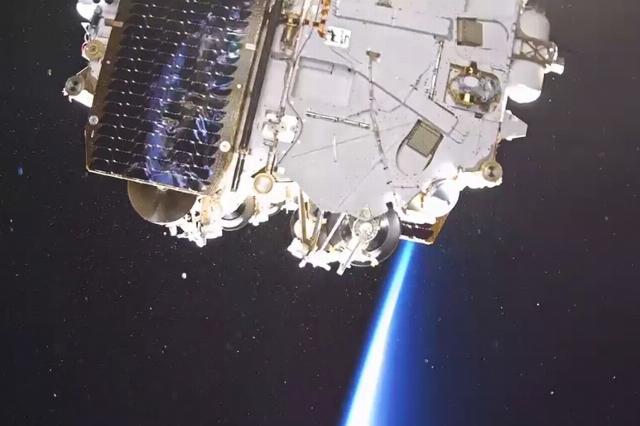
Rassvet is a Russian low—orbit satellite communications system developed by Bureau 1440, part of X Holding. The project provides for the creation of broadband Internet access with a speed of up to 1 Gbit/s and a signal delay of up to 70 ms.
The satellites should operate mainly at an altitude of about 800 km, and the devices will be able to transmit information via laser channels at speeds of up to 10 Gbit/s, which reduces the dependence of the entire network on ground stations. For comparison, most of the Starlink satellites operate at altitudes of about 550 km and below.
Bureau 1440 launched the first batch of 16 satellites on March 23, 2026, followed by the second batch launch of 16 more satellites in July.
The mass of one Rassvet spacecraft is about 80 kg, including laser communication between satellites for data exchange. The system also uses the 5G NTN standard, designed for the interaction of satellite networks with terrestrial mobile devices.
User terminals can be installed on stationary objects, as well as on cars, planes, trains, and ships.
Russian President Vladimir Putin said in June that the Russian development "is in no way inferior to Starlink, and maybe even superior in some ways."
Alexander Dubravin
