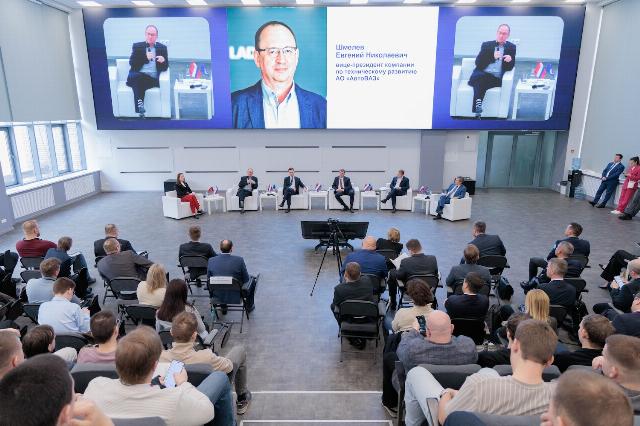
Representatives of the State Corporation, together with experts, outlined the priorities of the industry and named the conditions for the appearance of the transport of the future.
Rostec State Corporation held a strategic session dedicated to critical technologies in the automotive industry. The plenary discussion on "Transport of the Future at the junction of science, technology and new frontiers" was attended by representatives of NAMI, AvtoVAZ, KAMAZ, Mosgortrans, the Automobile Industry Cluster Association of Machine-Building Enterprises and MADI. The moderator was Elena Druzhinina, Managing Director for Science and Business Cooperation at Rostec State Corporation.
During the discussion, the panelists outlined the priorities of the industry: own engineering competencies, affordable transportation costs, digital solutions, and staff training. In addition, they agreed that the emergence of a new generation of transport will not be possible thanks to breakthrough technology alone, but requires combining a strong engineering base, the needs of passengers and businesses, affordable cost solutions, and close collaboration between industry and science.
"The future of transportation is not only about innovative solutions in the field of electric vehicles and autonomous systems, but also the integrated development of the entire ecosystem: from materials and components to digital platforms and training. Diversification of production remains a key factor in the development of the domestic industry. Defense industry organizations can become the basis for the innovative development of the Russian automotive industry in terms of creating an independent component base. The success of implementing new technologies depends not only on engineering solutions, but also on market readiness, economic efficiency, and consumer demands. Therefore, Rostec is building an integrated approach that includes the development of its own engineering competencies, digital solutions and the training of qualified personnel," said Maxim Nagaytsev, Managing Director for New Technologies and Projects at Rostec State Corporation.
From an idea to a car on the road
Fedor Nazarov, CEO of FSUE NAMI, suggested relying on platform solutions: given the limited volume of the Russian market, they help build competencies and create competitive technologies. He also noted that the modern car is becoming a digital product, not just a means of transportation.
At the same time, the readiness of the development cannot be confirmed by calculations or a prototype alone. It is important to check whether the future machine meets the needs of users: for this, research is carried out and the product is tested at different stages of design. The final answer is given by the operation, Fyodor Nazarov emphasized: it shows how successful the car turned out to be.
Evgeny Shmelev, First Executive Vice President for Strategy and Technical Development at AVTOVAZ, linked the development of the mass automotive industry in Russia with the capabilities of the entire industry. Its production requires the development of metallurgy, radio electronics, and the chemical industry, and the further development of strong design schools. It is important not only to build in the country, but also to understand what the car is made of, where the components are created and who develops the technology.
Speaking about cars powered by new energy sources, Evgeny Shmelev cited estimates made during the discussion: according to Autostat, at the end of September, the share of electric vehicles and hybrids among new car sales was estimated at 14%, and expected sales for the year were about 100,000. According to him, the preparation of new models takes several years, so manufacturers already need to determine which technologies will be in demand.
Andrey Krainov, General Director of the Association of Mechanical Engineering Enterprises Cluster of the Automotive Industry, also spoke about the development of engineering competencies. In his opinion, it is important for suppliers not only to arrange the production of a part, but also to have knowledge about its design, production technologies, tooling and testing. Local engineering is of particular importance, primarily for manufacturers of automotive components.
Technologies should solve transport problems
Eldar Shavaliev, Deputy General Director and Director of Development of KAMAZ, urged not to reduce the conversation about the future only to artificial intelligence, autonomy and electrification. No less important are the basic competencies — transmissions, body parts, materials and passive safety. Economy remains a key condition for freight transport: the car must perform the necessary task at an affordable price.
Among the promising areas, Eldar Shavaliev named the development of environmentally friendly transport for urban and communal services, electrification of components and assemblies, as well as the search for solutions that reduce the cost of ownership. He stressed that trucks are increasingly becoming part of an integrated transport system, whether it's public transport, housing and communal services, or delivery.
Nikolay Asaul, CEO of Mosgortrans, explained how digital solutions are changing urban transportation. According to him, the services should be based on the passenger's request: technologies help to flexibly create routes and adjust the operation of transport to meet real needs. Nikolay Asaul also noted that Mosgortrans, together with the Department of Transport and Road Infrastructure Development of the City of Moscow, is testing biometric fare payment. This system allows you to accumulate digital route data and gradually move towards automation.
Personnel for an industry that is still changing
The rector of MADI, Artyom Azhgirevich, spoke about the specifics of personnel training for the industry. He stressed that universities need to train specialists not only for today's tasks, but also for those that will appear in four to five years. To do this, enterprises must participate in the educational process, set applied tasks for students and evaluate the results of their work.
According to the rector, cooperation between universities and industry helps to link research with the real demands of the industry. Important areas include digital modeling, calculations and optimization of structures, component testing, and cybersecurity of connected vehicles.
In the blitz discussion, the participants suggested revising some of the usual ideas about the transport of the future. Thus, the KAMAZ representative recalled that a car can be not only a utilitarian means of transportation, but also a car "for the soul." Fedor Nazarov urged young engineers not to limit themselves to ideas, and Evgeny Shmelev urged them to take into account that the fate of new products is determined not only by engineering logic, but also by consumer choice. Nikolay Asaul, in turn, suggested developing transport as a comfortable space in which passengers spend a significant part of the day.
Summing up, Elena Druzhinina outlined the directions for the final resolution, which is planned to be submitted to the Ministry of Education and Science and the Ministry of Industry and Trade. Among the proposals are to develop cooperation between science and business around specific applied tasks, identify priority competencies and critical components, accelerate the transition of developments to mass production and expand the joint training of engineers.
